
The NHS is updating its pressure ulcer pathways - here's what's changed
The new international guideline on pressure injuries has some uncomfortable truths about heel protection. For years, clinicians have used whatever was to hand - pillows, fluid-filled gloves, sheepskin, egg-crate foam. The thinking was simple: something soft under the heel is better than nothing. It seemed reasonable. It felt proactive. The evidence says otherwise.
The 2025 International Pressure Injury Guideline - the fourth edition produced jointly by NPIAP, EPUAP, and PPPIA - includes a dedicated chapter on heels for the first time. It replaces the 2019 third edition and is explicit about what doesn't work: methods that many clinical settings still rely on daily.

New guidelines recognise the importance of mechanical factors
Importantly for those of us working in UK healthcare, the National Wound Care Strategy Programme and local NHS policies are already updating their pressure ulcer pathways against these recommendations. This isn't distant international guidance—it's becoming the reference standard for NHS and independent sector services.
Today I'm breaking down what the guideline actually says, which common approaches it recommends against, and what this means for practice in the UK.
Let's look at what's changed.
This is now a "living guideline" — and it's free to access.
One significant change in how this edition is delivered: it's no longer a static PDF document that gathers dust between editions.
The 2025 guideline launched on 27 February 2025 as a free, online interactive resource. The prevention recommendations are already live, with assessment and treatment chapters being added progressively throughout 2025. This "living guideline" model means recommendations can be updated as new evidence emerges, rather than waiting years for the next edition.
For clinicians, this matters. You can link directly to specific topic sections - support surfaces, repositioning, prophylactic dressings - and incorporate them into local protocols and teaching sessions. For patients and case managers, it provides an authoritative, accessible reference point when advocating for appropriate equipment.
The primary access point is the International Guideline website, which hosts the online chapters, evidence summaries, and implementation guidance.
The guideline treats heels differently for the first time.
Previous editions addressed heels as part of general pressure injury prevention. The 2025 update recognises what those of us working in this field have known for decades: heels are biomechanically unique and require specific interventions.
The heel presents a particular challenge. There's minimal soft tissue covering the calcaneus, blood supply to the area is relatively poor, and the geometry means that even modest pressure concentrates over a small contact area. The guideline now acknowledges this explicitly and provides heel-specific recommendations with their own evidence grading using the formal GRADE-based methodology.
This matters because it gives clinicians - and patients advocating for themselves - clear, evidence-graded guidance to reference when requesting appropriate equipment.
The guideline explicitly says: don't use fluid-filled gloves.
This one surprised many clinicians I've spoken with. Fluid-filled gloves - typically examination gloves filled with water and placed under the heel - remain common practice in some settings. They're cheap, readily available, and seem intuitively helpful.
The guideline is unambiguous: do not use them.
The evidence shows they don't maintain their position, they don't adequately redistribute pressure, and they can actually increase moisture at the skin surface. The practice persists largely because it feels like doing something, but the data suggests it may be doing more harm than good.
If you're in a clinical setting where this remains standard practice, the 2025 guideline provides the evidence base to advocate for change.
Egg-crate foam and sheepskin alone are not recommended.
Two other common approaches receive explicit guidance against their use as sole interventions:
Egg-crate foam overlays - These ubiquitous mattress toppers don't provide adequate pressure redistribution for heel protection. The guideline notes they may help with comfort but should not be relied upon for prevention.
Sheepskin - Natural sheepskin has been used for decades, but the evidence shows it's insufficient as a standalone intervention. It may help manage moisture and friction, but it doesn't address the fundamental problem of pressure.
The critical phrase here is "as sole interventions." The guideline isn't saying these materials have no place—it's saying they're not adequate on their own for patients at genuine risk of heel pressure injuries.
Repositioning is now individualised - not a rigid two-hourly rule.
One of the broader prevention themes worth noting: the guideline has moved away from prescriptive repositioning schedules.
The old "turn every two hours" rule - familiar to anyone who has worked in or been a patient in UK hospitals - is no longer recommended as a blanket approach. Instead, the guideline emphasises individualised repositioning based on the patient's specific risk factors, skin tolerance, and clinical context.
This matters for heel protection because it acknowledges reality: repositioning alone cannot reliably prevent heel pressure injuries in high-risk patients. It's one component of a prevention bundle that must also include appropriate support surfaces, heel off-loading devices, skin care optimisation, and attention to nutrition and mobility.
In other words, the guideline recognises that we need multiple layers of protection working together, not reliance on any single intervention.
The evidence strongly favours complete offloading over pressure reduction.
This is perhaps the most important principle the guideline reinforces. There's a fundamental difference between reducing pressure and eliminating it.
A multi-centre randomised controlled trial cited in the guideline compared heel offloading boots with standard care (primarily pillows and repositioning). The results were stark:
‘Boot group’: 0.4% developed heel pressure injuries
‘Standard care’ group: 8.4% developed heel pressure injuries
That's a twenty-fold difference. One pressure injury in the boot group versus eleven in the pillow group, and the single injury in the boot group was Stage 1, whilst the pillow group saw injuries progress to Stage 4.
The mechanical principle is straightforward: when the heel has zero contact with any surface, there can be no pressure injury. Pressure reduction strategies - pillows, foam, positioning - all still allow some contact and therefore some risk. Complete offloading eliminates that contact entirely.
UK practice is aligning to these recommendations now.
For those working in the NHS or independent sector, this isn't abstract international guidance.
The National Wound Care Strategy Programme is explicitly updating its pressure ulcer pathways in line with the NPIAP/EPUAP/PPPIA recommendations. Local NHS trusts are revising their protocols. The 2025 guideline is becoming the reference standard for risk assessment, prevention bundles, support surface selection, and treatment options.
This creates both an opportunity and an obligation. Clinicians can now point to authoritative, GRADE-rated evidence when advocating for proper equipment. But it also means that using approaches the guideline explicitly recommends against - fluid-filled gloves, foam as sole intervention, pillows alone - becomes increasingly difficult to defend.
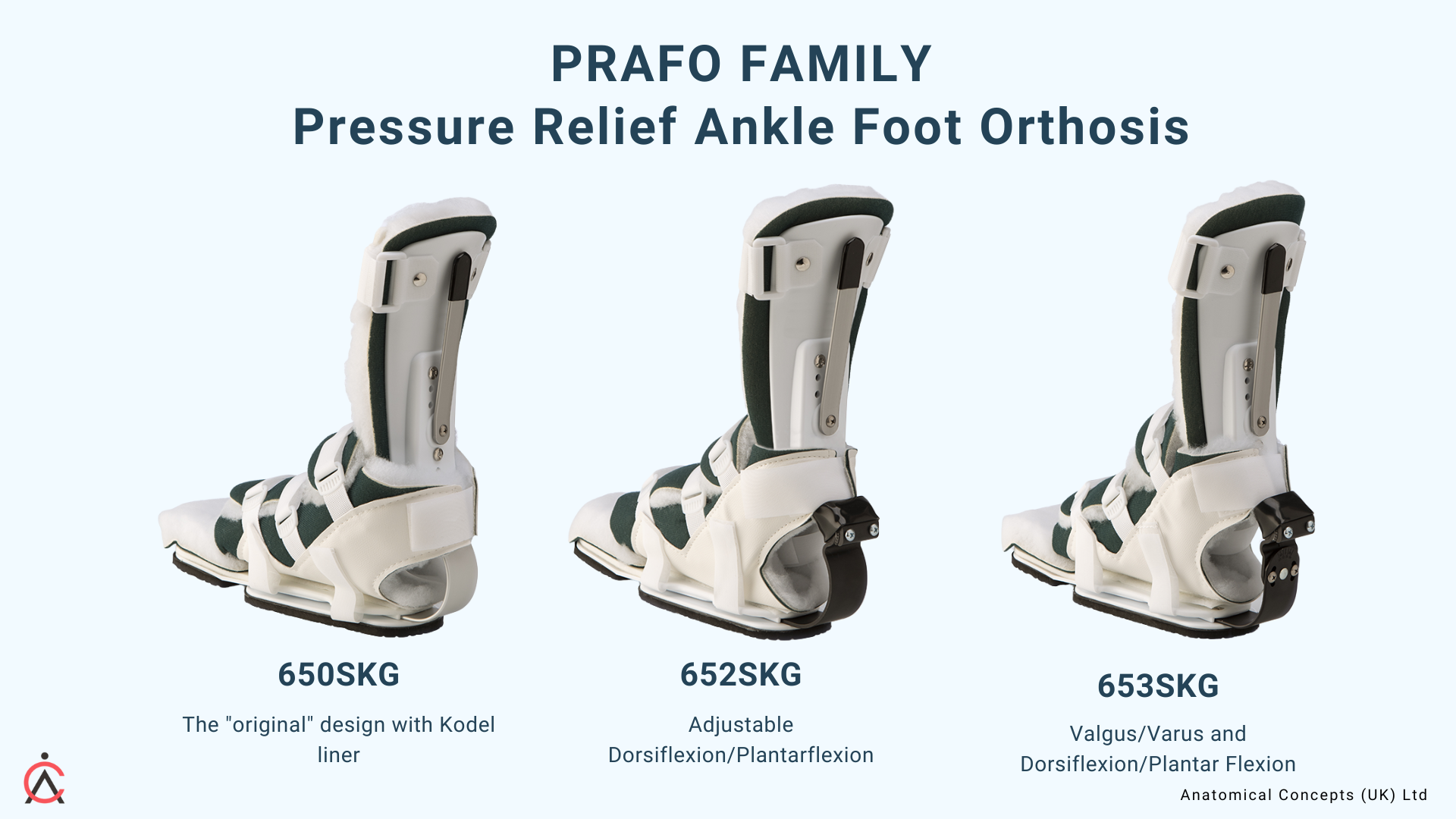
Each Prafo design features a metal, adjustable, upright structure that prevents the structure from flexing and contributing to tissue damage.
The recommendations align precisely with what we've advocated for since bringing the PRAFO to the UK in 1995. The metal upright structure resists the flexion that can cause plastic devices to deform. The design suspends the heel entirely, transferring load to the calf and foot where tissue can tolerate it safely. The evidence has finally caught up with the mechanical principles.
What this means for you.
If you're a patient at risk of heel pressure injuries, or caring for someone who is, the 2025 guideline gives you clear grounds to request appropriate equipment:
- Ask specifically for heel offloading devices rather than generic pressure reduction
- Challenge the use of pillows, gloves, or foam as sole interventions
- Reference the 2025 NPIAP/EPUAP/PPPIA guideline, it's free to access online
- Note that NHS pathways are updating to align with these recommendations
The evidence is now unambiguous. Complete heel offloading works. Pressure reduction measures don't provide adequate protection for patients at genuine risk.
After thirty years of advocating for proper heel protection, it's gratifying to see the international guidelines - and now UK practice - finally reflect what the evidence has shown all along.
Reference
Access the guideline at this link.
https://www.internationalguideline.com/the-international-guideline