

A Sequence can be triggered to auto repeat, manually, by user movement or by movement with a threshold as shown here.
Open the programme sheet for an auto-repeat "Grasp and Release" protocol on the Stim2Go from Pajunk and look at the chart in the phase editor at the bottom of the training page. There are three horizontal strips, one for each channel. Time runs along the bottom. In each strip a shape rises, holds and falls, and the three shapes start at different moments. Then, for nearly half the width of the page, nothing happens at all.
That is like a musical score. Three instruments, staggered entries, a long rest before the bar repeats. I have found this to be a useful way to explain stimulation sequence building to physiotherapists who are new to electrical stimulation, and this article is about using it to write your own.
There is a good reason to learn to compose rather than to hunt for the "correct" setting because nobody has found one. Every patient is likely to need a slightly different composition. A small crossover trial at Leeds changed the rising ramp, delay and extension on a single-channel foot-drop stimulator in 12 users and found no significant effect on their walking, only trends worth studying further (Marchant and colleagues, 2019). The trial's registration noted that these timings are usually set by clinicians through qualitative assessment and trial and error. The 2023 National Clinical Guideline for Stroke, recommending FES to the wrist and finger extensors, says that "stimulation protocols should be individualised to the person's presentation and tolerance" (recommendation 4.18C). In other words, writing the sequence is your job. The good news is the tools like Stim2Go provide good starting points and you can easily customise a programme to suit each situation.
In Start with the goal, not the settings I argued that the settings come last, once you know the goal and the job the stimulation is going to be doing. This article starts there.
Reading the score
Movements of a piece → Stim2Go stages. Up to three: warm-up, active training, cool-down (1 to 60 minutes each). You decide: whether a warm-up or cool-down is needed.
A bar, repeated → the stimulation sequence. You decide: how long one repetition of the movement takes, rest included.
Instruments → channels. Up to five, colour-coded on the cable, keypad and App. You decide: which muscle plays which part.
Notes → phases. Up to three per channel per sequence. You decide: when each muscle comes in and goes out.
Crescendo and diminuendo → ramp-up and ramp-down. You decide: how each contraction builds as it arrives and falls as it leaves.
Rests → any part of the sequence where a channel has no phase. You decide: how long each muscle has to recover from a contraction.
A drone → a channel set to Always On. You decide: whether one channel runs continuously under the rest.
Tempo → the sequence duration. You decide: the speed of the whole thing.
Two details matter more than they look. First, phase timings are set as percentages of the sequence, not in seconds. Lengthen the sequence and every ramp, note and rest stretches with it, which is exactly what happens to music when you slow the tempo. If you take a value in seconds from a paper or a colleague, convert it: a 2 second ramp in a 20 second sequence is 10%.
Second, loudness is relative. Each phase's intensity is a percentage of the intensity you set for that channel during the session, and the channel's maximum current is only the limit the control can reach. It is not a target. My own practice is to raise the intensity until I see a contraction and then go only a little above that although this does depend on the programmes intention, and sometimes on patient tolerance.
KEY POINT: A Stim2Go programme is like a musical score with a small vocabulary: stages, a repeating sequence, channels, phases, ramps and rests. Once you can read one programme sheet that way you can read them all, and you can start writing your own. The starting point is your knowledge of functional anatomy and the potential limitations of the individual patient.
Write the movement before you write the stimulation
A composer starts with the melody, not the orchestration. The equivalent here is the movement pattern you want to see.
Watch the task, or film it, and write down three things: which muscles are acting, in what order, and how long one repetition takes from start to start, including the pause before the next attempt. That last number gives you the sequence length. The order gives you the entries.
Copying normal timing is a sensible starting point rather than a proven one. In FES cycling after spinal cord injury, changing when each muscle fires changes how much work the legs produce and what it costs (Hunt and colleagues, 2006, in one rider; Hakansson and Hull, 2012, 11% more work in 11 riders with a computer-designed pattern). Nobody has compared physiologically optimised timings with arbitrary timings on a clinical outcome. The UK has done this before: the FES-UPP system from Salford, Sheffield Hallam and the National Clinical FES Centre at Salisbury treated a task as "a sequence of movement phases", and therapists with little FES experience set it up without engineering support (Sun and colleagues, 2018).
Bringing each muscle in
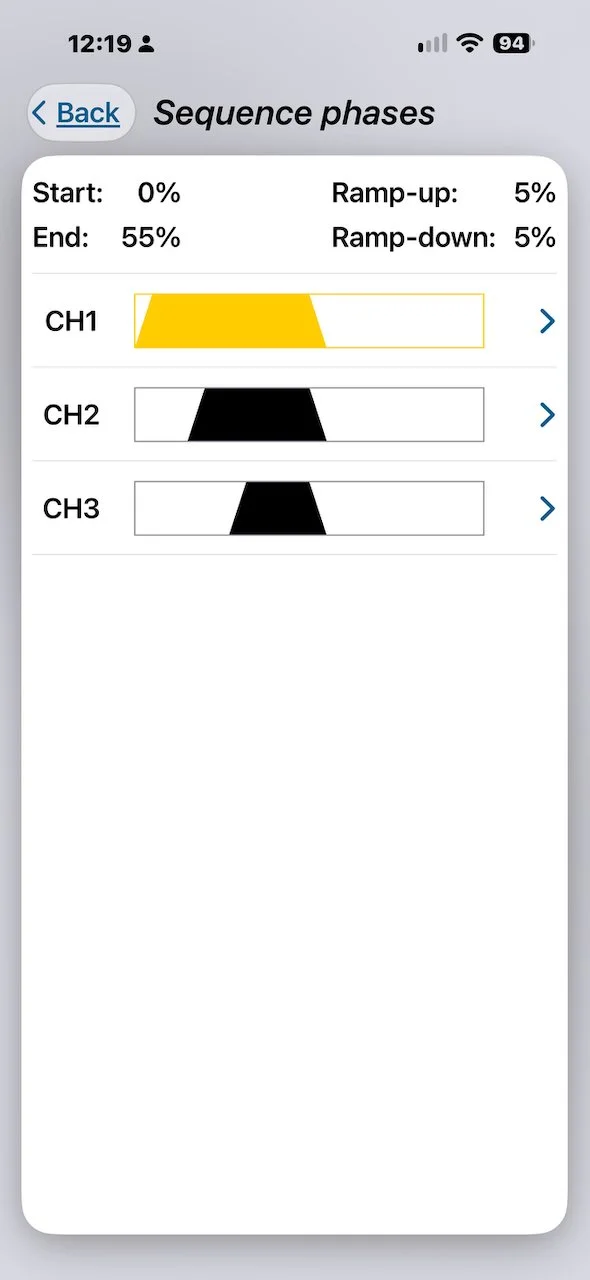
A simple grasp and release sequence
Grasp and Release shows how parts enter. In its 22 second sequence, reading from the manufacturer's chart:
Channel 1, the finger and wrist extensors, ramps up over the first 5% (about a second), then holds.
Channel 2, the finger flexors, comes in at about 15% (about 3 seconds in).
Channel 3, the thumb flexor, comes in at about 27% (about 6 seconds in).
All three ramp down together and are silent by about 55%, around 12 seconds into the sequence.
The entries are staggered the way instruments join one at a time, and the individual parts stop together. Each channel can carry up to three notes in a sequence, and on one channel they cannot overlap; an instrument plays one note at a time.
The same score appears in three versions of the grasp and release programme: one repeating on a timer, one fired by a manual key press in the App, and one fired by the client's own movement once it passes a threshold angle. The music does not change. Only the cue that starts the bar does.
Crescendo and diminuendo
The ramps decide how each contraction arrives and leaves. A contraction that builds smoothly is likely to be more comfortable and safer than one that arrives abruptly. This way the movement it produces is smoother, and in a limb with high tone a gentler arrival is less likely to provoke a spasm.
That last point is clinical practice rather than tested fact. A widely cited review gives 1 to 3 seconds as typical, with longer ramps sometimes used for spastic muscle (Doucet and colleagues, 2012). I could not find a study in people that tested ramp length against spasm or clonus. So you have to be able to watch and adjust the sequence for yourself. It is easy to lengthen the ramp-up where tone fights the movement, and give the ramp-down enough time for the limb to come back under control rather than drop.
The rests are written in
Look again at the auto-repeat Grasp and Release protocol. Nothing plays for roughly 10 of every 22 seconds. Now look at Muscle Training 2CH, which pairs an agonist and an antagonist in a 28 second sequence. The agonist works for about the first 12 seconds, the antagonist for about 12 seconds later in the bar, and each muscle rests while the other plays. It is call and response.
Those rests are there because stimulated muscle tires quickly. Stimulation recruits motor units all at once and always the same ones, which is part of why it fatigues faster than voluntary effort (Bickel and colleagues, 2011; we covered this in A Closer Look at Muscle Fatigue in FES Cycling and Spinal Cord Rehabilitation). The textbook starting point is an off time three times the on time, but no trial sits behind it. The one head-to-head study I know of in people after stroke stimulated the wrist extensors of 18 people for 5 seconds with 5, 15 or 25 seconds off. Each longer rest time was less fatiguing, and the author suggested starting at 1:5 (Packman-Braun, 1988). It is one small, old study, and Maffiuletti and colleagues (2018) make the fair point that the force the muscle produces matters more than the specific settings. I know personally from strength training in the gym that when the aim is ultimate strength, it’s better to take a longer break between exercise sets.
Rests have a second job in functional work because it is where the client gets ready to try again. Only auto repeat lets you write the rest between repetitions. In the manually triggered and movement-triggered modes, the sequence starts again when you press the key or the client next reaches the threshold.
As I wrote about previously, the various methods of triggering a sequence can be used to introduce progression. I might initially use an auto-repeat sequence for muscle strengthening then move on to manually trigger a functional sequence before selecting movement triggering or movement with threshold triggering.
KEY POINT: A rest is a decision, not what is left over. Make it too short and the muscle tires and the client has no space to prepare; make it too long and you lose effective repetitions. In auto repeat you write it into the sequence; in triggered modes the client's next attempt sets it.
Layering, drones and who starts the bar
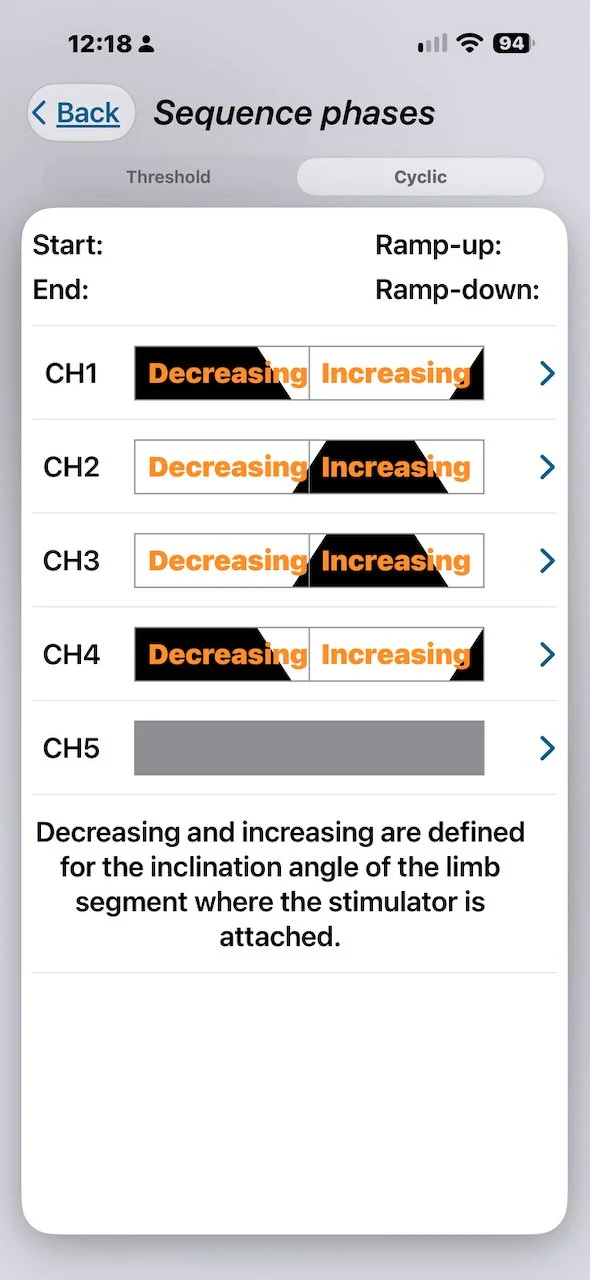
In this sequence pattern Channel 5 is always on
Not every part has to follow the bar. A channel set to Always On ignores the sequence and plays continuously, like a drone under a melody. Muscle Training 2CH uses this in its warm-up and cool-down: both channels run continuously at a low frequency for five minutes, before and after the working sequence. The always-on feature is typically used with the various pain relief and tSCS programmes.
The cue that starts the bar is the subject of The Threshold Is the Therapy, so I will only add one case here. In the cycling programmes the sequence has no fixed length at all. The sensor tracks the movement of the limb through each turn of the bike pedals, and the phases are placed on percentages of the cycle. The rider sets the tempo, and the score automatically stretches to fit.
Composing your own
Here is the order I might want to work in:
Name the goal and the job. What should the client be able to do, and is the stimulation there, for example, to build strength, assist a movement, respond to a movement cue, prime a movement or settle?
Write the movement out. Muscles, order, timing, and where it breaks down.
Give each muscle a channel and place its entry, hold and exit as percentages of the sequence.
Write the rests in and set the sequence length.
Choose the cue, then rehearse at low intensity with the client and revise what you see.
Start from the nearest standard template (there are lots of them) and edit it rather than look to start from a blank screen. For a strengthening bar of 5 seconds on and 15 seconds off, for example, set a 20 second sequence with one phase running from 0 to 25%, its 4 or 5% ramps inside it.
Building or editing a programme needs a therapist or physician account in the Stim2Go App, and the instructions for use warn that customised programmes need extra attention because they can cause skin irritation or muscle soreness. Some clients and carers hold their own accounts and adjust their programmes at home; if that is you, talk any new sequence through with your therapist before you use it. You can reach out to us at Anatomical Concepts and we can create a programme and "assign it" to you so it appears in your own App account. It would then need to be fine tuned to ensure it is effective.
Once a sequence is working, it becomes the thing you later thin out, as Fading the Help describes.
Where the analogy stops
You're probably tired of my music metaphor by now. Muscles tire and instruments do not. The score cannot hear the player, except through the angle the sensor reads. Louder is not better. And this is a way of thinking about programming, not music therapy: rhythmic auditory stimulation, walking to a beat, is a separate intervention with its own evidence, and nothing in this article involves sound.
What the evidence does not show
No trial has compared ways of composing a sequence, on the Stim2Go or any other device. The one trial of timing settings I found was small and null. Advice on rests comes from one 1988 study and convention, advice on ramps from expert opinion, and warm-up stages are untested. The standard programmes are the manufacturer's starting points. I read that not as a reason to leave sequences alone but as a reason to compose deliberately, change one thing at a time and measure what the client can do.
We know from practical experience that being able to create and modify sequences for an individual represents a very powerful therapy tool.
What I would suggest
Three things are worth trying with your next client:
Print one programme sheet and read it as a score: who plays, when they come in, how they arrive, and where the rests fall.
Before you open the App, write the movement out on paper: muscles, order, and how long one repetition takes.
Put the rests in on purpose, and write down why you chose them.
The same stroke guideline recommendation that asks for individualised protocols also says the person with stroke, their family or carers and their clinicians "should be trained in the safe application and use of electrical stimulation devices" (4.18C). At Anatomical Concepts we supply the Stim2Go in the UK and run hands-on training in building programmes for functional work, for therapists and, where they will be using the device at home, for clients and carers, starting from the client's goal rather than the menu. We are as happy to talk through whether stimulation suits a particular client as to talk about the device.
The choice of programme, and whether stimulation is right for a given person at all, stays with the treating clinician and the client.
If you would like to work through a sequence for a client, or talk about a training session for your team, get in touch. I am always glad to have the conversation.
Further reading
Marchant S, Michael S, Milner L, Tang KT. Effects of timing parameter changes on the gait of functional electrical stimulation users with drop foot. Journal of Rehabilitation and Assistive Technologies Engineering 2019;6:2055668319859142. https://doi.org/10.1177/2055668319859142
Intercollegiate Stroke Working Party. National Clinical Guideline for Stroke for the UK and Ireland. London: ISWP; 2023. https://www.strokeguideline.org
Doucet BM, Lam A, Griffin L. Neuromuscular electrical stimulation for skeletal muscle function. Yale Journal of Biology and Medicine 2012;85(2):201 to 215. https://pmc.ncbi.nlm.nih.gov/articles/PMC3375668/
Packman-Braun R. Relationship between functional electrical stimulation duty cycle and fatigue in wrist extensor muscles of patients with hemiparesis. Physical Therapy 1988;68(1):51 to 56. https://doi.org/10.1093/ptj/68.1.51
Bickel CS, Gregory CM, Dean JC. Motor unit recruitment during neuromuscular electrical stimulation: a critical appraisal. European Journal of Applied Physiology 2011;111(10):2399 to 2407. https://doi.org/10.1007/s00421-011-2128-4
Maffiuletti NA, Gondin J, Place N, Stevens-Lapsley J, Vivodtzev I, Minetto MA. Clinical use of neuromuscular electrical stimulation for neuromuscular rehabilitation: what are we overlooking? Archives of Physical Medicine and Rehabilitation 2018;99(4):806 to 812. https://doi.org/10.1016/j.apmr.2017.10.028
Hunt KJ, Ferrario C, Grant S, Stone B, McLean AN, Fraser MH, et al. Comparison of stimulation patterns for FES-cycling using measures of oxygen cost and stimulation cost. Medical Engineering and Physics 2006;28(7):710 to 718. https://doi.org/10.1016/j.medengphy.2005.10.006
Hakansson NA, Hull ML. Can the efficacy of electrically stimulated pedaling using a commercially available ergometer be improved by minimizing the muscle stress-time integral? Muscle and Nerve 2012;45(3):393 to 402. https://doi.org/10.1002/mus.22302
Sun M, Smith C, Howard D, Kenney L, Luckie H, Waring K, et al. FES-UPP: a flexible functional electrical stimulation system to support upper limb functional activity practice. Frontiers in Neuroscience 2018;12:449. https://doi.org/10.3389/fnins.2018.00449
Pajunk. Stim2Go User Manual (Neurology), 2025; and Descriptions of all Stim2Go Programmes, 2025.
Related articles on our site
The Threshold Is the Therapy: Making Stimulation Something Your Client Earns
Fading the Help: How to Hand the Movement Back to Your Client
One Device, Many Exercises: Getting More From a Single Stimulator
Articles on this site are researched and drafted with the help of AI tools, then checked, edited and approved by me. Every citation is verified against the original source before publication.