
At the end of The Threshold Is the Therapy I said that raising the stimulation triggering threshold is one step in a longer sequence of handing more of the conscious limb movement back to the client. This article is about the whole sequence of how to do this with Stim2Go from Pajunk.
When stimulation is used to help someone practise a movement, it is like scaffolding. Scaffolding goes up to support the structure so the building can be built, and the plan always includes taking it down when the job is complete. The trouble with electrical stimulation is that sometimes a session with the scaffolding fully up looks very good. The hand opens, the arm reaches, the client stands, so it is easy to leave everything as it is, because nothing seems to need changing. Of course in many cases there is always going to be a need for ongoing support and we might need a physical orthosis or have to use stimulation in that way.
Goal setting in rehabilitation is always difficult and client expectations have to be balanced by what can be achieved in practice. In this article we are focusing on a situation in which functional recovery might be expected. This is relevant to stroke, incomplete spinal cord injury, and MS in our case load. The plan for "taking the help away" should be made at the first session, carried out and revised one step at a time, and judged by what the client can do with the stimulator switched off.
The progression ladder on Stim2Go
The Stim2Go from Pajunk gives you several ways of starting a stimulation sequence, and each one asks the client to do a little more of the movement than the one before. Put in order, they make a progression ladder:

Timed stimulation (auto repeat). The sequence runs on a clock when you press a key in the App. You choose which muscles to stimulate and their pattern of activation. Perhaps the client learns what the contraction feels like and the muscle is conditioned, but the client does nothing to decide when it happens. This is where the C5/C6 client in the last article started, with several weeks of shoulder conditioning. It could be relevant too when spasms are troublesome and blocking useful movement. We could use a tSCS protocol to reduce that tone and provide a window of opportunity for useful therapy.
Manual trigger. You watch for the attempt, or feel it under your hand, and press the key in the app. The stimulation now arrives with the client's effort, even though they cannot yet fire it themselves. This applies in situations such as sit-to-stand attempts when the therapist decides when to trigger the stimulation by watching the client's effort.
Movement trigger with a threshold. The client fires stimulation by their movement. The inertial sensor in the unit measures the changing angle of the limb segment it is strapped to, and once a certain, critical angle is reached the stimulation sequence is fired. In our earlier article we described how an arm reaching forward could be used to trigger shoulder stabilisation. With clients recovering from a stroke we might use the movement of an unaffected arm to trigger muscle activation in the affected limb. We have also placed Stim2Go on the trunk and used the client's forward lean, as they start to stand, to trigger the quadriceps and gluteal muscles in a sit-to-stand movement.
A higher threshold. As the threshold is adjustable it can be used to encourage progress. The client has to produce more of the selected movement before help arrives. The last article covered this step in detail.
Less stimulation. Reducing stimulation is tricky but with some clients we see that the muscles respond more efficiently after a period of training. We lower the intensity ceiling so the contraction requires more of the user's effort rather than completes the movement for them. It's tricky because we need the client to succeed with their effort balanced with just enough assistance.
Off. The client practises without stimulation. You may still use it for a warm-up, or on a bad day, but the work is theirs. Ideal, but not always achievable.
Two practical rules sit underneath the progression ladder. Only change one thing at a time, so that when performance drops you know why. And expect to go back down as well as up; a client who has been ill, is tired, or is having a day of increased tone may need yesterday's level of effort, and that is not a failure. Anyone who has experience with physical conditioning understands that.
KEY POINT: Each rung of the progression ladder asks the client to contribute more of the movement: from stimulation on a clock, through your manual trigger and then theirs, to a higher threshold, less stimulation and none. Move one variable at a time, and step back down without fuss when the day calls for it.
Why the stimulation assistance should come down sometimes
The reason for fading assistance comes from motor learning rather than from the stimulation literature, and I should say that I am not a motor learning scientist. I am a bioengineer who has spent a long time watching how people use devices and working with clients face to face.
In the 1980s and early 1990s, researchers studying feedback in healthy volunteers noticed something counterintuitive. Giving people more help during practice, such as more frequent feedback about how they did, tended to improve their performance while they practised and to reduce what they retained afterwards. Richard Schmidt called this the guidance hypothesis: help that guides you to the right answer can stop you working the answer out for yourself.
Winstein, Pohl and Lewthwaite (1994) tested the physical version of this, the closest thing in that literature to a stimulator moving a limb. Volunteers learned a movement with either physical guidance or feedback on their result, given either on every attempt or on a faded schedule. Physical guidance given on every attempt produced the poorest retention of all. Kantak and Winstein (2012) later set out why this matters. It turns out what someone does at the end of a practice session is their real-time performance, but learning (what they have retained) is better judged after a delay and without the help.
I would not stretch this further than it goes. These were mostly healthy people learning laboratory tasks. In stroke, for example, the evidence is thinner. Cirstea and Levin (2007) showed that people with chronic stroke could learn reaching under a faded feedback schedule, and a systematic review by Subramanian and colleagues (2010) found that feedback helps upper limb learning after stroke but that the best schedule in patients is still unknown.
Rehabilitation robotics has run into the same question, with mixed answers. Hornby and colleagues (2008) found that therapist-assisted treadmill training, with the therapist giving help only as needed, improved walking speed more than a robot that guided every step, though many things differed between the two groups besides the amount of help. A later trial of a robot set to assist only as needed (Alingh and colleagues, 2021) found it no better overall than conventional training. The principle has support; the size of the benefit in practice is not settled.
Test with the stimulator off
If learning is judged without the help, then the most useful thing you can do is measure performance first without the help.
The foot-drop literature has done this for years, and it gives us useful language. The orthotic effect is the difference the device makes while it is switched on. The therapeutic effect is the change in how the person walks with it switched off, over weeks of use. A device can have a large orthotic effect and no therapeutic effect at all.
The results are a useful reality check. In a multicentre trial of 93 people within a year of stroke, Everaert and colleagues (2013) found that both a foot-drop stimulator and an ankle-foot orthosis produced therapeutic effects on walking speed, measured with the device off. The stimulator's therapeutic effect was a little larger but not significantly so. A systematic review by Kafri and Laufer (2015) found therapeutic effects consistently when FES was used as a training tool, but could not show that FES beat matched training without it. And Sheffler and colleagues (2013), in 110 people with chronic stroke, found no evidence of motor relearning on lower limb impairment with peroneal stimulation, although walking and quality of life improved in both their groups.
Put plainly, stimulation can leave something behind when it is switched off, but it does not always, and it is not guaranteed to leave more than other good training. That is exactly why you want to measure it in your own client rather than assume it.
In practice, this means choosing the outcome measure that matches the specific client's goal, which was the starting point in our recent article Start with the goal, not the settings, and repeating it with the stimulation off at a fixed interval. The device-off score tells you whether the help is being turned into the client's own movement. The device-on score tells you mainly how well the device works. Of course this is only relevant in certain cases - not for complete spinal cord injury for example.
KEY POINT: Judge progress with the stimulator switched off. The foot-drop trials separate what the device does while it is on from what the person keeps when it is off, and only the second tells you whether the help can come down.
When to step down, and when to step back
There is no trial to tell you when to move a client to the next progress rung, so what follows is my working rule rather than a published one. Step down when the client succeeds on most attempts across two sessions at the current rung and the device-off measure is holding or improving. Step back up after illness, a flare of spasticity, a bad night or a run of failed attempts.
As the help comes off, watch how the client is achieving the movement as well as whether they achieve it. Taking stimulation away and finding that the client now reaches the threshold by using compensatory movements is not progress. The sensor rewards anything that tilts it, so your eyes are part of the measurement.
In our last article we described a C5/C6 ASIA C client (incomplete spinal cord injury) that was able to progress by using Stim2Go's range of triggering methods. We started with a period of strength building to specific shoulder stabilisation muscles, adding further muscles over time using a 20-minute auto-repeat sequence. He gradually could extend his arm sufficiently to use movement triggering with a threshold. We included triceps stimulation triggered as the upper arm moved past a preset angle. As this triggered stimulation is based on user effort we could encourage multiple repetitions and gradually increase the volume of work done. Over time we would expect in this case to reduce and perhaps remove the trigger threshold altogether along with the stimulation intensity.
When the help should not come down
Fading is for stimulation that is being used to train a movement. It is not the plan for every client, and it is worth deciding at the start which job the stimulation is doing.
Some stimulation is doing the job of an orthosis or a health intervention, and keeping it is the plan. FES cycling after complete spinal cord injury is the clearest example. It is there for the training of muscle, bone and fitness, and those benefits depend on the sessions continuing.
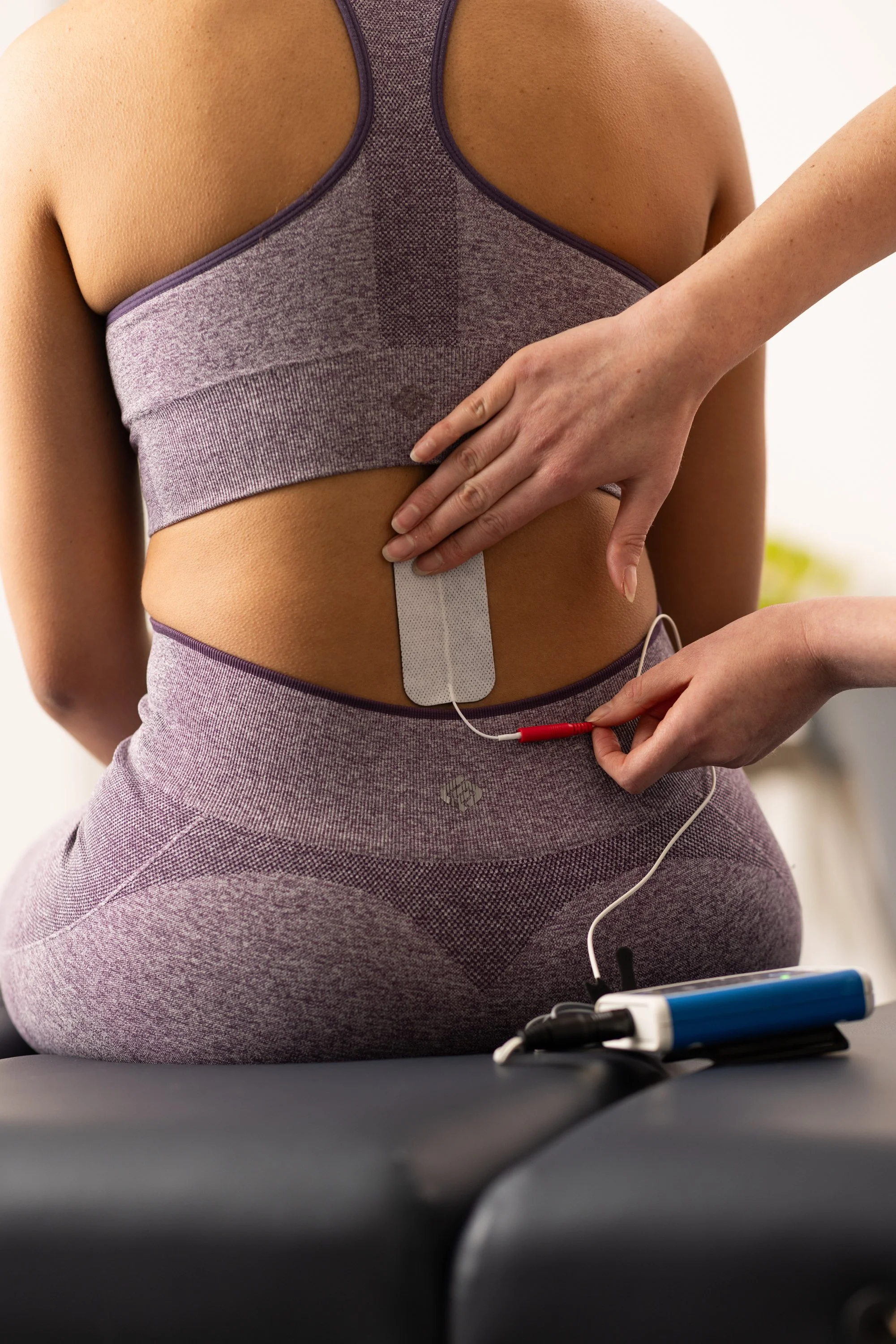
We use the tSCS protocols for relief of spasms and to facilitate more effective training
We also often use Stim2Go for transcutaneous spinal cord stimulation (tSCS) to dampen troublesome spasms. In our experience some clients have fewer spasms for a few hours afterwards, which gives a window for more targeted training. The trial evidence is less settled: the first sham-controlled trial, in 16 people with progressive MS, did not find a significant effect on spasticity after a single session (Spieker and colleagues, 2025).
Foot-drop stimulation in multiple sclerosis is another. In a UK series of 187 people with MS, Street, Taylor and Swain (2015) found that walking speed improved with the stimulator on but found no significant training effect, and a meta-analysis by Miller and colleagues (2017) found the same pattern across 19 studies. For those clients, a stimulator that is still in use a year later is not a failure to progress. It is the device doing what it was chosen for.
The mistake is to mix the two up: to leave a training programme running as if it were an orthosis, or to feel that long-term use of an orthotic programme means something went wrong.
What the evidence does not show
I have not found a trial of any FES system that compared stimulation faded over time with stimulation held constant, and no trial has looked at fading on the Stim2Go. Searching for stimulation that was faded, weaned, progressively reduced or given only as needed turned up engineering papers and a single case report in which an orthosis, not the stimulation, was faded.
What exists is a principle from motor learning, largely from healthy volunteers; mixed but encouraging results from robotics; and the foot-drop trials, which show that what is left when the device is switched off can be measured and is sometimes modest. The ladder in this article is built from those pieces. I think it is sound, but it is an argument rather than a result, and the device-off measure is how you find out whether it is working for your client.
What I would suggest
If you are using a Stim2Go for task practice, three things are worth doing:
At the first session, write down which "training rung" the client is on and what the next one will be. Planning the exit at the start is what stops a good-looking session becoming the permanent one.
Pick one outcome measure that matches the goal and repeat it with the stimulation off every few weeks. Let that number, rather than the session itself, decide when to step down.
Move only one variable at a time. You might change the trigger, the threshold, the intensity or the number of channels, but never several together.
At Anatomical Concepts we supply the Stim2Go in the UK and run hands-on training in setting it up for functional work, including how to build a programme that is meant to come off. We are as happy to talk through whether stimulation suits a particular client as to talk about the device, and sometimes the answer is that something else should come first.
The choice of programme, and whether stimulation is right for a given person at all, stays with the treating clinician and the client.
If you would like to talk through a client, a caseload or a training session, get in touch. I'm always glad to have the conversation.
Further reading
Winstein CJ, Pohl PS, Lewthwaite R. Effects of physical guidance and knowledge of results on motor learning: support for the guidance hypothesis. Research Quarterly for Exercise and Sport 1994;65(4):316 to 323. https://doi.org/10.1080/02701367.1994.10607635
Kantak SS, Winstein CJ. Learning-performance distinction and memory processes for motor skills: a focused review and perspective. Behavioural Brain Research 2012;228(1):219 to 231. https://doi.org/10.1016/j.bbr.2011.11.028
Cirstea MC, Levin MF. Improvement of arm movement patterns and endpoint control depends on type of feedback during practice in stroke survivors. Neurorehabilitation and Neural Repair 2007;21(5):398 to 411. https://doi.org/10.1177/1545968306298414
Subramanian SK, Massie CL, Malcolm MP, Levin MF. Does provision of extrinsic feedback result in improved motor learning in the upper limb poststroke? A systematic review of the evidence. Neurorehabilitation and Neural Repair 2010;24(2):113 to 124. https://doi.org/10.1177/1545968309349941
Hornby TG, Campbell DD, Kahn JH, Demott T, Moore JL, Roth HR. Enhanced gait-related improvements after therapist- versus robotic-assisted locomotor training in subjects with chronic stroke: a randomized controlled study. Stroke 2008;39(6):1786 to 1792. https://doi.org/10.1161/STROKEAHA.107.504779
Alingh JF, Fleerkotte BM, Groen BE, Rietman JS, Weerdesteyn V, van Asseldonk EHF, et al. Effect of assist-as-needed robotic gait training on the gait pattern post stroke: a randomized controlled trial. Journal of NeuroEngineering and Rehabilitation 2021;18(1):26. https://doi.org/10.1186/s12984-020-00800-4
Everaert DG, Stein RB, Abrams GM, Dromerick AW, Francisco GE, Hafner BJ, et al. Effect of a foot-drop stimulator and ankle-foot orthosis on walking performance after stroke: a multicenter randomized controlled trial. Neurorehabilitation and Neural Repair 2013;27(7):579 to 591. https://doi.org/10.1177/1545968313481278
Kafri M, Laufer Y. Therapeutic effects of functional electrical stimulation on gait in individuals post-stroke. Annals of Biomedical Engineering 2015;43(2):451 to 466. https://doi.org/10.1007/s10439-014-1148-8
Sheffler LR, Taylor PN, Gunzler DD, Buurke JH, Ijzerman MJ, Chae J. Randomized controlled trial of surface peroneal nerve stimulation for motor relearning in lower limb hemiparesis. Archives of Physical Medicine and Rehabilitation 2013;94(6):1007 to 1014. https://doi.org/10.1016/j.apmr.2013.01.024
Street T, Taylor P, Swain I. Effectiveness of functional electrical stimulation on walking speed, functional walking category, and clinically meaningful changes for people with multiple sclerosis. Archives of Physical Medicine and Rehabilitation 2015;96(4):667 to 672. https://doi.org/10.1016/j.apmr.2014.11.017
Miller L, McFadyen A, Lord AC, Hunter R, Paul L, Rafferty D, et al. Functional electrical stimulation for foot drop in multiple sclerosis: a systematic review and meta-analysis of the effect on gait speed. Archives of Physical Medicine and Rehabilitation 2017;98(7):1435 to 1452. https://doi.org/10.1016/j.apmr.2016.12.007
Spieker EL, Hoffmann M, Otto C, Ruprecht K, Harms L, Schauer T, et al. Short-term effect of transcutaneous spinal cord stimulation in patients with multiple sclerosis: a randomized sham-controlled crossover study. Frontiers in Neurology 2025;16:1618519. https://doi.org/10.3389/fneur.2025.1618519
PAJUNK. Stim2Go Instructions for Use, version 1.8.1.
Related articles on our site
The Threshold Is the Therapy: Making Stimulation Something Your Client Earns
Standing Up Again: How Responsive Electrical Stimulation Can Support Sit-to-Stand Practice
One Device, Many Exercises: Getting More From a Single Stimulator
Articles on this site are researched and drafted with the help of AI tools, then checked, edited and approved by me. Every citation is verified against the original source before publication.