
Ask someone in the early stages of recovery from a spinal cord injury or stroke what they most want to do again, and the answers are often smaller and more specific than you might expect. Not "run a marathon." More often, it is something like rising from a chair without help, managing a transfer to the bed, or pushing up to standing so that getting to the toilet is your own business and nobody else's.
Sit-to-stand sits at the centre of all of that. It is one of the most important movements in daily life and one of the first functional milestones a therapist will work on. If you can move reliably between sitting and standing, a great deal of independence follows. This article looks at how electrical stimulation, and in particular a responsive electrical stimulation device like the Stim2Go, can support sit-to-stand practice as part of a wider rehabilitation programme.
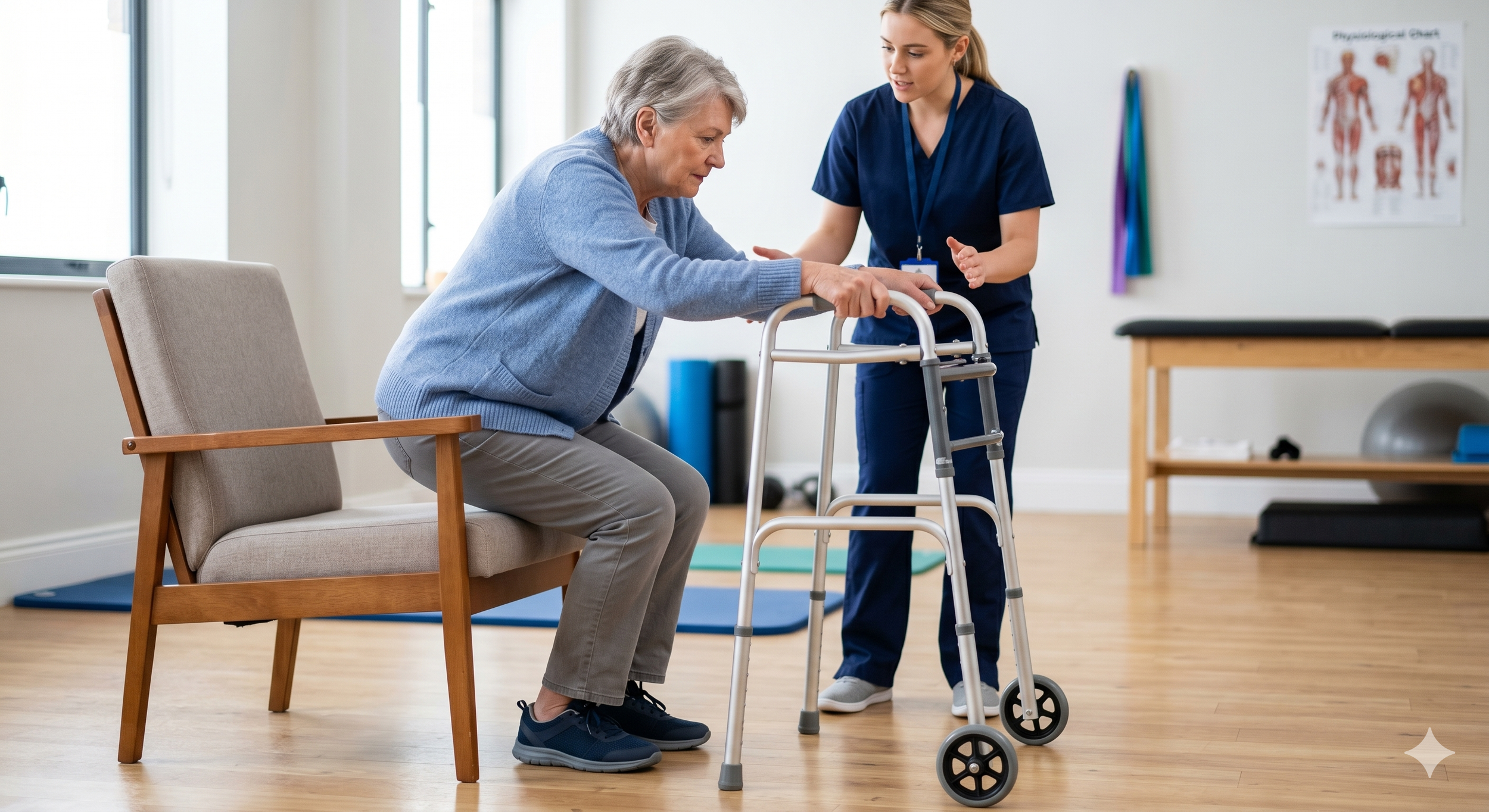
Why Sit-to-Stand Matters So Much
The movement looks simple. You lean forward, your thighs and buttocks do the work, and you rise. In reality it is a demanding, whole-body task that asks a lot of the quadriceps at the front of the thigh and the gluteal muscles. After a neurological injury, those muscles may be weak, slow to activate, or difficult to recruit on demand, even when some movement remains.
The fact is, sit-to-stand is rarely just one transfer. It is the foundation for transfers in general, for standing tolerance, and for the upright time that brings its own long-term health benefits. Working on it is one of the more productive things you can do in rehabilitation, because so much else depends on it.
Where Electrical Stimulation Fits

Neuromuscular electrical stimulation (NMES) uses small electrical pulses delivered through pads on the skin to make a muscle contract. When the pads are placed over the quadriceps and gluteals, the stimulation can add force to the muscles at the exact moment you are trying to rise. In other words, it does not stand you up like a machine. It tops up the effort you are already making, so that the movement becomes possible, or becomes easier and more controlled.
This matters for two reasons. The first is practical: a movement you could not complete on your own becomes a movement you can practise. The second reason is about recovery itself. When you actively try to stand, and the stimulation arrives in time with your own effort, your brain and spinal cord receive feedback from a completed movement. Active, repeated, task-specific practice of this kind is one of the better-understood ways of encouraging the nervous system to adapt. We have written before about how this kind of stimulation can encourage neuroplasticity, and sit-to-stand is a very natural place to apply the principle.
Stimulation That Responds to You
For a long time, the limitation with electrical stimulation in this setting was timing. A stimulator that simply switches on and off to a fixed clock cannot know the moment you decide to stand. Most devices available have been limited in this respect.
This is where a newer generation of devices like the Stim2Go changes the picture.
The Stim2Go is a small, body-worn stimulator, weighing around 185 grams, that contains motion sensors similar to those found in modern phones and watches. It can be set up so that stimulation is triggered by your own movement, by a sensed change in muscle activity, or by a simple manual press at the right moment. The point is that the device can wait for you and your activity. When you initiate the rise, the assistance arrives in step with your intention, neither ahead of nor behind it.
The same unit is controlled from an app on a phone or tablet, comes with a library of programme templates, and can be set up for several different uses, from sit-to-stand and reaching practice to pain and spasms and FES cycling. For someone weighing up a purchase, that versatility is worth noting: it is one device serving several rehabilitation needs rather than a separate machine for each.
When Spasticity Gets in the Way
For some people, the obstacle to standing is not only weakness. Spasticity, the involuntary stiffness and resistance that can follow a spinal cord injury or stroke, can make the legs difficult to position and the movement difficult to start.
The Stim2Go also offers transcutaneous spinal cord stimulation (tSCS), an approach that research has linked to reductions in spasticity. Used before or alongside functional practice, it can sometimes quieten the stiffness enough to make the sit-to-stand work more productive. The evidence here is promising rather than settled, and it is something to explore with a knowledgeable clinician rather than to expect as a guarantee.
Practising With a Therapist, and at Home
In the early stages, this work belongs with a physiotherapist who can assess you, place the electrodes correctly, set sensible stimulation levels, and judge how hard to push. None of that should be guesswork.
What a device like this adds is the ability to continue structured practice between appointments. A common frustration we hear is that the health service is excellent at keeping you alive and getting you through the acute stage, but that the longer, slower work of regaining function is something you increasingly have to take on yourself. A programmable, app-based stimulator with saved settings makes regular home practice realistic, which matters because consistency, not intensity, is usually what moves the needle.
Being Realistic About What to Expect
A few points of balance are worth stating plainly.
Outcomes vary greatly between individuals. Stimulation supports practice; it does not replace the work, nor is it a cure.
Motion-triggered assistance works best when you have some residual movement to sense. Where movement is minimal, manual or automatic triggering can still be used, and the right approach depends on assessment.
There are sensible contraindications and precautions, and a proper assessment is in place to identify them.
The general principle of stimulation-assisted functional practice is well established. Device-specific outcome research for newer systems is still being built, and we would rather tell you that than overstate it.
Summary
Sit-to-stand is a small movement with a large reach into everyday independence. Electrical stimulation can help by adding force to the right muscles at the right moment, and a responsive device like the Stim2Go can time that assistance to your own effort rather than to a fixed clock. Used within an assessed programme, with a therapist's guidance and consistent practice, it offers a practical way to work on one of the movements that matters most.
If standing and transfers are a goal for you or someone you support, we would be glad to talk it through and help you understand whether this approach is a sensible fit. That conversation, and a proper assessment, is always the right place to start.