Over many years of working in rehabilitation, I've heard two questions from clinicians more often than any others. What's the evidence that this works and is safe? And what's the cost?
They're the right questions. A therapist who asks them is protecting a patient from misplaced hope and a budget from wasted money. What I've come to doubt is whether we all mean the same thing by the first one. "What's the evidence?" is usually asked as if evidence were a single ladder, with a large, blinded randomised trial at the top. If a device has no trial at the top, the conversation can end there.
For a rehabilitation device, that evidence ladder often doesn't fit, and the reasons are practical rather than philosophical. I've set them out at length in a new whitepaper, and this article is the short version: how device evidence gets graded, why so much of it lands at "low certainty", what that verdict does and does not mean, and how the money decides how much evidence ever gets produced.
I should say where I stand. We supply electrical stimulation devices, including FES cycling systems, and for some years we represented the Indego exoskeleton in the UK and Ireland, so we gain if devices like these become easier to fund. I'm a bioengineer by background, and I've worked on these problems as a clinician, then as an academic, then as a business person, so I've seen them from several sides.
"Does it work?" is really five questions
Each of these is best answered by a different kind of study:
Can it work under ideal conditions? That is efficacy, and the explanatory randomised trial is built for it.
Does it work in everyday practice? That is effectiveness: pragmatic trials, cohorts and registries.
Does it work for this person? Group averages hide individuals. Single-case designs and N-of-1 trials answer this.
Is it safe? Rare harms need large numbers over long periods, which registries and post-market surveillance supply better than trials.
Is it worth the money? That needs health economic evaluation, which depends on all of the above.
The Medical Research Council's 2021 framework for complex interventions makes the same point. It does not reject randomised trials, and says that for some questions they remain the best way to get an unbiased estimate, but it accepts that some questions decision makers ask cannot be answered by efficacy or effectiveness research alone (Skivington 2021).
Why device evidence so often lands at low certainty
Most guidelines, NICE's included, grade evidence with GRADE. Randomised trials start at high certainty and are rated down for, among other things, risk of bias and imprecision; missing blinding counts against them (Balshem 2011). That applies to every intervention equally. The trouble is that device trials hit those penalties more often.
You often can't blind the participant. People can often feel electrical stimulation. In a study designed to validate a sham TENS unit, an inactive sham fooled only 21% of participants and the best transient sham 40% (Rakel 2010). Nobody is blinded to being walked across a room by an exoskeleton.
The populations are small. Estimates of new spinal cord injuries in the UK each year run from 1,270, the only peer-reviewed figure (McDaid 2019), to 4,400 in a 2024 charity estimate, and the people eligible for any one device are a fraction of either. A two-arm trial needs about 63 people in each group to detect a moderate effect with 80% power. A 2021 review of FES cycling after spinal cord injury found 92 studies with 999 adults, about 11 per study. Nearly every one of the 35 studies reporting power output or aerobic fitness found improvement, yet that evidence was graded low certainty, because none was a randomised or high-level trial (van der Scheer 2021).
The device also works through people. Results may depend on how well it's set up, the therapist's skill and the patient's effort, all of which improve with practice, and the device itself may be two generations on by the time the trial reports. Even the outcome measures can miss the point: for the same 364 people with spinal cord injury, average quality of life scores ranged from 0.25 to 0.61 depending on which instrument was used (Whitehurst 2016).
KEY POINT: Low certainty is not the same as no effect. A low certainty rating says the true effect may differ substantially from the estimate. GRADE is not biased against devices; it rates every small, unblinded trial down, and device trials are more often small and unblinded.
A large null trial is evidence, and it should change minds
The reverse also holds. Altman and Bland made the point in 1995 that a non-significant result from a trial too small to detect a worthwhile difference is not evidence of no effect (Altman 1995). On the other hand, a precise null result from a large, well-run trial is.
Two trials show what that looks like. RATULS randomised 770 people after stroke and found robot-assisted arm training no better than usual care and not cost effective (Rodgers 2019); NICE now says do not offer it. The largest randomised trial of personal exoskeleton use, in 161 US veterans across 15 centres, found no benefit on its primary outcomes. Use was low, partly because the companion the FDA requires was unavailable 43.9% of the time (Spungen 2024). Both changed my reading of their technologies.
Large trials can also show a device is a reasonable choice without being better. For drop foot after stroke, FES was non-inferior to an ankle foot orthosis in 495 people (Bethoux 2014), and over 30 weeks in 197 people there was no difference in gait speed, though users were more satisfied with FES (Kluding 2013). If anyone has told you FES beats an orthosis for walking speed, including people selling stimulators, those trials don't support it. What equivalence gives a clinician is a genuine choice.
Guidance carries a date, and two UK guidelines disagree
NICE's 2009 interventional procedures guidance on FES for drop foot judged the evidence on safety and efficacy adequate. That programme does not assess cost effectiveness, so "NICE approved" and "NICE funded" are different things.
The stroke guidance shows another trap. The 2025 Cochrane review of electromechanical gait training, covering 101 trials and 4,224 people, found that it probably increases the chance of walking independently (odds ratio 1.65, moderate certainty), with nine people treated for one more to walk independently (Mehrholz 2025). NICE's 2023 stroke rehabilitation guideline still says to offer it only in the context of a research study, in a recommendation tagged 2013. Six months earlier, the 2023 National Clinical Guideline for Stroke for the UK and Ireland, also published in Scotland as SIGN 166, said people who cannot walk independently should be considered for it. It also says people whose foot drop impedes mobility should be offered an ankle foot orthosis or FES.
KEY POINT: Read the date on a recommendation, not just the guideline. Two UK guidelines published in the same year give different answers on gait trainers and on FES, and which one your service follows may decide what your patient is offered.
What's the cost? Three questions, and a loop
The cost question deserves the same care. What does the device cost? Compared with what, over how long? And whose budget pays, and whose budget benefits?
In England, most rehabilitation devices have no national route to payment at all. The government's 10 Year Health Plan says that, unlike medicines, there is no national pathway to prioritise and fund the highest impact health technology. NICE's new range of £25,000 to £35,000 per quality-adjusted life year applies to its Technology Appraisal programme, which is mostly medicines; its HealthTech programme still uses £20,000 to £30,000. Device regulation adds its own cost. The European Commission's own 2025 review reports real safety gains from the Medical Device Regulation, alongside high and often disproportionate compliance costs, and in May 2024 the maker of ReStore, a soft exo-suit for walking after stroke, stopped selling it in the EU rather than recertify it.
Put those together and you get a loop. No national payment route means a small, local market. A small market can't fund large trials. Small trials are graded low certainty, which gives payers a reason not to pay. Regulation adds cost at the point where a device enters the loop.
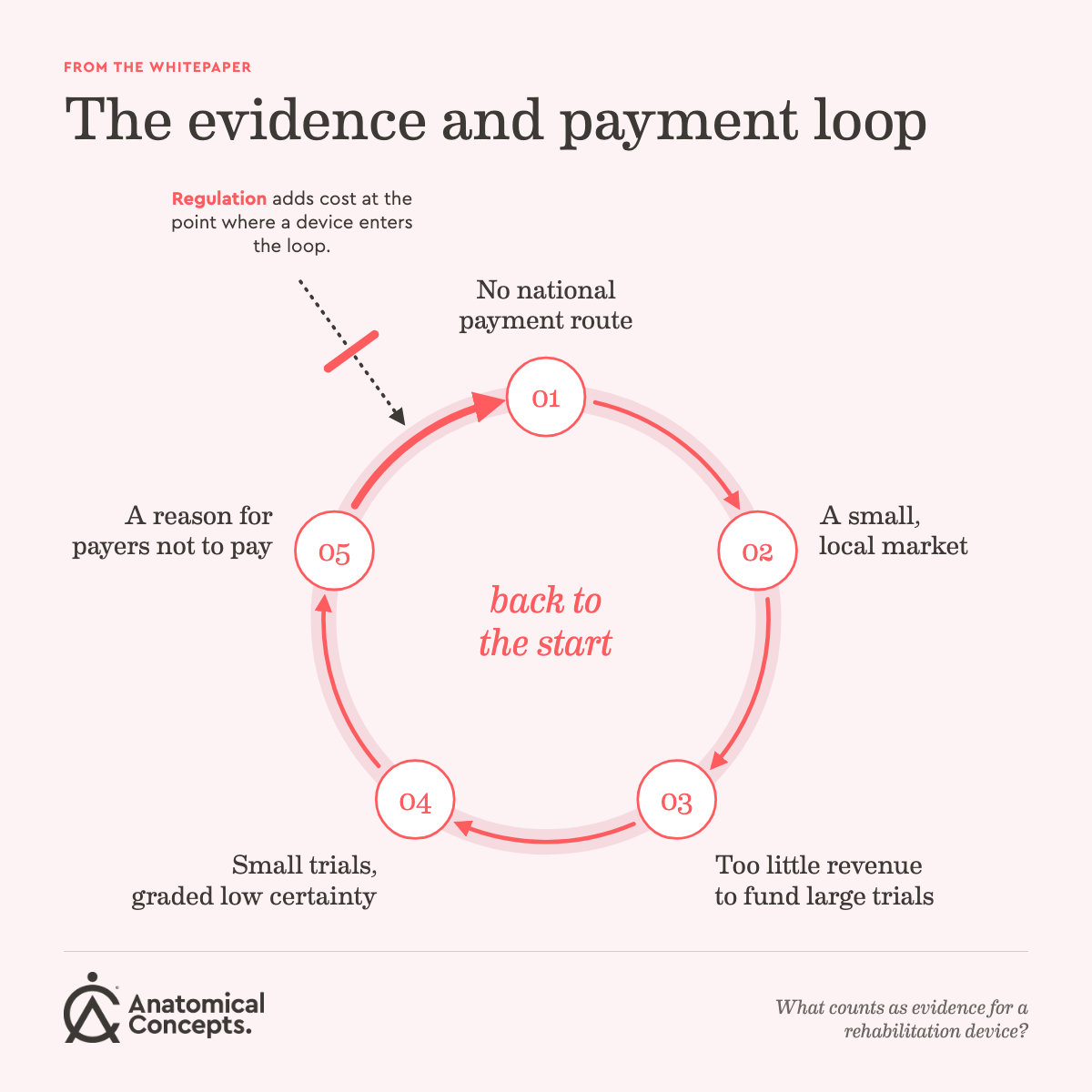
KEY POINT: The system that asks "what's the evidence?" also decides whether anyone can afford to answer. That is not an argument for skipping evidence; it is an argument for evidence demands proportionate to risk, payment conditional on collecting outcomes, and designs that fit small populations.
Five questions to ask of any device's evidence
What question was the study asking? Can it work, does it work in practice, does it work for this person, is it safe, or is it worth it?
What was it compared with? Nothing, a sham, usual care, or another device? Matching an established alternative may be a perfectly good result.
How many people, and could the study have detected a worthwhile difference? A null result from 14 people is not the same as one from 700.
Who knew which treatment was given, and who measured the outcome? If participants couldn't be blinded, were the assessors, and were the outcomes objective?
Does it describe this device, this population and this setting? An earlier generation, a different diagnosis or clinic results applied at home is indirect evidence.
What I would suggest
Take the five questions to the next device that comes up, including the ones we supply. You'll be harder to sell to, and fairer to the devices that deserve it.
Record your own outcomes. Every service that uses a device produces evidence, and most of it is lost. Choose a standard measure, record it before and after, and consider a simple single-case design where a patient's baseline is stable. Shared through audit or a registry, those records are part of the evidence that's missing.
And ask the cost question in full: compared with what, over how long, and from whose budget. A device that saves a carer's hours or a hospital admission may never show up on the budget that buys it.
For the products we deal with, what we offer is assessment and training, not just supply. That starts with a conversation about goals, looks at the equipment the person already has, and where practical includes a trial session before anything is bought. Sometimes the answer is that a device would suit them well. Sometimes it is that something else should come first. Either is a useful answer.
Decisions about any individual patient belong with the clinical team and the clinicians who assess them; nothing here replaces that.
If you'd like the full whitepaper, with the evidence map, the worked examples on FES and exoskeletons and all 78 references, ask me for a copy through our contact page. And if you read the evidence differently, I'd welcome the conversation. A conversation costs nothing, and I would rather help you ask the right questions than see you spend money answering the wrong ones.
Further reading
Balshem H, Helfand M, Schünemann HJ, Oxman AD, Kunz R, Brozek J, et al. GRADE guidelines: 3. Rating the quality of evidence. Journal of Clinical Epidemiology 2011;64(4):401 to 406. https://doi.org/10.1016/j.jclinepi.2010.07.015
Skivington K, Matthews L, Simpson SA, Craig P, Baird J, Blazeby JM, et al. A new framework for developing and evaluating complex interventions: update of Medical Research Council guidance. BMJ 2021;374:n2061. https://doi.org/10.1136/bmj.n2061
Altman DG, Bland JM. Absence of evidence is not evidence of absence. BMJ 1995;311(7003):485. https://doi.org/10.1136/bmj.311.7003.485
Rakel B, Cooper N, Adams HJ, Messer BR, Frey Law LA, Dannen DR, et al. A new transient sham TENS device allows for investigator blinding while delivering a true placebo treatment. Journal of Pain 2010;11(3):230 to 238. https://doi.org/10.1016/j.jpain.2009.07.007
McDaid D, Park AL, Gall A, Purcell M, Bacon M. Understanding and modelling the economic impact of spinal cord injuries in the United Kingdom. Spinal Cord 2019;57(9):778 to 788. https://doi.org/10.1038/s41393-019-0285-1
van der Scheer JW, Goosey-Tolfrey VL, Valentino SE, Davis GM, Ho CH. Functional electrical stimulation cycling exercise after spinal cord injury: a systematic review of health and fitness-related outcomes. Journal of NeuroEngineering and Rehabilitation 2021;18(1):99. https://doi.org/10.1186/s12984-021-00882-8
Whitehurst DGT, Mittmann N, Noonan VK, Dvorak MF, Bryan S. Health state descriptions, valuations and individuals' capacity to walk: a comparative evaluation of preference-based instruments in the context of spinal cord injury. Quality of Life Research 2016;25(10):2481 to 2496. https://doi.org/10.1007/s11136-016-1297-3
Rodgers H, Bosomworth H, Krebs HI, van Wijck F, Howel D, Wilson N, et al. Robot assisted training for the upper limb after stroke (RATULS): a multicentre randomised controlled trial. Lancet 2019;394(10192):51 to 62. https://doi.org/10.1016/S0140-6736(19)31055-4
Spungen AM, Dematt EJ, Biswas K, Jones KM, Mi Z, Snodgrass AJ, et al. Exoskeletal-assisted walking in veterans with paralysis: a randomized clinical trial. JAMA Network Open 2024;7(9):e2431501. https://doi.org/10.1001/jamanetworkopen.2024.31501
Bethoux F, Rogers HL, Nolan KJ, Abrams GM, Annaswamy TM, Brandstater M, et al. The effects of peroneal nerve functional electrical stimulation versus ankle-foot orthosis in patients with chronic stroke: a randomized controlled trial. Neurorehabilitation and Neural Repair 2014;28(7):688 to 697. https://doi.org/10.1177/1545968314521007
Kluding PM, Dunning K, O'Dell MW, Wu SS, Ginosian J, Feld J, et al. Foot drop stimulation versus ankle foot orthosis after stroke: 30-week outcomes. Stroke 2013;44(6):1660 to 1669. https://doi.org/10.1161/STROKEAHA.111.000334
Mehrholz J, Kugler J, Pohl M, Elsner B. Electromechanical-assisted training for walking after stroke. Cochrane Database of Systematic Reviews 2025;5:CD006185. https://doi.org/10.1002/14651858.CD006185.pub6
National Institute for Health and Care Excellence. Stroke rehabilitation in adults. NICE guideline NG236. October 2023. https://www.nice.org.uk/guidance/ng236
Intercollegiate Stroke Working Party. National Clinical Guideline for Stroke for the UK and Ireland. 2023 edition. https://www.strokeguideline.org
Related articles on our site
The Stages of Electrical Stimulation: A History in Seven Turning Points
Key findings from the Neurokinex trial of the Onward Medical ARC-ex device
Understanding the Cost of Care: Why Medical-Grade Stimulation Devices Outprice Consumer Units
Articles on this site are researched and drafted with the help of AI tools, then checked, edited and approved by me. Every citation is verified against the original source before publication.