Waveform matters: what new evidence tells us about transcutaneous spinal cord stimulation
Transcutaneous spinal cord stimulation (tSCS) has moved quickly from a research curiosity to a recognised tool in neurological rehabilitation. People living with spinal cord injury, stroke, and multiple sclerosis are asking us about it. Clinicians want to know which device to recommend. Equipment commissioners want evidence-led guidance before authorising spend that can run into tens of thousands of pounds per system.
A paper published in Nature Biomedical Engineering on 12 May 2026 has added something important to that conversation. It is not a clinical trial. It is a careful study of the physics and physiology that govern which nerve fibres a tSCS device actually recruits. The finding is consequential, and it bears directly on the choice of device.
In short: the waveform you choose determines whether tSCS does the thing rehabilitation needs it to do.
What tSCS is trying to achieve
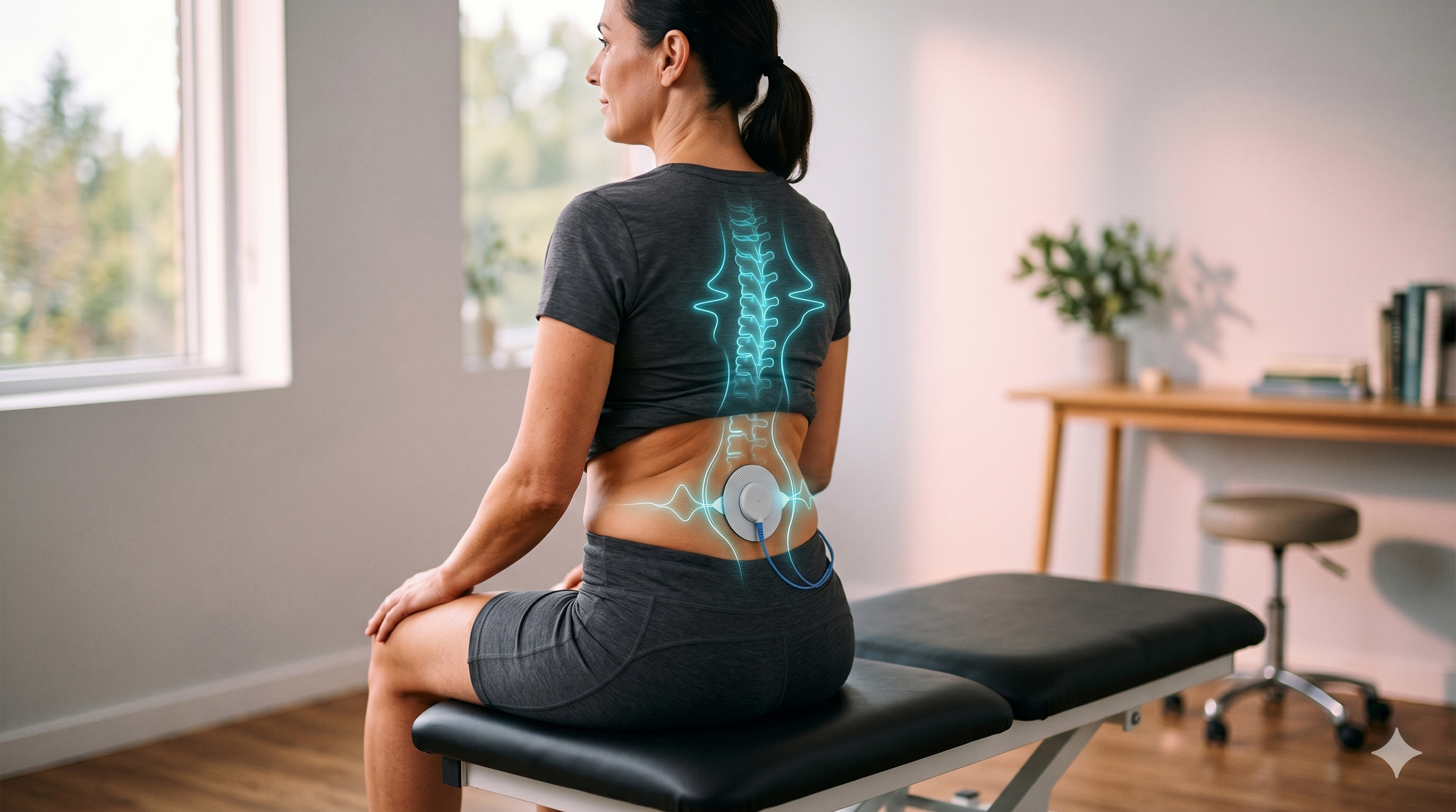
tSCS is not a treatment in the way a drug is a treatment. It is a way of priming the spinal cord so that rehabilitation works better. Used well, it lowers the threshold for voluntary movement, calms spasticity, and creates a window in which therapy can drive lasting change.
The mechanism that matters for recovery is afferent recruitment. The dorsal roots of the spinal cord carry large sensory fibres that, when activated synchronously, depolarise networks of spinal interneurons. Those interneurons sit at the heart of the locomotor and grasping circuits. Wake them up, pair the activation with task-specific training, and you have the conditions for use-dependent plasticity. Hebb's old phrase ("cells that fire together wire together") describes the principle exactly.
If your stimulation recruits the wrong fibres, or recruits the right fibres in the wrong pattern, you may still see a useful effect during the session. The muscle may twitch. The hand may grip more firmly. The cyclist may push harder on the pedals. But the lasting change, the rewiring that lets someone keep the gain after the device is switched off, depends on synchronised afferent input arriving at spinal interneurons in time with descending voluntary drive.
That is what we mean by plasticity-driving tSCS. Anything less is acute facilitation, and the two are not the same.
The new finding
The Keesey et al. paper, with authors from Washington University in St. Louis and the Medical University of Vienna, did something simple and instructive. They tested how different tSCS waveforms recruit nerve fibres in 28 human participants and extended the empirical thresholds into a computational model of dorsal root anatomy.
Their conclusion:
kilohertz-frequency carrier waveforms (the approach used in the newest generation of FDA/MHRA cleared tSCS devices) raise the threshold for afferent fibre recruitment and bias the recruitment that does occur towards motor efferent fibres rather than the sensory afferents that drive plasticity. This bias is most pronounced at the cervical levels, which are the spinal region where these devices are most commonly applied.
Conventional long-duration biphasic waveforms (pulse widths of around 1 ms, frequencies between 15 and 50 Hz) recruit afferents preferentially and produce the synchronised volleys that spinal interneurons respond to.
The authors put it cautiously. Kilohertz waveforms, they conclude, "warrant careful consideration in the context of neurorehabilitation applications."
That is academic language for: be careful what you choose, because the physics may not support the goal.
Why this happens
Three principles converge.
Chronaxie. Every nerve fibre has a characteristic pulse duration at which it is most efficiently excited. For the large sensory afferents we want to recruit, that duration sits comfortably in the half-millisecond to one-millisecond range. Short, fast-alternating kilohertz pulses fall below this window. Threshold rises sharply, and rises more steeply for afferents than for the motor efferents that lie closer to the surface electrodes. The net effect: at the intensities patients can tolerate, motor efferents reach threshold first, and afferents reach it late or not at all.
Synchrony. When pulses arrive faster than a fibre can fully recover, firing becomes irregular and some fibres simply fail to fire. The same phenomenon is used deliberately in 10 kHz peripheral nerve block for chronic pain. Useful in that context but counter-productive when the goal is to send a coherent afferent volley into the dorsal horn.
Spatial summation. Spinal interneurons respond to synchronised input. A desynchronised volley produces weaker postsynaptic responses, even if the same total number of afferents fired. The summation that lights up the locomotor and grasping networks depends on coordinated arrival.
The conventional waveform was not chosen by accident. It was chosen because it sits where the physiology wants it. The Vienna group, alongside colleagues at UCLA and elsewhere, established this through two decades of human work before the technology became commercially attractive enough for new entrants to design around different waveforms.
What the evidence says about 'conventional' waveforms
The functional outcome literature for conventional-waveform tSCS is now substantial.
Gerasimenko and colleagues demonstrated in 2015 that five of five motor-complete (AIS B) participants regained voluntary stepping-like movements with 30 Hz, 1 ms biphasic lumbar tSCS over 18 weeks (DOI: 10.1089/neu.2015.4008). In 2018, Inanici and colleagues showed that cervical tSCS plus physical therapy in chronic incomplete tetraplegia produced large GRASSP gains and several-fold increases in pinch strength, with benefits sustained at three-month follow-up without further stimulation. That is the signature of genuine plasticity rather than acute facilitation (DOI: 10.1109/TNSRE.2018.2834339).
Gad and colleagues reported a 325% grip strength increase during cervical stimulation and a 225% increase without stimulation after eight sessions over four weeks (DOI: 10.1089/neu.2017.5461).
Hofstoetter and colleagues showed in 2020 that a single 30-minute session of 50 Hz lumbar tSCS at sub-reflex intensity produced clinically meaningful reductions in spasticity persisting for at least two hours, with cumulative carry-over over six weeks of home use (DOI: 10.1089/neu.2019.6588).
These are not isolated reports. They are a connected body of work using the same broad waveform family, building outcomes on a shared mechanistic understanding.
What about the newer devices?
The newer kilohertz-carrier devices have published clinical evidence as well, principally a 60-participant multicentre trial in Nature Medicine that showed improvements in fingertip pinch force, prehension, and motor and sensory scores in chronic incomplete cervical SCI. The functional gains are real, and patients have benefited.
The question Keesey et al. raise is what those gains represent. If the mechanism is acute motor facilitation (direct efferent recruitment plus motoneuron pool excitability changes during stimulation), the device is doing something useful while it is on. If the mechanism is plasticity, the gains should persist and accumulate after stimulation stops. The primary endpoint in the published trial was assessed during stimulation, which does not separate these two possibilities.
This is not a criticism of the patients or the trialists. It is a genuine open question that the new mechanism's evidence now sharpens.
KEY POINT
The choice between a kilohertz-carrier tSCS device and one delivering conventional waveforms is not a choice between newer and older technology. It is a choice between two different stimulation strategies that recruit different nerve fibres and produce different kinds of effect. For lasting rehabilitation gains, the evidence clearly points to waveforms that synchronously recruit sensory afferents.
What this means in practice
For anyone weighing a tSCS purchase, three implications follow.
First, ask about the waveform. Pulse width, frequency, and whether the device uses a kilohertz carrier or delivers the pulse directly are not minor specification details. They determine which fibres the device recruits and, therefore, what kind of effect it produces.
Second, look at the outcome literature for the waveform family the device uses, not just the device brand. Two decades of work using conventional biphasic 0.5 to 1 ms pulses at 15 to 50 Hz underpins the modern understanding of tSCS-driven plasticity. A device delivering that waveform family is operating in a well-mapped clinical space.
Third, separate "what happens during stimulation" from "what persists afterwards." Both matter. They are not the same thing, and a device that excels at one may not excel at the other.
For equipment commissioners and case managers funding equipment in medical-legal cases, this matters both commercially and clinically. The premium kilohertz devices currently command price points of £25,000 and above. Comparable functional outcomes have been documented in the published literature using conventional waveform devices that cost a fraction of that. The mechanism evidence now provides a principled reason why this is so, rather than leaving it as a coincidence.
Where Stim2Go fits
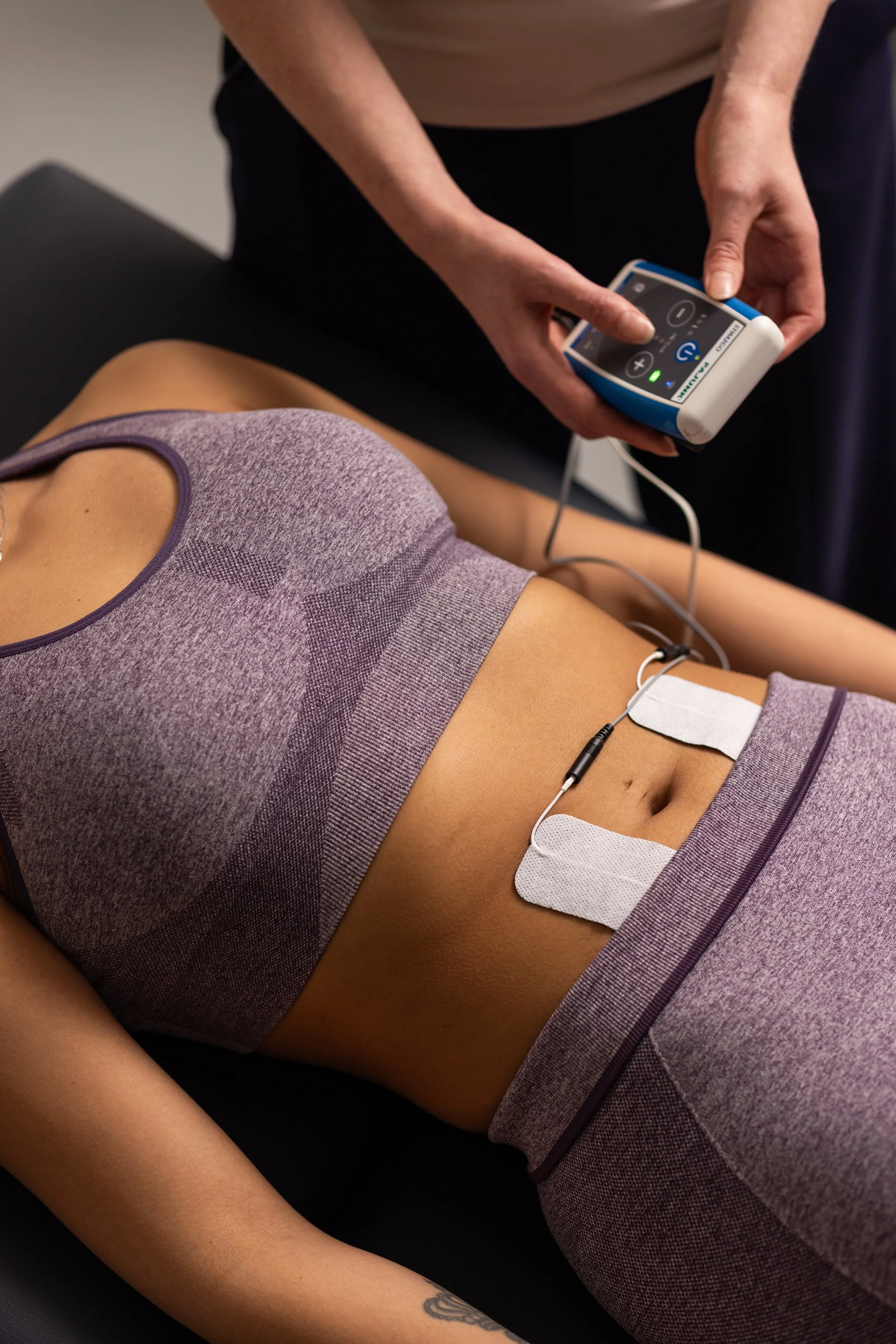
With Stim2Go we have two electrodes on the abdomen and one over T11/12 vertebrae
Stim2Go, developed by SensorStim Neurotechnology in Berlin and manufactured by Pajunk in Germany, delivers conventional biphasic waveforms in the parameter range supported by the published literature. Pulse widths of around 1 ms, frequencies from 30 Hz upwards, sub-motor threshold intensities calibrated against the posterior root muscle reflex. The protocols are the protocols. The mechanism is the mechanism the new paper supports.
Stim2Go also combines tSCS with FES cycling on a single platform, with home-use compatibility already demonstrated in the published six-week studies of comparable home stimulation. For someone trying to consolidate spinal priming, task-specific training, and long-term home maintenance into one practical regime, this matters.
We are not arguing that Stim2Go is the only sensible choice in every case. Individual assessment matters. Lumbar work and upper-limb work raise different questions. Some patients will be better served by combining tSCS with a different modality. That conversation is what we are here for.
What the new evidence does is shift the framing. The conventional waveform family is no longer the "older" approach competing against "newer" alternatives. It is the approach that the underlying physiology supports.
Caveats worth stating
The Keesey et al. study used 28 unimpaired participants and extrapolated to SCI populations through computational modelling. That extrapolation is reasonable but not the same as a clinical outcome trial.
Mechanism findings do not always translate cleanly to clinical practice. The kilohertz-device trials are real and their results are not invalidated by this paper. The question is the type of recovery they produce and how durable it proves to be.
Lumbar tSCS retains some afferent selectivity even with kilohertz waveforms, so the mechanism argument is sharper for cervical (upper-limb) work than for lumbar (lower-limb) applications.
Finally, "preferential recruitment" is a population statement. Both waveform families recruit some of both fibre types. The argument concerns the ratio at clinically useful intensities, not absolutes.
Where this leaves us
The choice of tSCS device is now a choice with mechanism-level evidence behind it. For most rehabilitation goals, particularly cervical applications targeting hand and upper-limb function, the waveform family that aligns with both the new mechanism finding and twenty years of outcome literature is the conventional biphasic, sub-100 Hz approach.
If you are considering tSCS for yourself, a client, or a commissioned service, the questions to ask are now sharper than before. We are happy to walk through them with you.
References
Keesey R, Hofstoetter US, Hu Z, Lombardi L, Hawthorn R, Bryson N, Alashqar A, Rowald A, Minassian K, Seáñez I. Fundamental limitations of kilohertz-frequency carriers in afferent fibre recruitment with transcutaneous spinal cord stimulation. Nature Biomedical Engineering. 2026 May 12. DOI: 10.1038/s41551-026-01684-w.
Gerasimenko YP, Lu DC, Modaber M, et al. Noninvasive reactivation of motor descending control after paralysis. Journal of Neurotrauma. 2015;32(24):1968-80. DOI: 10.1089/neu.2015.4008.
Inanici F, Samejima S, Gad P, Edgerton VR, Hofstetter CP, Moritz CT. Transcutaneous electrical spinal stimulation promotes long-term recovery of upper extremity function in chronic tetraplegia. IEEE Transactions on Neural Systems and Rehabilitation Engineering. 2018;26(6):1272-1278. DOI: 10.1109/TNSRE.2018.2834339.
Gad P, Lee S, Terrafranca N, Zhong H, Turner A, Gerasimenko Y, Edgerton VR. Non-invasive activation of cervical spinal networks after severe paralysis. Journal of Neurotrauma. 2018;35(18):2145-2158. DOI: 10.1089/neu.2017.5461.
Hofstoetter US, Freundl B, Danner SM, Krenn MJ, Mayr W, Binder H, Minassian K. Transcutaneous spinal cord stimulation induces temporary attenuation of spasticity in individuals with spinal cord injury. Journal of Neurotrauma. 2020;37(3):481-493. DOI: 10.1089/neu.2019.6588.
Moritz C, Field-Fote EC, Tefertiller C, et al. Non-invasive spinal cord electrical stimulation for arm and hand function in chronic tetraplegia: a safety and efficacy trial. Nature Medicine. 2024;30(5):1276-1283. DOI: 10.1038/s41591-024-02940-9.