
Heel pressure injuries are one of those problems where the evidence has been ahead of everyday practice for years. We have known for many years that pillows and improvised supports rarely keep a heel clear of the bed for long, and that a heel touching anything is a heel under pressure and shear. The 2025 International Pressure Injury Guideline (the fourth edition produced by NPIAP, EPUAP, and PPPIA) has now caught up to that reality, and in doing so it has changed the language clinicians and commissioners should use when they think about heel protection.
The guideline introduces a phrase worth noticing: "floating heels."
It is not a marketing line. It is a clinical description of what an effective heel offloading intervention has to achieve, taken from the guideline itself. And it has practical implications for any service that has to choose, fund, or audit heel protection equipment.
What the guideline actually says
The 2025 guideline is the first edition to give the heel its own dedicated section. The reasoning is anatomical. The posterior heel has a small surface area, very little soft tissue coverage, and is unusually sensitive to shear, particularly when an immobile person lies supine and the heel rim contacts the support surface. For a body part with these properties, redistribution or reduction of pressure across a larger area is not really an easy option, because there is no larger adjacent area to redistribute to.
The guideline therefore sets out two linked positions.
First, as a good practice statement, it recommends that the heels of people at risk of pressure injuries should be elevated so that they are not in contact with the full body support surface. Second, in its supporting information, it goes further: heels should be "fully free from the full body support surface." That is the position the guideline calls "floating heels."
It then suggests using a heel offloading device appropriate to the individual's mobility and activity level. The accompanying evidence summary reports that, when the heel was used as the unit of analysis, heel offloading devices were associated with a heel pressure injury rate of 0.4 per cent, compared with 8.4 per cent for pillows, with a relative risk of 0.06.
The guideline grades the certainty of that evidence as very low, and it is honest about doing so. But the direction of effect is consistent across the studies that exist, and there is no comparable evidence pointing the other way.
Why "floating" is not the same as "elevated"
This is where I think the guideline does its most useful work, because it forces a distinction that has been blurred in clinical practice for years.
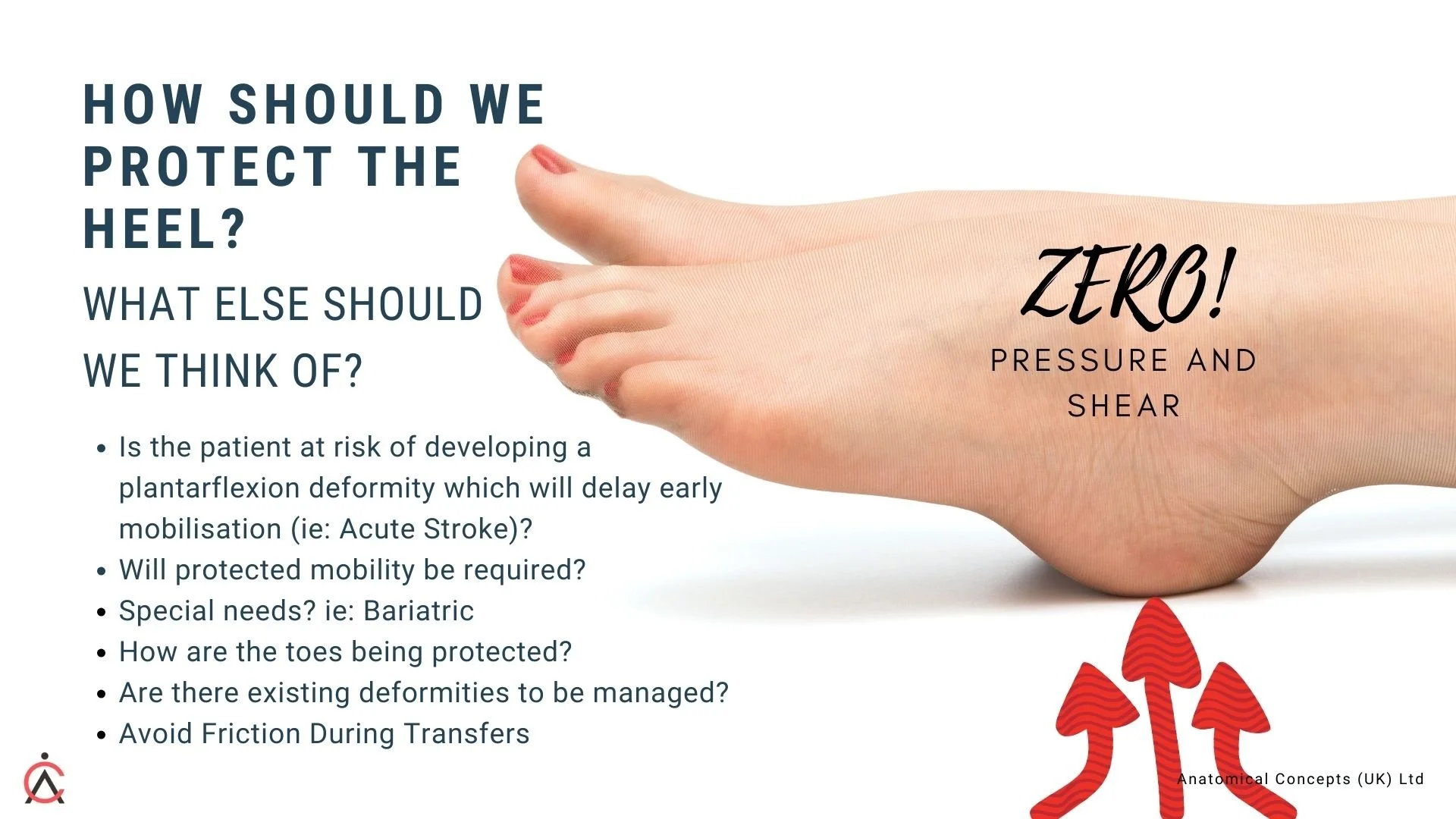
"Elevation" simply means the leg is raised. A pillow under the calf elevates the leg. So does a folded towel. So does a heel cup that lifts the heel a centimetre off the mattress. None of those are necessarily "floating" the heel.
A heel is floating when nothing at all is touching the posterior calcaneus.
That is a higher standard than "elevation," and it matters for two reasons. First, partial contact still concentrates pressure over the small heel surface area, which is exactly the configuration most likely to occlude end-artery blood supply to the skin. Second, partial contact still allows shear, which research has repeatedly shown to be at least as damaging to perfusion as direct compression. Reducing pressure without eliminating contact leaves both mechanisms in play.
The guideline language is deliberate on this point. Fully free.
What an effective heel offloading device has to do
The same section of the guideline sets out what selection and fit have to achieve and it is a specification rather than a wish list. A heel offloading device should:
Be appropriate to the individual's mobility and activity level.
Support optimal foot and ankle alignment, including resistance to the plantarflexion that drives the heel back into contact with whatever is below it.
Be checked regularly, in use, to confirm the heel is still floating.
Be reconsidered as mobility, fall risk, oedema, sensation, skin status, or tolerance change.
The guideline also issues a specific warning. Poorly chosen or poorly fitted devices can create new risks: device-related pressure injury at sites other than the heel, restriction of movement, or falls. A device that deforms under load, or that shifts during a transfer, can fail quietly.
That is the test any heel offloading product should be evaluated against.
Where the PRAFO fits
We have used PRAFO ankle foot orthoses for more than thirty years, and the design intent of the device maps line for line onto the criteria the 2025 guideline now sets out.
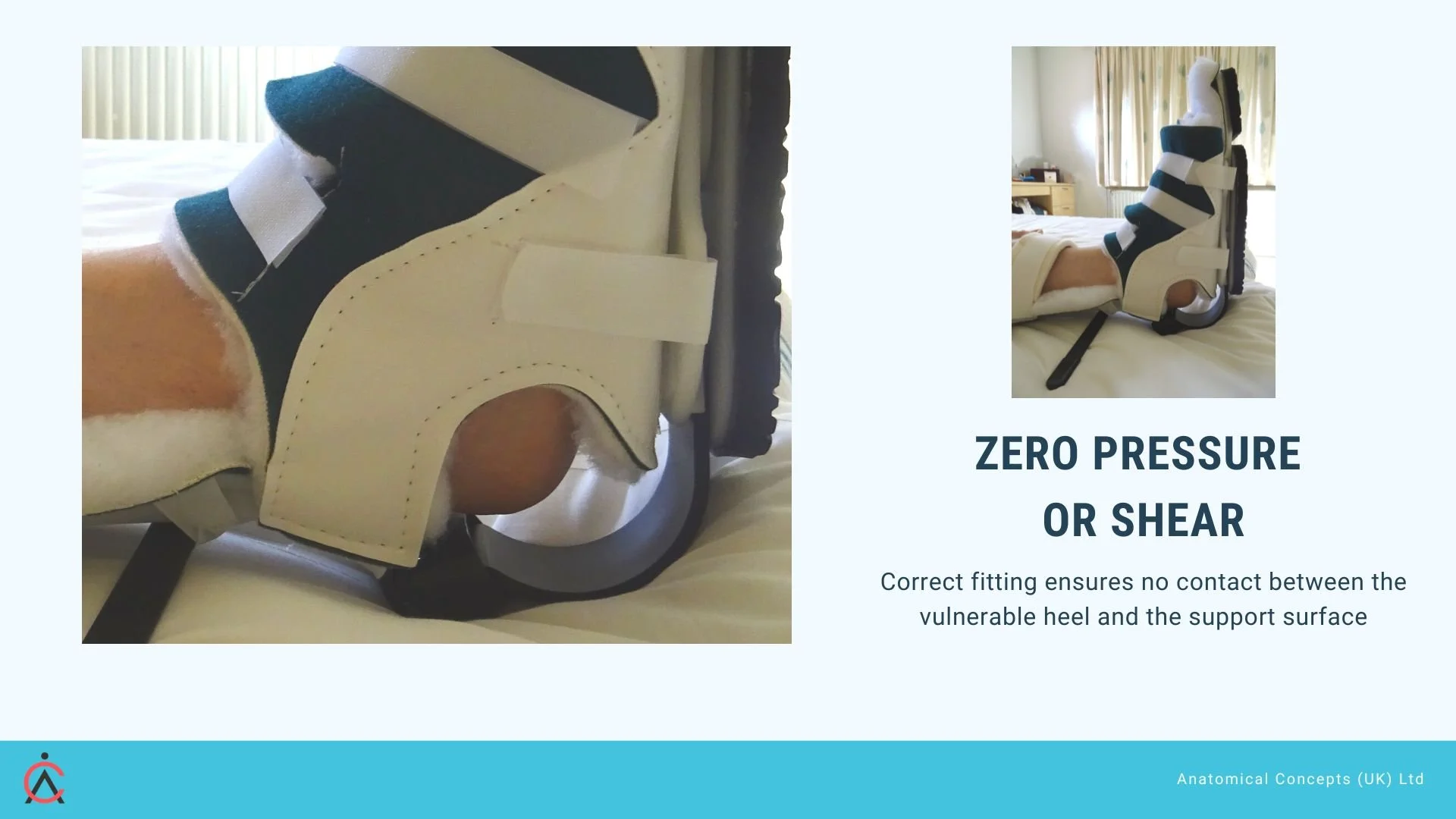
The PRAFO design is built around the mechanical goal of preventing any direct heel loading. The foot and ankle are cradled so that the heel sits suspended within the orthosis, not on it. Load is carried through the calf and the dorsum of the foot, both of which have more soft tissue coverage and a larger contact surface than the heel itself. There are no sharp transitions or localised tissue compression which can create shear.
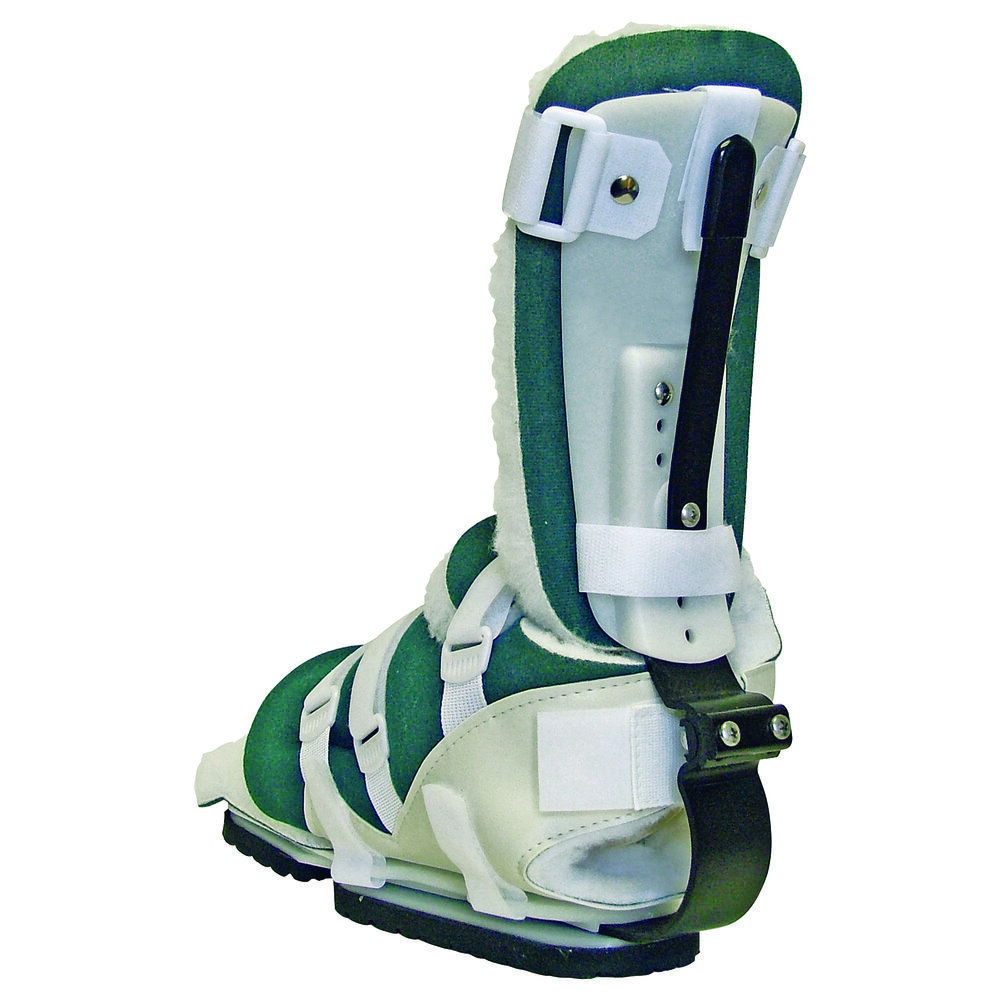
PRAFO model with adjustable dorsi/plantar flexion and washable kodel liner
The rigid posterior upright resists plantarflexion and the gradual collapse that turns a "raised" heel back into a contacting one. In fact the PRAFO is the only device of it’s kind with a metal structural upright which prevents distortion of the structure. All PRAFO models also allow protected ambulation, which keeps the offloading principle intact during early mobilisation rather than only in bed.
In the language of the 2025 guideline, the PRAFO is designed to keep the heel fully free from the full body support surface rather than simply to reduce the pressure acting on it. That distinction is the central point.
What I would not say, and what I think it is important to be clear about, is that the guideline recommends the PRAFO. It does not. The guideline does not endorse any single brand or product family. The defensible position is narrower and, in my view, stronger: the PRAFO is consistent with the guideline because it operationalises the floating heel requirement, and it is reasonable to consider it for patients whose mobility, activity level, and risk profile suit its use.
That is a more useful claim than a "recommendation," because it tells the clinician what to look for in any device, not just ours.
What this means in practice
If your service is updating its pressure ulcer prevention pathway in response to the new guideline, three practical questions are worth asking about whatever is currently in use.
First, does it actually float the heel? Not elevate, not reduce pressure on, but float. A simple sliding-paper test under the heel during use is a fair proxy.
Second, does it stay floating? Pillows fail this test reliably; sedation, transfers, and routine repositioning all displace them. A device that needs constant readjustment in a busy ward is a device that will fail in practice.
Third, has it been chosen for this person? Mobility, fall risk, oedema, sensation, skin condition, and tolerance all change the right answer. A device that suits an immobile ICU patient may not suit the same person three weeks later in rehabilitation. We believe the PRAFO supports continuity of care as it supports protection as the patient progresses through recovery and back to the community.
These questions sit underneath the guideline's own implementation criteria. They are also the questions we ask when we assess a patient for a PRAFO.
Summary
The 2025 guideline raises the standard for heel protection by defining what success actually looks like: the heel suspended fully clear of any surface. It supports the use of heel offloading devices over pillows and improvised supports for people at risk, while being open about the fact that the comparative evidence base is small and graded as low or very low certainty. It expects devices to be individually selected, fitted, checked, and reconsidered.
The PRAFO is consistent with that framework. It was designed for the requirement the guideline now articulates, and three decades of clinical use suggest it does the job reliably when it is correctly chosen and fitted. It is not the only device capable of achieving floating heels, but it is one we have seen work where pillows, gloves, and improvised supports do not.
If your service is reviewing its heel protection pathway, or you are a case manager or family member trying to understand what "good" looks like in a costed care plan, that is the question to start with. Does the intervention actually float the heel, and does it keep doing so over a shift, a day, and a week?
If the answer is no, the 2025 guideline now gives you the language to say so.
If you would like to talk through a specific patient or service before deciding whether a PRAFO assessment is appropriate, please get in touch. We are happy to have the conversation, even when it ends in a "not for this patient" answer.
Further reading
European Pressure Ulcer Advisory Panel, National Pressure Injury Advisory Panel, Pan Pacific Pressure Injury Alliance. Prevention and Treatment of Pressure Ulcers/Injuries: Clinical Practice Guideline. 4th edition. 2025. https://internationalguideline.com
Anatomical Concepts (UK). Pressure Reduction vs Complete Offloading: Why the Distinction Matters for Tissue Viability. 2026.
Anatomical Concepts (UK). Why Pillows Fail: The Biomechanics of Heel Suspension. 2026.
Anatomical Concepts (UK). Shear Forces at the Heel: The Hidden Damage Mechanism. 2026.