The question turns up in epilepsy forums in several forms, and since we began distributing an ear-worn vagus nerve stimulator (tVNS E) it has started to reach us too. Someone has been told about the implant. The phrase they hear is "an operation", and they would rather not have one. They have found a device that clips into the ear, and they want to know whether it does the same job without the surgery.
Behind that question sit two different operations. One removes or disconnects the part of the brain where seizures start. The other fits a stimulator under the skin of the chest, with a wire to the vagus nerve in the neck. The short answer is that the ear device has not formally been compared with either of them. No trial has asked whether it is as good as either operation, so nobody can tell you absolutely that it is. What follows explains what each route offers, why the comparison is harder than it looks, and who the ear device might reasonably be for.
The tVNS is a certified medical device which means for certain conditions, including epilepsy there is some evidence that benefit can arise from it's use. This article examines this in some detail.
Two operations, not one
For people whose seizures start in one identifiable, removable area, resective surgery is the treatment most likely to stop them altogether. In a randomised trial of temporal lobe epilepsy, 58% of people who had surgery were free of seizures that impair awareness at one year, against 8% of those who continued on medication alone (Wiebe 2001). A second trial, stopped early, found 11 of 15 surgical patients seizure-free in their second year against none of 23 on medication (Engel 2012).
That is why NICE's epilepsy guideline (NG217) says that everyone with drug-resistant epilepsy should be referred for an assessment for surgery. Only if resective surgery is not suitable does it recommend considering vagus nerve stimulation, as an add-on to anti-seizure medication.
The implanted stimulator is a different kind of treatment. In the controlled trial that led to its approval, 31% of people on the higher stimulation setting halved their seizures over 14 weeks, against 13% on a low setting (VNS Study Group 1995). Longer follow-up, without a control group, reports roughly four to six people in ten halving their seizures after two to five years (Morris 1999; Mao 2022; Englot 2016). Seizure freedom is rare: about 8% in the largest registry (Englot 2016). The NICE committee's own evidence review calls it a "palliative" procedure and says seizure freedom "is not anticipated".
KEY POINT: The ear device is not a route around a surgical assessment. Whatever someone decides about stimulation, the assessment comes first, because it is the only thing that can tell them whether a cure is on the table. Both forms of vagus nerve stimulation are add-on treatments that aim to reduce seizures, not to end them.
What the ear device actually reaches
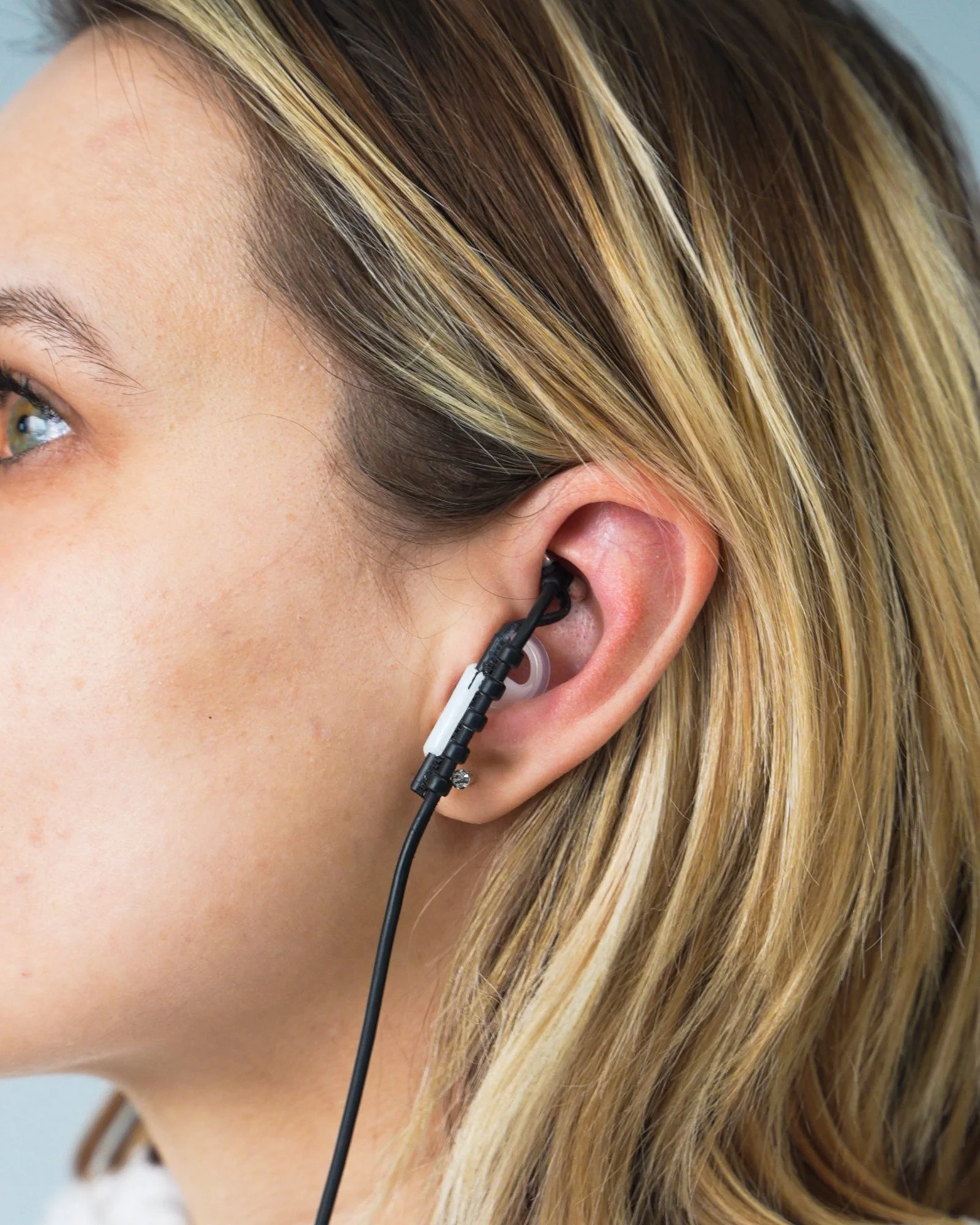
tVNS ear electrode
This is the part of the question I can speak to with some authority. I am not an epileptologist, and I have no caseload in epilepsy. My background is bioengineering and electrical stimulation, and the useful questions here are engineering ones: what is being stimulated, how much of it, and for how long.
The vagus nerve sends one small branch to the skin of the outer ear, including the upper hollow of the ear's bowl, called the cymba conchae. The device we distribute places its electrode there. In a brain imaging study, stimulation at that site, compared with stimulation of the earlobe, activated the brainstem nuclei through which vagus nerve stimulation is thought to act, including the nucleus tractus solitarius and the locus coeruleus (Frangos 2015). That study was in 12 healthy volunteers and was funded by the company that developed the original device. It shows the ear route reaches the right places. It does not show what that achieves in epilepsy.
The ear branch is also small. An anatomical count found that it carries about one fifth to one sixth of the large myelinated fibres present in the vagus nerve in the neck, where the implant's electrode sits (Safi 2016). One of that paper's authors had worked for the same company.
Then there is dose. In its pivotal trials, the implant stimulated for 30 seconds every five minutes, around the clock, programmed by a generator that never forgets to deliver stimulation. The trials of ear stimulation used between two and four hours a day, delivered by the person wearing it, and adherence has the potential to fall away over months. In one Danish study of the predecessor to our device, only 6 of 37 people completed the full 18 months (Sabers 2021). The trials do not even agree on intensity: one set it at the highest level people could tolerate, while the German trial now running sets it just below the level people can feel.
Site matters as much as dose. A clip on the earlobe, as sold with some consumer devices, is aimed at the wrong place: the earlobe is the site researchers use for sham stimulation.
KEY POINT: Same vagus nerve, but not the same dose. A smaller population of fibres, stimulated for part of the day, might work as well as the implant, less well, or differently. The mechanism gives a good reason to run the trial. It cannot tell you the result.
What the trials of the ear device show
The evidence is mixed. Each result below carries a limitation.
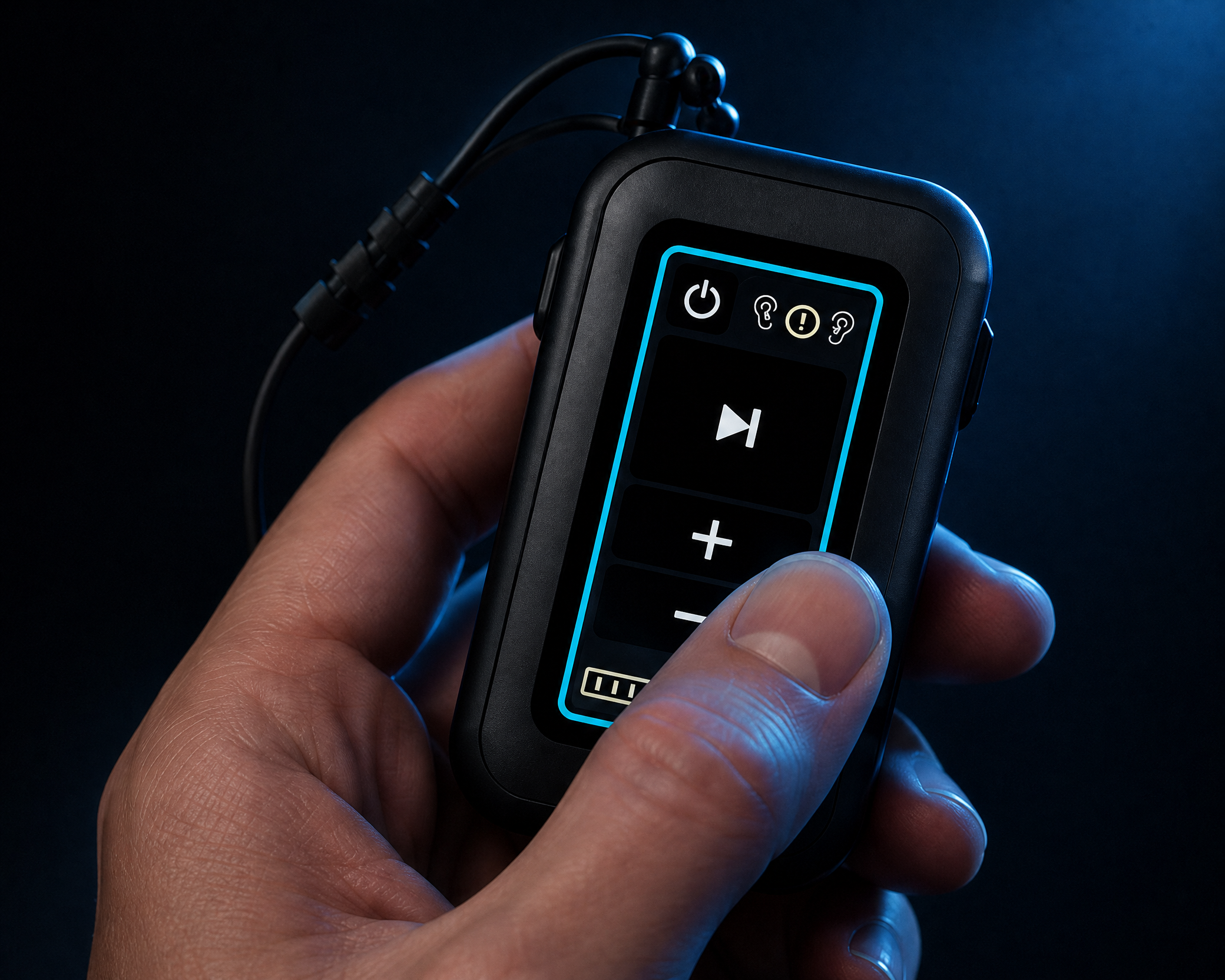
tVNS stimulator
The largest European trial used NEMOS, the predecessor of the device we distribute. It randomised 76 people to a higher or a lower stimulation setting for 20 weeks and did not meet its main goal: seizures fell by 23.4% on the higher setting against a 2.9% rise on the lower one, a difference that was not judged statistically significant (Bauer 2016). The figure often quoted from this trial, a 34% reduction, applies only to the 26 people who completed treatment on the higher setting, compared with their own starting point. There is a fair point in the trial's defence: the comparison group was itself receiving stimulation, at double the current, which makes a difference harder to show. That explains why the result may be smaller than the true effect. It does not turn it into a positive result.
The most positive trial came from China and used a different manufacturer's ear device (Yang 2023). Of those who completed 20 weeks, 44.7% halved their seizures, against 16.7% on a low-level stimulation control. Two cautions apply. Only 112 of the 150 people randomised were analysed, and the average number of seizures did not differ significantly between the groups. Notably, the difference only appeared at 20 weeks, not at 4 or 12.
When the randomised trials are pooled, seizure frequency falls significantly, but the difference in the proportion of people who halve their seizures does not reach significance (Moro 2025). The certainty of the evidence is low.
Where the two routes clearly differ is safety. Across studies of the implant, 27% of people report hoarseness or voice change, 4% have an infection and about 2% a vocal cord palsy (Mao 2022). Every generator also needs a further operation when its battery runs down, as the NICE evidence review notes. The ear device's common side effects are skin irritation and headache (Redgrave 2018), and it of course stops the moment it is taken off.
Why we can't yet say it is as good as the implant
No trial has put the ear device and the implant to be judged side by side, and none has tested whether one is at least as good as the other. The comparisons you will find online set a figure from one trial beside a figure from another, from different decades, different patients and different control conditions. That is not a reliable comparison. I have made that mistake myself: an earlier article on this site described the two as comparable, and it has since been corrected.
I have watched this pattern repeat across the history of electrical stimulation, which I traced in The Stages of Electrical Stimulation. The claim nearly always arrives before the evidence doe to support it.
The regulators have read the same evidence and reached cautious conclusions. In Germany, the Federal Joint Committee (G-BA), which decides what statutory health insurance pays for, judged that ear stimulation has the potential to be a worthwhile treatment option. The comparison it made was with medication alone, not with the implant, and because the existing trials could not prove a benefit it commissioned a trial to find out. That trial, TRAVAST, will randomise 164 adults to active or sham stimulation for a year and is due to finish in March 2028 (Penke 2026). Its protocol states that it is not designed to compare the ear device with the implant. In England, NICE included one ear stimulation trial in its review of the evidence on vagus nerve stimulation, and noted that "tVNS is not used within the NHS".
One idea deserves a direct answer, because people assume that trying the ear device first shows whether the implant would work. That has never been tested (Barbella 2018 raised it only as a question for future research). Given the difference in fibres and dose, a poor response at the ear could not rule out a good response to the implant.
KEY POINT: Nobody has compared the ear device with the implant, and the German trial now running will not either. What it will settle is whether the ear device beats sham stimulation over a year, which is the question that has to be answered first.
Who it might be for
With all of that said, there are people for whom the ear device is a reasonable thing to discuss with their neurologist. They are adults with drug-resistant epilepsy who have had a surgical assessment, or are waiting for one, and for whom surgery is not suitable or has been declined. Some will have been offered the implant and not wanted the operation. Some will not be suitable for it. Some will be on a (potentially long) waiting list.
For those people tVNS it is an add-on, used alongside unchanged medication, under the supervision of their epilepsy team. It needs a seizure diary kept for several weeks before starting, so that any change can be read against something. And it needs patience: in the most positive trial, the effect only separated from control at 20 weeks, so judging it at six weeks will probably be misleading.
Conclusion
First, ask your neurologist or epilepsy nurse whether you have had, or should have, an assessment for epilepsy surgery.
Second, start a seizure diary now, whatever you decide. It is the only way anyone, you included, will know whether a treatment is helping.
Third, if the implant has been offered and you are hesitating, ask your team what worries them and what worries you. Hoarseness, battery replacement and an operation that carries some risk are fair concerns. So is the evidence gap described above.
Our tVNS UK service starts with a conversation: whether you have had a surgical assessment, the four situations in which the device must not be used, and who your neurologist is. If we think the device is unlikely to help, we say so. If you go ahead, we write to your consultant, keep in touch at fixed points, and review the diary with you at week 20. We sell the device, and that interest is plainly ours to declare. The details are on the tVNS UK epilepsy page, and there is a separate evidence page for your neurologist. For the wider background on the device itself, see Transcutaneous Vagus Nerve Stimulation: An Approved Medical Device with Emerging Rehabilitation Promise.
Decisions about your treatment belong with you and your clinicians, and nothing we do replaces that relationship.
If it would help to talk it through, we are happy to. Our website at https://tvns-uk.com has furthre information
Further reading
Wiebe S, Blume WT, Girvin JP, Eliasziw M. A randomized, controlled trial of surgery for temporal-lobe epilepsy. New England Journal of Medicine. 2001;345(5):311 to 318. https://doi.org/10.1056/NEJM200108023450501
Engel J Jr, McDermott MP, Wiebe S, et al. Early surgical therapy for drug-resistant temporal lobe epilepsy: a randomized trial. JAMA. 2012;307(9):922 to 930. https://doi.org/10.1001/jama.2012.220
National Institute for Health and Care Excellence. Epilepsies in children, young people and adults. NICE guideline NG217; 2022, updated 2026. https://www.nice.org.uk/guidance/ng217
National Institute for Health and Care Excellence. Epilepsies in children, young people and adults: Evidence review 14, vagus nerve stimulation. NICE guideline NG217; 2022. https://www.nice.org.uk/guidance/ng217/evidence/14-vagus-nerve-stimulation-pdf-398366282777
The Vagus Nerve Stimulation Study Group. A randomized controlled trial of chronic vagus nerve stimulation for treatment of medically intractable seizures. Neurology. 1995;45(2):224 to 230. https://doi.org/10.1212/wnl.45.2.224
Morris GL 3rd, Mueller WM. Long-term treatment with vagus nerve stimulation in patients with refractory epilepsy. Neurology. 1999;53(8):1731 to 1735. https://doi.org/10.1212/wnl.53.8.1731
Mao H, Chen Y, Ge Q, et al. Short- and long-term response of vagus nerve stimulation therapy in drug-resistant epilepsy: a systematic review and meta-analysis. Neuromodulation. 2022;25(3):327 to 342. https://doi.org/10.1111/ner.13509
Englot DJ, Rolston JD, Wright CW, et al. Rates and predictors of seizure freedom with vagus nerve stimulation for intractable epilepsy. Neurosurgery. 2016;79(3):345 to 353. https://doi.org/10.1227/NEU.0000000000001165
Frangos E, Ellrich J, Komisaruk BR. Non-invasive access to the vagus nerve central projections via electrical stimulation of the external ear: fMRI evidence in humans. Brain Stimulation. 2015;8(3):624 to 636. https://doi.org/10.1016/j.brs.2014.11.018
Safi S, Ellrich J, Neuhuber W. Myelinated axons in the auricular branch of the human vagus nerve. Anatomical Record. 2016;299(9):1184 to 1191. https://doi.org/10.1002/ar.23391
Sabers A, Aumuller-Wagner S, Christensen LR, et al. Feasibility of transcutaneous auricular vagus nerve stimulation in treatment of drug resistant epilepsy: a multicenter prospective study. Epilepsy Research. 2021;177:106776. https://doi.org/10.1016/j.eplepsyres.2021.106776
Bauer S, Baier H, Baumgartner C, et al. Transcutaneous vagus nerve stimulation (tVNS) for treatment of drug-resistant epilepsy: a randomized, double-blind clinical trial (cMPsE02). Brain Stimulation. 2016;9(3):356 to 363. https://doi.org/10.1016/j.brs.2015.11.003
Yang H, Shi W, Fan J, et al. Transcutaneous auricular vagus nerve stimulation (ta-VNS) for treatment of drug-resistant epilepsy: a randomized, double-blind clinical trial. Neurotherapeutics. 2023;20(3):870 to 880. https://doi.org/10.1007/s13311-023-01353-9
Moro P, Rocha Dos Santos MA, Balduino de Souza AL, et al. Can transcutaneous auricular vagus nerve stimulation be considered a viable adjunctive therapy in drug-resistant epilepsy? A systematic review and meta-analysis of randomized controlled trials. Epilepsy and Behavior. 2025;167:110394. https://doi.org/10.1016/j.yebeh.2025.110394
Redgrave J, Day D, Leung H, et al. Safety and tolerability of transcutaneous vagus nerve stimulation in humans: a systematic review. Brain Stimulation. 2018;11(6):1225 to 1238. https://doi.org/10.1016/j.brs.2018.08.010
Penke M, Tutone ZL, et al. Transcutaneous vagus nerve stimulation as add-on therapy versus pharmacotherapy alone (TRAVAST): study protocol for a prospective, randomised, triple-blind, controlled, multicentre trial. BMJ Open. 2026;16(7):e119787. https://doi.org/10.1136/bmjopen-2026-119787
Barbella G, Cocco I, Freri E, et al. Transcutaneous vagal nerve stimulation (t-VNS): an adjunctive treatment option for refractory epilepsy. Seizure. 2018;60:115 to 119. https://doi.org/10.1016/j.seizure.2018.06.016
Related articles on our site
Articles on this site are researched and drafted with the help of AI tools, then checked, edited and approved by me. Every citation is verified against the original source before publication.