
Stroke rehabilitation is a race against time. The first weeks and months after a stroke represent a critical window for neurological recovery, when intensive therapy can make the greatest difference to long-term outcomes. Anything that delays or limits that rehabilitation—including preventable complications like heel pressure ulcers—costs the patient precious time.
Yet the very factors that make stroke rehabilitation urgent also make heel protection challenging. The hemiplegic leg lies immobile. Sensation may be impaired. Muscle tone may push the heel into sustained contact with the mattress. The patient cannot feel the damage as it occurs.
This article examines why stroke survivors face particular heel vulnerability and how to balance protection with the mobilisation that recovery requires.
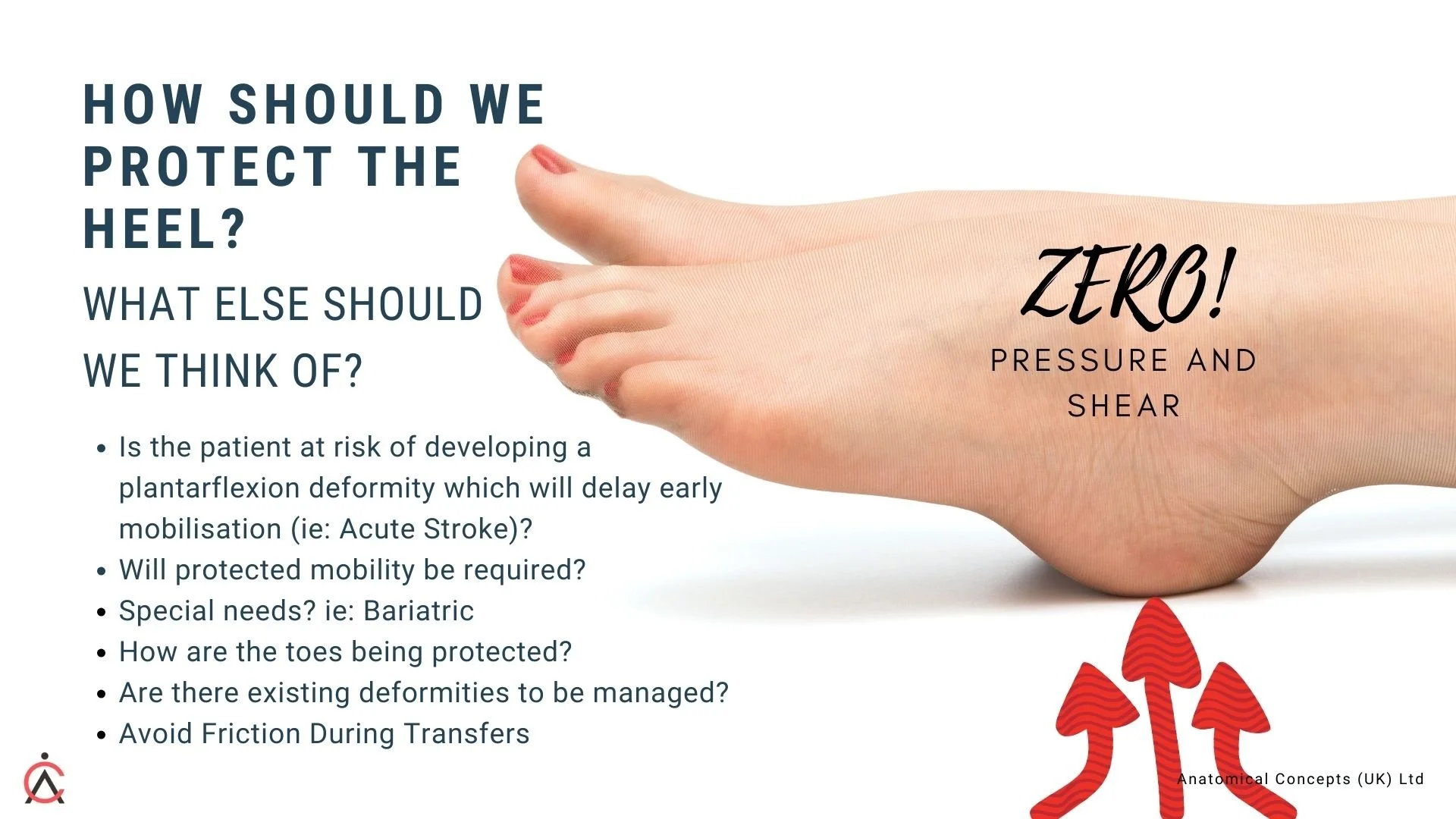
The hemiplegic leg is uniquely vulnerable.
After stroke affecting one side of the body, the leg on the affected side faces a combination of risk factors that the unaffected leg does not: The patient typically cannot move the affected leg voluntarily, or can move it only weakly. The ability to shift position, lift the heel off the mattress, or adjust posture in response to discomfort is reduced or absent.
Sensory impairment often accompanies this motor weakness. The discomfort that would prompt someone with intact sensation to move may not register. The patient doesn't feel the pressure building. In addition, many stroke survivors develop increased tone (spasticity) in the affected leg, often with plantarflexion at the ankle. This pushes the heel into the mattress with sustained force that the patient cannot voluntarily release. This can also lead to the development of a plantar flexion contracture, which is going to delay ambulation and complicate continuity of care.
When lying supine, the affected leg naturally falls into external rotation with the heel resting on the bed. Without active movement to change this, the position persists for hours. The unaffected leg can be moved, repositioned, and adjusted. The affected leg often cannot. This asymmetry means the hemiplegic heel bears disproportionate risk.
High plantarflexion tone creates particular problems.
The spasticity pattern common after stroke deserves specific attention. When muscle tone is increased in the plantarflexors (calf muscles), the ankle is pushed into a pointed-toe position. This indirectly Increases pressure at the heel as the foot is pushed downward against the mattress and creates sustained force that the patient cannot voluntarily release. If a soft and compliant heel and foot protection device is used, this will deform under the load. Far from protecting the foot, malleoli and heels will contribute to the problem.
Standard foam boots and cushioning devices are insufficient when working against significant plantarflexion tone. The force generated by spastic muscles can compress foam, deform plastic shells, and push the heel back into contact with whatever surface lies beneath.
This is one reason the PRAFO's metal upright structure matters. Metal doesn't compress under load. It maintains the heel in a floating position even when plantarflexion tone is working against it. You receive the benefit of total pressure and shear relief on the vulnerable heel area and resist the development of plantar flexion deformities. Each PRAFO also has a lateral stabilising bar that can be positioned to prevent the limb's external rotation, placing pressure on the malleoli.
Sensation loss removes the warning system.
Many stroke survivors have impaired sensation on the affected side. This varies a great deal. —some retain partial sensation, others have complete loss—but any reduction in sensory feedback affects pressure injury risk.
The warning system works like this in someone with intact sensation:
1. Pressure causes discomfort
2. Discomfort prompts movement
3. Movement relieves pressure
4. Tissue damage is prevented
When sensation is impaired, step one fails. No discomfort is perceived. No movement is prompted. Pressure continues. Tissue damage proceeds. Fundamentally, any amount of pressure applied to tissue can be destructive If applied continuously for long enough. Individuals who lack sensation lack a protective response that would normally be present.
This means stroke survivors cannot rely on how their heel feels to assess risk. A heel that feels fine—or feels nothing at all—may be experiencing damaging pressure levels. Visual inspection and proactive protection replace the sensory warning system that no longer functions.
Early mobilisation is essential—and heel injuries can prevent it.
Stroke rehabilitation emphasises early, intensive mobilisation. The evidence is clear that getting patients up, moving, and participating in therapy as soon as medically appropriate improves outcomes. Of course, there are benefits too for the service by freeing up beds and achieving earlier discharge. But a heel pressure ulcer on the affected leg directly impedes this:
There may be concerns that weight-bearing on the affected side becomes problematic when the heel is damaged. Standing practice is potentially limited when heel contact causes pain or risks wound deterioration. Inevitably gait retraining is delayed while wound management takes priority. and the patient loses valuable rehabilitation time during the critical early window.
The paradox is sharp: the immobility that increases heel pressure ulcer risk is exactly what early mobilisation aims to overcome. A heel injury sustained during the early days enforces continued immobility, creating a vicious cycle. Prevention isn't just about avoiding a wound. It's about preserving the patient's ability to participate fully in the rehabilitation that will determine their long-term recovery.
Protection must support mobilisation, not compete with it.
This is where heel protection device selection matters critically. A heel protection device that only works when the patient is in bed provides protection during rest but creates a problem during rehabilitation. When the device is removed for physiotherapy, the heel is exposed. When mobilisation begins, protection ends.
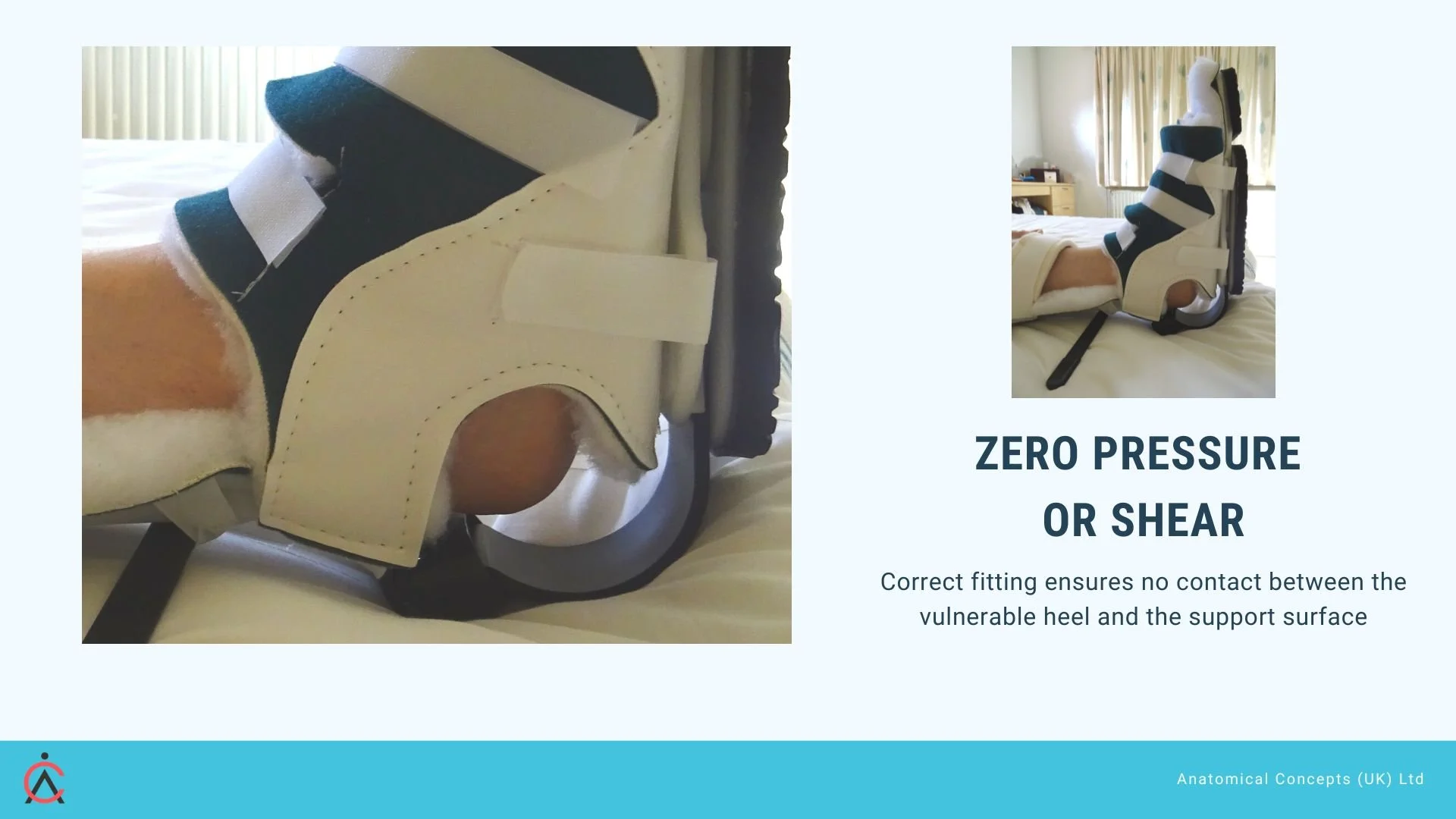
For stroke rehabilitation, the device needs to:
Protect the heel during bed rest when immobility and tone create sustained pressure creating a risk of ulceration
Remain in place during sitting when the patient begins sitting
Support standing and weight-bearing when initial transfers and gait training begin
Enable walking practice as the patient progresses
The PRAFO range achieves this through its multi-purpose design. The integrated walking base allows the same device that protects the heel in bed to support safe ambulation during rehabilitation. Protection doesn't have to stop when therapy begins.
This continuity matters because it removes a barrier to early mobilisation. The physiotherapist doesn't need to choose between protecting the heel and progressing the patient's mobility. Both can happen together.
The affected and unaffected sides need different approaches.
One underappreciated aspect of stroke care is that risk differs between sides. The affected leg—with its immobility, sensory loss, and potential spasticity—faces much higher heel pressure ulcer risk than the unaffected leg. This asymmetry should inform prevention strategy.
At minimum, the affected heel needs complete offloading during bed rest and continued protection during mobilisation activities. If high tone is present, contributing to plantar flexion forces, a device capable of resisting these forces should be used. Regular visual inspections are needed to ensure that protection is maintained (since sensation cannot be relied upon)
The unaffected leg may need standard prevention measures but typically doesn't face the same degree of risk—the patient can move it, feel it, and adjust it.
Resource allocation should reflect this asymmetry. The affected heel warrants more intensive protection than the unaffected side.
Practical recommendations for stroke rehabilitation.
Assess heel risk on admission. Every stroke patient with leg weakness or sensory impairment should be considered at risk for heel pressure ulcers on the affected side. Don't wait for skin changes to implement protection.
Implement offloading early. Fit appropriate heel protection within the first 24 hours of admission. The earlier protection begins, the more effective prevention will be. The heel area should be suspended to provide a zero pressure and shear environment.
Choose devices that support the full rehabilitation pathway. A device that must be removed for physiotherapy creates gaps in protection. Select devices that work during both rest and mobilisation.
Assess for plantarflexion tone. If spasticity is present, ensure the heel protection device can resist the forces generated. Soft foam devices may be inadequate. If the structure deforms, you can even cause ulceration under the malleoli which are in contact with the protection device. A metal structure that will not deform ensures the heel remains protected and the forces that attempt to create contractures are resisted.
Inspect the affected heel daily. Since the patient cannot feel damage occurring, visual inspection is essential. Check for any redness that doesn't resolve within 30 minutes of pressure relief.
Maintain protection through discharge. Heel vulnerability doesn't end when the patient leaves hospital. Ensure protection continues into rehabilitation units and community settings. The PRAFO designs use washable Kodel liners that can be replaced as and when necessary.
The rehabilitation window is too valuable to lose.
After stroke, time matters. The brain's capacity for reorganisation and recovery is greatest in the early weeks and months. Rehabilitation during this period shapes long-term outcomes. A heel pressure ulcer is not just a wound. It's a barrier to the rehabilitation that could change the patient's life trajectory. Prevention is always best of course. Early, continuous, appropriate heel offloading—protects more than the skin. It protects the patient's access to the intensive mobilisation that stroke recovery requires.
That's why heel protection after stroke isn't a secondary concern. It's a prerequisite for optimal rehabilitation.