
The Origins of Transcutaneous Spinal Cord Stimulation (tSCS)
Transcutaneous spinal cord stimulation (tSCS) represents one of the most promising developments in neurorehabilitation, offering a non-invasive approach to modulating spinal circuits for pain management and spasticity reduction. Other applications targeting specific functions are under research.
But where did this technology come from? Why should you care? In this article, we explore the fascinating history of tSCS and how it has evolved from early experiments with electrical stimulation to become a practical therapeutic tool, one that is now available to clinicians and patients through devices like the Stim2Go, the first European-approved device for transcutaneous spinal cord stimulation.
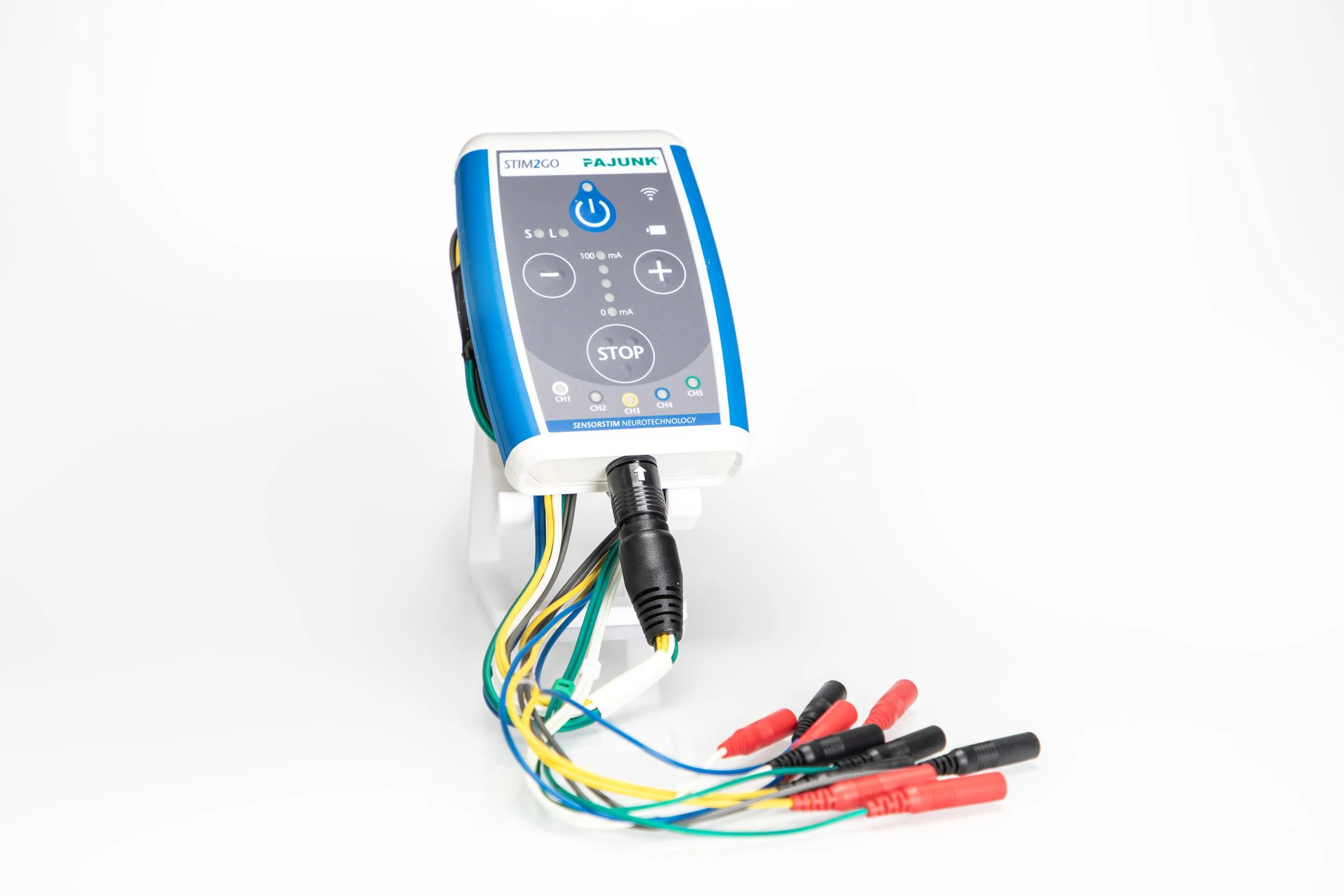
Stim2Go is a very versatile stimulation device that features several tSCS protocols for treating troublesome neuropathic pain and spasms. Stim2Go supports many other rehabilitation activities of course. For example, Stim2Go supports FES Cycling with tSCS. Your imagination limits what’s possible but there are a wide range of programme templates to start.
As we will learn in this article, these tSCS protocols perhaps seem unusual as they target the central nervous system and sensory nerve fibres rather than the peripheral nervous system. We have been surprised with the enthusiasm with which these methods have been greeted.
A Century in the Making
The story of tSCS and electrical stimulation begins not in a modern laboratory but in the 19th century, with pioneering neurologists exploring how electricity could influence the nervous system. Guillaume Duchenne, a French neurologist, systematically investigated muscle and nerve activation using surface electrical stimulation in patients with paralysis. His meticulous work laid the conceptual foundation for what would eventually become a sophisticated therapeutic approach.
The next major leap came in the 1960s with the publication of the "gate control" theory of pain by Ronald Melzack and Patrick Wall in 1965. This theory suggested that stimulating large-diameter nerve fibres could inhibit pain signals travelling to the brain, effectively "closing the gate" on painful sensations. This insight led directly to the development of invasive dorsal column stimulators for pain relief. Dr. C. Norman Shealy performed the first clinical application of spinal cord stimulation in 1967, implanting electrodes in patients suffering from cancer pain. By 1968, Medtronic had released the first commercially available spinal cord stimulation system.
These early implanted devices demonstrated something crucial: stimulating dorsal spinal structures could modulate both sensory and motor function. The door had been opened.
From Implants to Surface Electrodes
Throughout the 1970s, 1980s, and 1990s, research continued on two parallel tracks. Animal studies during this period revealed that tonic stimulation of dorsal roots and spinal networks could generate locomotor-like patterns, coordinated stepping movements, even in the absence of input from the brain. This work helped establish the concept of central pattern generators (CPGs) in the spinal cord, neural circuits capable of producing rhythmic motor outputs independently.
Simultaneously, clinical epidural SCS studies were exploring applications beyond pain relief, investigating effects on motor control and spasticity. The evidence was mounting that spinal locomotor and reflex networks could be engaged electrically to support movement after injury.
The question became: could these benefits be achieved without surgery?
The immediate precursor to modern tSCS emerged from high-voltage percutaneous and transcutaneous stimulation over the lumbosacral spine. Researchers aimed to activate peripheral motor axons and posterior root afferents through the skin. Then, in 1997, came a breakthrough: researchers demonstrated that transcutaneous stimulation over the lumbar enlargement could evoke locomotor-like activity in people with spinal cord injury. For the first time, it was clear that spinal locomotor circuitry could be accessed non-invasively.
Consolidation and Understanding
The 2000s brought greater clarity about how tSCS actually works. In 2007, Minassian and colleagues published influential work showing that single-pulse tSCS could reliably recruit posterior root afferents and produce monosynaptic reflex responses in multiple leg muscles. Their research clarified that tSCS primarily acts via dorsal root sensory fibres rather than directly stimulating motor neurons, a crucial distinction for understanding its therapeutic mechanism.
Over the following decade, researchers extended tSCS applications to cervical and thoracic levels, documenting effects on motor output, spasticity, and spinal excitability in both uninjured participants and those with spinal cord injury. The technique was maturing from a research curiosity into a genuine therapeutic approach.
How tSCS Works
Understanding the mechanism helps explain why this technology holds such promise. When electrical current is delivered through surface electrodes placed over the spine, it primarily depolarises large-diameter sensory afferents in the dorsal roots. These are the Group Ia and other large proprioceptive fibres that carry position and movement information from the muscles.
Once activated, these dorsal-root afferents synapse onto spinal interneurons and motoneuron pools, engaging complex reflex circuits, monosynaptic stretch reflexes, reciprocal inhibition, presynaptic inhibition, and recurrent inhibition. This transsynaptic recruitment modulates motoneuron excitability and the multi-segmental pattern-generating networks we mentioned earlier. The effect depends strongly on ongoing sensory inputs, voluntary drive, and stimulation parameters.
Because the current spreads over several spinal segments, tSCS can simultaneously change excitability across lumbar or cervical networks, altering both spinal reflexes and corticospinal motor evoked potentials. Research into paired-associative protocols, combining tSCS with transcranial magnetic stimulation, has demonstrated longer-lasting, plasticity-like increases in corticospinal excitability, indicating the potential for therapeutic changes in sensorimotor pathways.
For people with spinal cord injury and spasticity, tSCS protocols appear to strengthen Ia-mediated inhibitory circuits and normalise post and presynaptic inhibition in spinal networks. These changes correlate with reduced tonic stretch reflexes, spasms, and clonus.
tSCS Versus Epidural Stimulation
It's worth understanding how tSCS compares to its surgical predecessor. Epidural spinal cord stimulation (eSCS) uses surgically implanted leads placed in the epidural space, providing direct access to dorsal columns and roots. This allows more focal, segment-specific stimulation with finer control over targeting.
tSCS, by contrast, must pass current through skin, subcutaneous tissue, and bone, producing a broader, less focal electric field. This necessitates higher current amplitudes compared to the lower currents used at the cord level in epidural systems.
However, what tSCS sacrifices in precision, it gains in accessibility and safety. There is no surgery, no implant, and no risk of surgical complications. Treatment can be started early, repeated easily, and adjusted in outpatient or home-based settings. This makes tSCS attractive for screening candidates, for integration with task-specific training, FES, or robotics, and for ongoing rehabilitation where regular adjustments are needed.
Recent research suggests the two approaches may be complementary rather than competing. In direct comparisons, epidural SCS has shown stronger immediate improvements in voluntary motor control, whilst tSCS contributed more to balance and postural control. The field is increasingly viewing these technologies as tools in a combined therapeutic arsenal.
Stim2Go: Bringing tSCS to European Clinical Practice
The history of tSCS culminates in devices that make this technology accessible for practical clinical use. The Stim2Go, developed by SensorStim Neurotechnology GmbH and brought to market by Pajunk GmbH, represents a significant milestone: it is the first European-approved device for transcutaneous spinal cord stimulation.
At Anatomical Concepts, we are proud to offer the Stim2Go in the UK. This five-channel electrical stimulation system is controlled via an iOS or Android app and comes equipped with more than 30 programme templates, including specific protocols for tSCS applications targeting spasticity reduction at 33 Hz and 50 Hz frequencies, tSCS priming to establish optimal stimulation parameters, and combined tSCS with FES cycling.
The device requires a specific electrode configuration with three electrodes: for example, two placed on the abdomen and one at the T11-T12 vertebrae. The tSCS priming programme helps determine the required stimulation intensity by slowly increasing current until muscle twitches appear in the legs, the posterior root-muscle (PRM) reflex. Treatment intensity is then set at 90% of this threshold.
What makes Stim2Go particularly valuable is its versatility. Beyond tSCS, the same device supports functional electrical stimulation cycling, TENS for pain management, and neuromuscular electrical stimulation for strength training. We already have clients at home actively using tSCS as part of their ongoing rehabilitation, taking advantage of the fact that Stim2Go has been first to market with this innovative approach in Europe.

A Promising Future
The origins of tSCS span more than a century of scientific discovery, from Duchenne's surface stimulation experiments, through the gate control theory and early implanted stimulators, to animal studies revealing spinal pattern generators, and finally to today's sophisticated non-invasive devices.
Research continues to refine our understanding of optimal parameters, electrode placements, and patient selection. The main applications at present are managing pain and spasticity, with functional improvements remaining an active area of investigation. What is clear is that tSCS offers a safe, accessible means of modulating spinal circuits that can be integrated with other rehabilitation approaches.
By combining this cutting-edge technology with traditional physiotherapy, FES cycling, and other interventions, we can address complex neurological challenges more effectively. The flexibility of Stim2Go's platform allows customisation based on individual patient progress, enabling a truly patient-centred approach to therapy.
If you are interested in exploring how tSCS might benefit your patients or your own rehabilitation, we would be pleased to discuss the options and arrange a demonstration.
Related articles
https://www.anatomicalconcepts.com/articles/stim2go-and-support-for-transcutaneous-spinal-cord-stimulation https://www.anatomicalconcepts.com/articles/combining-tscs-with-fes-cycling-whats-the-benefit
https://www.anatomicalconcepts.com/articles/stim2gos-body-aware-technology-is-changing-therapy
https://www.anatomicalconcepts.com/articles/fes-cycling-revisited
Stim2Go is brought to market by Pajunk GmbH and designed by SensorStim Neurotechnology GmbH in Berlin. Anatomical Concepts are UK dealers.