
When a Soft Heel Boot Is Not Enough: How Heel Protection Escalates in the NHS
In 1994, I was visiting the Cleveland Clinic and saw a product design I came to know as the PRAFO (pressure relief ankle-foot orthosis). I recognised this as a practical orthosis being used to reduce the risk of heel pressure ulcers developing in at-risk patients following orthopaedic procedures. It's true that I liked the concept so much that we created a company, Anatomical Concepts (UK), to bring the products to the UK. Thirty years have now gone by, and we still deal with the PRAFO range. We still see the challenge that heel pressure ulcers present to affected individuals and our healthcare systems. For decades, we've emphasised prevention, yet acquired ulcers remain a widespread problem. We have some understanding of the mechanical and medical factors that heighten risk and lead to pressure ulcers, but something is missing.
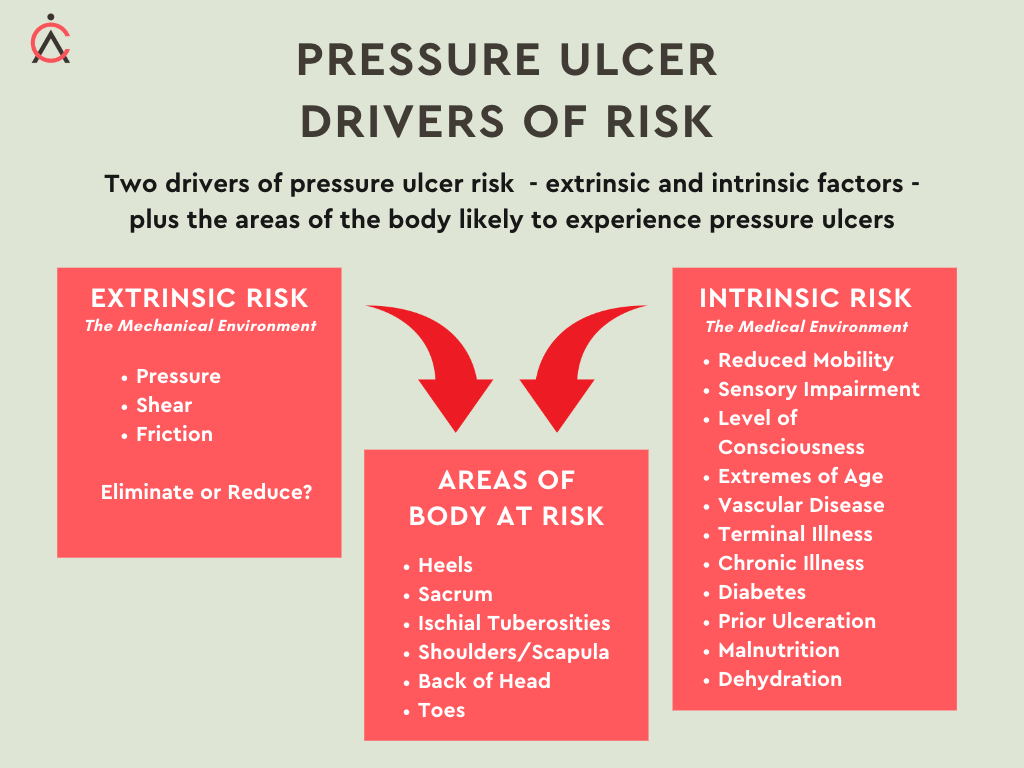
Mechanical and Medical influences on Pressure Ulcer Risk
There is a conversation I have had many times over the years, usually with a tissue viability nurse and usually after the event. A ward did all "the right things". Risk was assessed, heel protection was applied, the care plan was documented but a patient still developed a heel pressure ulcer, sometimes with the protective device sitting right there on the leg.
The instinct is to ask what went wrong with the care. I remember at times in the USA that developing a pressure ulcer was seen very much as a failure of care and would often cause insurance companies to avoid providing payment in such cases.
In my experience, the more useful question is different: was the device in place still the right device for that particular patient on that particular day?
Heel protection is not one decision made once. It is a pathway with an escalation step built into it, and the escalation step is the part I find is least well known.
This article is about that step: what national and international guidance now expects, what the evidence does and does not support, and how heel protection actually reaches a patient inside an NHS hospital.
What best practice now asks for: a floating heel

The 4th edition of the International Pressure Injury Guideline, published by the European and American pressure injury panels in September 2025, gives heels their own chapter for the first time. Its core expectation is simple. For a person at risk, the heel should be elevated so that it is fully free of the support surface, with the weight of the leg carried along the calf. Clinicians increasingly call this a "floating heel": nothing in contact with the posterior heel at all. At Anatomical Concepts, we have advocated this for a long time because it is the only way that anyone could guarantee that the mechanical factors that can lead to pressure ulcers are eliminated.
That is a more demanding standard than much of what we have seen in the UK over the years. Thirty years ago I would typically see foam boots, rolled-up towels, and even balloons fixed to heels. I'm sure standards have improved somewhat, but I can't promise that we would see floating heels being used in every hospital.
NICE guidance on pressure ulcers (CG179), which dates from 2014, asks clinicians to discuss "a strategy to offload heel pressure" with people at high risk. It names no method and sets no target position.
The 2025 international guideline fills in what that conversation should actually contain: how to position the limb, how to verify the heel is truly clear, and what to reconsider when it is not. Scotland's own framework, the Healthcare Improvement Scotland standards on pressure ulcer prevention from October 2020, sets out organisational expectations, risk assessment on admission, regular reassessment, and a person-centred plan; the international guideline now supplies the heel-specific detail that sits comfortably inside them.
KEY POINT: The standard of care for an at-risk heel is now described, internationally, as a heel fully free of the support surface. Elevation that leaves partial contact, or padding that softens contact without removing it, does not meet that description. The practical test is a hand passed beneath the heel: if you cannot do it, the heel is not floating.
What soft heel protection does well
I want to be clear about something before going further. The soft heel protection boots stocked on NHS wards are, for most patients, a perfectly good answer. They are quick to apply, comfortable enough for many people to tolerate, familiar to staff, and available at the bedside without a referral. The international guideline is equally pragmatic: where a heel offloading device is not available or not appropriate, well-placed pillows under the calf are the recommended fallback, and for many patients they do the job.
The guideline also draws some firm lines. Improvised methods, such as a fluid bag under the heel, are explicitly not recommended, and sheepskins are not to be relied on alone, because they soften contact rather than remove it. No device removes the need for repositioning and skin inspection: a heel device should come off at least twice daily for a skin check, more often where there is oedema, diabetic foot disease, arterial disease or absent sensation.
So the question is not whether soft devices work. It is which patients sit outside what they were designed to do.
Do heel boots actually prevent pressure ulcers?
Here I want to be candid about the evidence, because the clinicians I respect most will check it anyway.
The international guideline's recommendation to use a heel offloading device is conditional. Its published PDF grades the supporting evidence as low certainty, while the guideline's web page lists the same recommendation as very low certainty.. The pooled analysis behind it shows a striking effect: taking each heel as the unit of analysis, pressure injuries occurred in 0.4% of heels with an offloading device against 8.4% with pillows. But the same evidence table also reports the analysis by individual patient: 0.5% against 4.1% (risk ratio 0.13, 95% confidence interval 0.02 to 0.99), a smaller effect whose interval only just excludes no difference. The guideline's text calls it non-significant; the trial's own authors reported a significant reduction. Quoting the first figure without the second overstates the case.
There is a further detail, buried in a footnote, that I think is the most important sentence in the chapter: both trials in that pooled analysis used the same device, a soft offloading boot, tested against pillows in intensive care. The largest of them, by Barakat-Johnson and colleagues in 2022, randomised 394 Australian ICU patients and recorded one heel injury with the boot against eleven with pillows. That is a genuinely useful result. But it is evidence about one soft boot against pillows in one setting. It is not evidence about heel devices as a class; it says nothing about one device design against another, and it contains nothing at all about orthoses of the kind I work with.
As my original background was engineering, I have good knowledge of the mechanical factors such as pressure and shear that are part of the drivers for pressure ulcers. Therefore, in my mind, the case for devices that utilise the floating heel concept is hard to argue against. If indeed, pressure and shear are important factors in the development of pressure ulcers, then eliminating pressure and shear from that area must be effective. Of course, medical risk factors remain, so it is still possible for heel ulcers to develop even when the floating heel concept is adopted. No mechanical device can deal with this.
No trial has compared a rigid heel suspension orthosis against a soft boot. That should change soon: WHiTE14: PRESSURE 3, a three-arm NHS trial of around 3,100 hip fracture patients across 30 sites, is comparing standard care, constant low-pressure devices and offloading devices, with results anticipated during 2026. When it reports, I will update this article.
KEY POINT: The evidence for heel offloading devices rests on two trials of a single soft boot against pillows, graded by the guideline itself as conditional, with low or very low certainty depending on whether you read its PDF or its web page. No published trial compares rigid against soft devices. What follows from that is not scepticism about offloading; it is that device selection has to run on clinical reasoning about the individual patient, applied to a mechanism nobody disputes: a heel that touches nothing cannot experience load.
The patients in whom standard devices struggle
Research into how these devices behave in real wards, notably the realist evaluation by Greenwood and colleagues across the UK in 2023, found that tissue viability specialists use them everywhere but regard no single device as right for every patient at every point. My own experience says the difficulties cluster in a recognisable group:
High muscle tone. After a stroke or brain injury, plantarflexion tone can drive the foot down and the limb into rotation for hours at a time. A soft device can be pushed out of position by exactly the forces it is supposed to protect against.
Absent or impaired sensation. After spinal cord injury, or with advanced neuropathy, the patient cannot feel a device that has migrated, creased or begun to rub, so the failure goes unreported.
Agitation and delirium. A device that depends on staying neatly placed struggles with a patient who does not stay neatly placed. The guideline itself flags restlessness and the limited evidence in agitated and cognitively impaired people as live issues.
External rotation and unusual limb geometry. The guideline's implementation notes ask for devices that hold foot alignment and control external rotation. Oedema, contracture and fixed deformity all defeat a one-size-fits-most solution.
Weight-bearing and mobility. Prolonged bed rest is never desirable, and whenever possible patients should be mobilised. The moment a patient stands, an in-bed device is likely to be doing a job it was never designed for.
None of this is a criticism of soft boots. It is a description of the boundary of their design brief.
Who actually provides heel protection: the four routes
Ask who supplies heel protection in an NHS hospital, and you will get different answers, because four routes run in parallel. NHS Greater Glasgow and Clyde's adult inpatient guideline on heel pressure redistribution, the most explicit board-level document I know of, sets them out, and the pattern is typical of UK practice:
Ward stock. Every ward holds a supply of standard redistribution devices in a range of sizes, applied by ward staff trained to fit them. This is first-line protection, available immediately.
Tissue viability. All hospital-acquired damage at grade 2 or above is referred to the tissue viability service, which confirms grading and steers the response.
Orthotics. Where the standard device is not suitable for the individual, or the skin deteriorates despite a suitable device being properly used, the guideline directs a referral to the orthotic service for an assessed, fitted device.
Podiatry. Damage arriving with the patient at or below the malleolus goes to podiatry, which matters particularly for the diabetic foot.
The same Glasgow guideline contains a sentence that any manufacturer writing on this subject has a duty to meet head-on: it states that there is no robust evidence for any one specific pressure redistributing device. On the trial evidence reviewed above, that is correct, and it applies to every product on the market, including ours. What the pathway sensibly recognises is that the absence of a "winning" device is precisely why an escalation route to individual assessment exists.
The three triggers for an orthotics referral
Put plainly, the escalation moment arrives when any of three things is true:
the standard device is not suitable for this patient's limb, tone or behaviour;
the skin is deteriorating despite a suitable device correctly applied; or
the patient is going to bear weight. The Glasgow guideline is explicit that in-bed heel devices are not for use in weight-bearing "unless specifically assessed by an orthotist", and that redistribution for walking needs an orthotics referral.
That third trigger is the one I see missed most often, because it arrives disguised as good news: the patient is progressing, physiotherapy has begun, and the heel protection quietly comes off at exactly the moment the demands on the heel change.
For tissue viability teams, there is one audit question that surfaces all of this better than anything else I know: of last year's hospital-acquired heel injuries, how many patients already had a redistribution device in place when the damage occurred? If the answer is more than a few, the ward-stock tier is not failing; the escalation step is being reached too late or not at all.
KEY POINT: Escalation to an orthotist is not an admission that first-line care failed. It is the pathway working as designed: the standard device serves the standard patient, and assessment exists for the patient whose tone, sensation, limb shape or mobility has moved beyond the standard case.
Where an orthotist-fitted device fits
This is the point at which a relatively rigid, adjustable ankle-foot orthosis of the PRAFO type enters the picture, and I want to describe its role accurately.
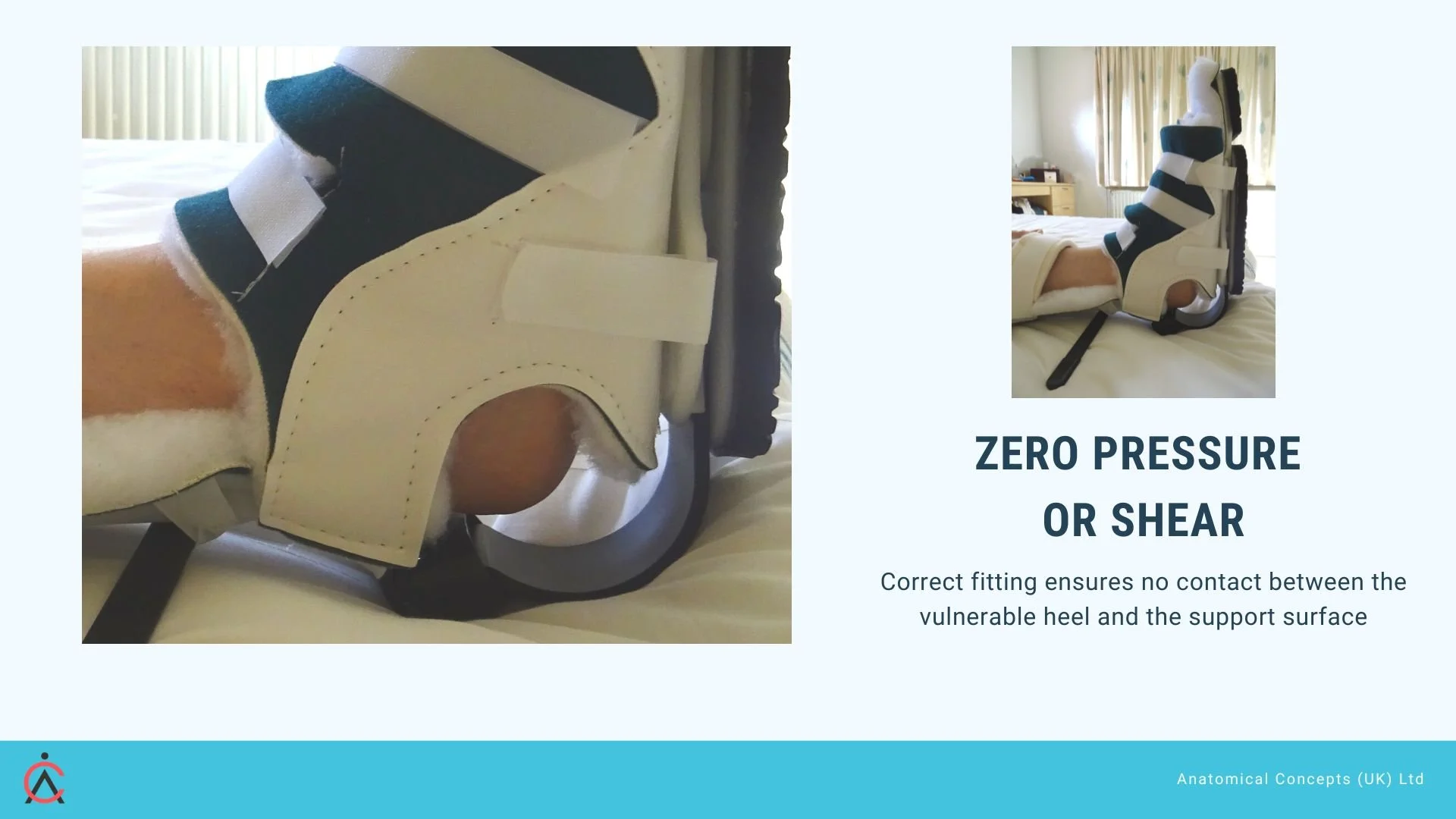
A PRAFO heel suspension orthosis is built to hold the offloaded position rather than merely to create it: a frame that suspends the heel completely while carrying load along the calf, holds the foot near plantigrade against tone, controls external rotation, and can be adjusted by the clinician to an individual limb, including one that is swollen, contracted or changing week by week. All PRAFO designs include a walking base, so protection does not have to be removed when standing practice begins; whether walking in one is appropriate for a given patient is exactly the assessment the orthotist is there to make. All the PRAFO designs use a metal upright structure which resists the forces generated by high tone or by gait in an appropriate way.
These are the properties the international guideline's implementation notes ask clinicians to look for in the harder cases. What I cannot tell you is that a trial shows this class of device outperforms a soft boot, because no such trial exists. What I can tell you, from more than three decades of supplying and supporting these devices, is the mechanism and the reasoning: patients whose tone or behaviour displaces a soft device need protection that does not depend on staying put by goodwill.
What I would suggest
If you are a clinician thinking about your own unit, three things are worth doing with your team this month. First, run the audit question: how many hospital-acquired heel injuries last year already had a device in place? Second, walk the pathway: does every ward know the three triggers for an orthotics referral, and how to make one? Third, check the standard against the hand test: are at-risk heels actually floating, or elevated and still touching?
Anatomical Concepts (UK) supplies the PRAFO range and has done so since the early days of the product. Where we can help is assessment: if you have patients in whom standard devices are failing, we are glad to talk through whether an orthotist-fitted device is worth considering, and to support your orthotic service with sizing, fitting and adjustment. Of course, where other clinicians such as podiatrists or physiotherapists are dealing with these problems, we can train them to be comfortable with all aspects of the PRAFO and help to choose the most suitable product from the range.
Decisions about any individual patient belong with the clinical team and the clinicians who assess them; nothing here replaces that.
And if you simply want to compare notes on heel protection pathways, evidence or product design, I am always pleased to have that conversation. You can reach us through the contact page.
Further reading
Haesler E (ed). Prevention and Treatment of Pressure Ulcers/Injuries: Clinical Practice Guideline. The International Guideline, 4th edition. EPUAP, NPIAP, PPPIA; 2025. https://internationalguideline.com
Barakat-Johnson M, Lai M, Stephenson J, et al. Efficacy of a heel offloading boot in reducing heel pressure injuries in patients in Australian intensive care units: a single-blinded randomised controlled trial. Intensive and Critical Care Nursing. 2022;70:103205. https://doi.org/10.1016/j.iccn.2022.103205
Greenwood C, Nixon J, Nelson EA, McGinnis E, Randell R. Offloading devices for the prevention of heel pressure ulcers: a realist evaluation. International Journal of Nursing Studies. 2023;141:104479. https://doi.org/10.1016/j.ijnurstu.2023.104479
Greenwood C, Nelson EA, Nixon J, Vargas-Palacios A, McGinnis E. Comparative effectiveness of heel-specific medical devices for the prevention of heel pressure ulcers: a systematic review. Journal of Tissue Viability. 2022;31(4):579-592. https://doi.org/10.1016/j.jtv.2022.09.009
Costa ML, Greenwood C, Nixon J. Preventing pressure sores after hip fracture. Bone and Joint Journal. 2025;107-B(2):135-138. https://doi.org/10.1302/0301-620X.107B2.BJJ-2024-0635.R1
National Institute for Health and Care Excellence. Pressure ulcers: prevention and management. Clinical guideline CG179; 2014. https://www.nice.org.uk/guidance/cg179