We understand that committing to FES Cycling is more than just a financial investment. It is a commitment to long-term health and wellbeing which may require learning, additional support and/or adjustment to a daily routine. FES Cycling is not something you will do only for a few months but for many years, and you need to feel confident that the system is right for you and what you want to achieve.
Thinking of Investing in an FES Cycling system?
We’re all different. Some people like approaching companies and getting lots of information, and asking questions, and don’t mind (or even enjoy) ‘a sales pitch’. Other people prefer to gather information at their own pace, consider carefully and discuss without any pressure or email funnels! Even if you have already reached out to us or another provider, or perhaps even had a demo, it’s normal to have questions.
We decided to run these short introductory webinars to allow for a bit of both. We’re running both afternoon and evening sessions that will hopefully allow you (or any family / friends / support staff) to attend when they are available too.
Below you’ll find a table with the next available dates, but you can see our full listing of webinars here.
What we’ll cover.
In the webinar we will have a short presentation to go over:
The science behind Functional Electrical Stimulation & suitability criteria
The benefits and/or potential outcomes of using FES as part of your rehab or long term health maintenance
Information and comparison of devices available on the market
Costs of RehaMove systems
Our approach to FES Cycling
Things you might want to consider before making an investment
And then there will be plenty of time to ask your own questions!
The Q&A box will be open throughout and we’ll spend time to make sure all questions are covered. You can request to be unmuted if you’d prefer to verbalise your question.
Cameras will be turned off and you will only see the speaker and the presentation.
Sessions will not be recorded.
Although we need some details to send you a link, you won’t be added to a mailing list and you’ll only get one follow up email from Zoom with our direct contact details and next steps if you want to reach out.
Not ready yet?
Absolutely fine. Here are a few links to other articles that might be helpful. Don’t forget to browse the product pages and read through the Q&A there too. Feel free to Reach Out at any stage if you have questions. We’re here when you need us!

We first started to work with FES cycling around 17 or 18 years ago now. We were told that many people with MS would be our clients. Actually that hasn't been the case, largely because the cost of most FES cycling systems were unaffordable. We couldn't help them. As we've started to work with the Stim2Go, we've found many more of our clients now have MS. They've been able to use the Stim2go for FES cycling and much more.
Most people with MS who own a motorised passive-active bike did not start out with one. They started with an ordinary exercise bike, and at some point it stopped being usable. They could no longer get on the upright one. The standard bike became unusable because they could not generate enough momentum. Their feet would not stay on the pedals, or a heel kept catching the frame, or tone made the whole thing impossible. A MOTOmed or a THERA-Trainer, with a motor that moves the legs when they will not move on their own, was the answer to that problem, and for many people, it has been a good one.
The question this article answers is whether the electrical stimulation you may have seen on a bike in a rehabilitation gym can be added to the bike you already have at home, and whether it is worth it. The Stim2Go, a very flexible yet powerful stimulator, is not tied to any bike. Let's look at what the evidence supports.

Many people have a motorised passive-active bike at home. They use it for a year or two, usually a MOTOmed or a THERA-Trainer, and they use it most days. Their legs go round. The question is whether their legs are getting anything from it beyond going round, and whether the electrical stimulation they saw on the bike in the spinal unit gym could ever come home.
Passive cycling does beneficial things, and adding synchronised electrical stimulation provides a measurable step on top. And the part that has changed recently is that the stimulator no longer has to arrive bolted to a new bike. For many years, we worked with the RehaMove system, which integrated an 8-channel stimulator with a version of the MOTOmed bike. We were always aware that the total cost of the system meant that many people could not adopt it. And as the stimulator needed to communicate directly by cable with the bike, we were restricted to one or two models of MOTOmed. Why should they give up the bike that they were already using and replace it with one that happened to support FES cycling?
Things have changed now with the arrival of Stim2Go. The bike you already own, whatever the make, is the awkward part of an FES cycling system, and you already have it. Let's see whether adding Stim2Go would be worth it.
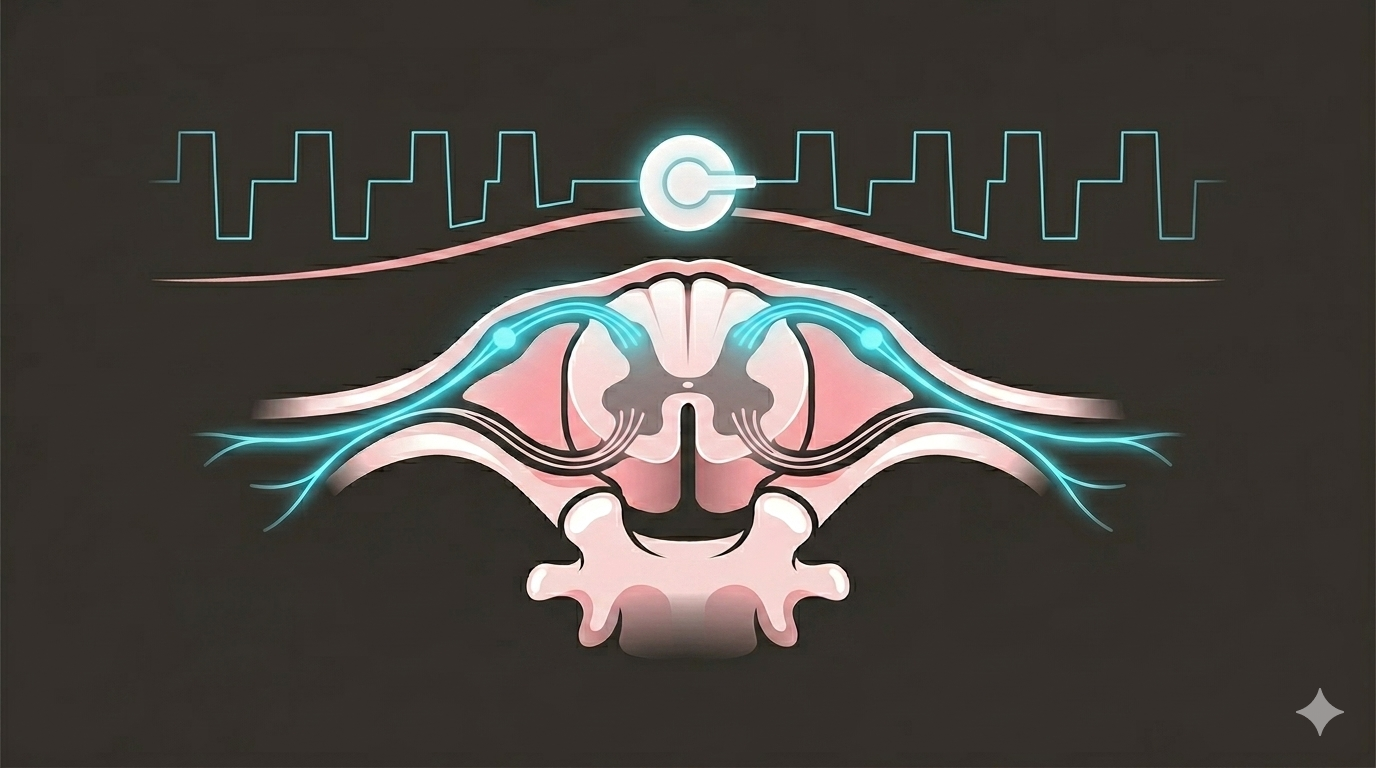
Stim2Go from Pajunk is proving a very popular system for electrical stimulation due to its flexibility. In addition to supporting FES Cycling, it boasts many novel applications and the ability to create custom applications. Amongst its programs, there have been a number of transcutaneous spinal cord stimulation (tSCS) applications. Up until now, these were typically utilised to target severe spasms or pain.
We're getting to grips with some new cervical tSCS programs and two combined cervical-lumbar tSCS programs. These place one electrode on the neck and another on the lower back, and run both in the same 20-minute session. It is in beta testing, available under European and UK medical device rules only, and not cleared in the United States. I want to walk through the idea behind this configuration and what the human evidence shows.

Over roughly 250 years, therapeutic electrical stimulation has jumped to a new level perhaps seven times, and each jump was made possible by a new technological development. It might have been a way of handling current, storing it, generating it, shaping it, measuring it, timing it, or using it to tune the nervous system rather than drive it, and finally today triggering it from the person's own movement or intention. These are the stages I allude to in the title.
The first stimulator I worked with, as a PhD student in the late 1970s, filled a good part of a laboratory bench and needed someone who understood it standing beside it. The Stim2Go electrical stimulation device I carry to homes or clinics now is the size of my hand. It can be strapped to a client's thigh, senses when they start to move, and is set up from an app on my phone. Both deliver a pulse of current to a nerve. Almost everything else about them has changed.

When I demonstrate an FES cycling system, spasticity is usually in the room before I have finished setting up. A leg that will not settle onto the pedal. A knee that pushes out straight at the wrong moment. A foot that starts bouncing the instant it takes any weight. The person in the chair rarely calls it spasticity. They say their legs have a mind of their own, or that everything goes rigid when they transfer, or that the spasms wake them at three in the morning. The clinical word comes later, if it comes at all.
This article is for the person who has just been introduced to that word, or who has lived with the thing itself for years without anyone quite explaining it. I want to cover what spasticity and spasms actually are, why they happen after a spinal cord injury, a stroke or with multiple sclerosis, what they do to daily life, and what genuinely helps, from medication through to electrical stimulation. I will try to be clear about what the evidence shows and what it does not; if different people have told you contradictory things, that is partly because the field itself contains genuine uncertainty.

After a neurological injury, whether a spinal cord injury, a peripheral nerve injury, or a period of enforced immobility, clients often ask: "Will electrical stimulation bring the muscle back?"
I have learned to pause before answering, because "back" hides two quite different questions. The first is about size: will the muscle get bigger again? Obviously, this is what people notice when they look down at their legs. The second is about substance: will the tissue that returns actually be muscle, in the working sense of the word, rather than a mixture of shrunken fibres, fat and scar? This is less obvious to a client, but it's what we actually need. Researchers call this second property muscle quality, and it is the more important of the two. It is also the one that almost nobody explains to patients.
In this article, I want to walk through what muscle quality means, how it is measured, what happens to it after injury, and what electrical stimulation has been shown to do about it. I will cover both of the situations we work with: innervated muscle, where the nerve supply is intact and conventional stimulation applies, and denervated muscle, where the nerve supply has been lost and an entirely different approach is needed. The evidence differs between the two, and so do the limits of what is possible, and I will be plain about both.
One of the quieter worries in rehabilitation is rarely about the therapy itself. It is about money. Equipment is expensive, budgets are tight, and funding is often uncertain until late in the process. The fear we hear most is not "will this work," but rather "will I spend a significant sum and end up with the wrong thing, or with several things that do not work well together." Does this sound familiar?
It is a reasonable worry, and it deserves a straight answer rather than a sales pitch. This article looks at one practical way of reducing that risk: choosing a single, flexible stimulator that covers several rehabilitation needs, rather than a separate machine for each. The device we have in mind is the Stim2Go, and the point is not so much the brand as the principle behind it.
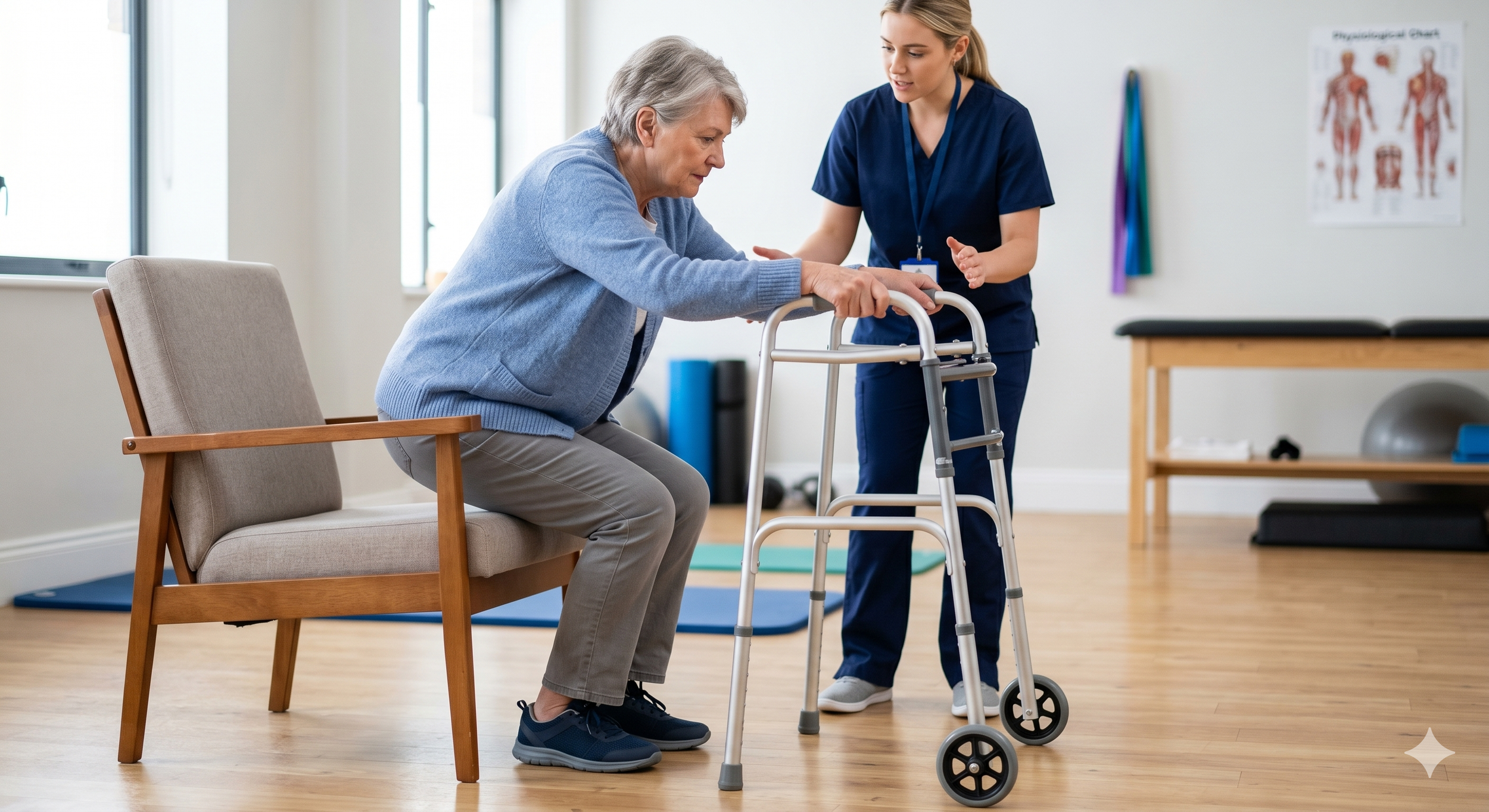
Ask someone in the early stages of recovery from a spinal cord injury or stroke what they most want to do again, and the answers are often smaller and more specific than you might expect. Not "run a marathon." More often, it is something like rising from a chair without help, managing a transfer to the bed, or pushing up to standing so that getting to the toilet is your own business and nobody else's.
Sit-to-stand sits at the centre of all of that. It is one of the most important movements in daily life and one of the first functional milestones a therapist will work on. If you can move reliably between sitting and standing, a great deal of independence follows. This article looks at how electrical stimulation, and in particular a responsive electrical stimulation device like the Stim2Go, can support sit-to-stand practice as part of a wider rehabilitation programme.