
Stim2Go from Pajunk is proving a very popular system for electrical stimulation due to its flexibility. In addition to supporting FES Cycling, it boasts many novel applications and the ability to create custom applications. Amongst its programs, there have been a number of transcutaneous spinal cord stimulation (tSCS) applications. Up until now, these were typically utilised to target severe spasms or pain.
We're getting to grips with some new cervical tSCS programs and two combined cervical-lumbar tSCS programs. These place one electrode on the neck and another on the lower back, and run both in the same 20-minute session. It is in beta testing, available under European and UK medical device rules only, and not cleared in the United States. I want to walk through the idea behind this configuration and what the human evidence shows.
What "two levels at once" actually means
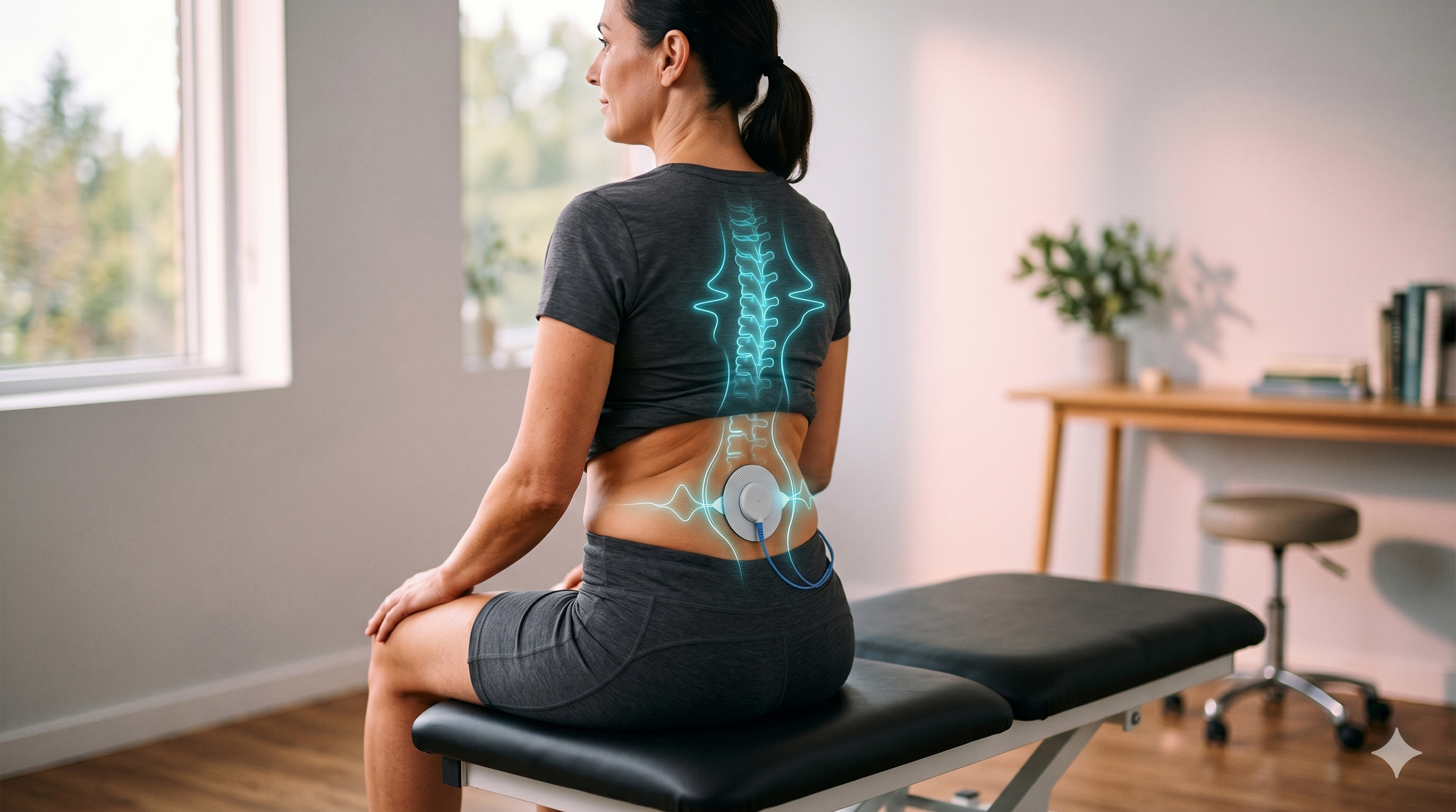
tSCS delivers current through skin electrodes over the spine. At the right intensity, it excites large sensory nerve fibres where they enter the cord, and those fibres wake up the movement circuits at that level. Our introduction for non-clinicians covers the basics.
The two-level programme uses a small oval electrode over the fifth cervical vertebra, roughly the base of the neck, and a larger rectangular electrode over the junction of the eleventh and twelfth thoracic vertebrae, just above the small of the back. Both return their current to a pair of large electrodes over the hip bones. The settings on both channels are identical: one-millisecond biphasic pulses with no kilohertz carrier, at 33 Hz in one version and 50 Hz in the other.
Three details are worth knowing. The neck electrode is less than half the area of the lumbar one, so at the same current it carries more than twice the current density at the (potentially) less comfortable site. Each channel needs its own intensity, set against that person's reflex threshold, rather than matched numbers. And "at the same time" does not mean simultaneous pulses: the Stim2Go has a single current source, so the channels fire in turn, 10 milliseconds apart at 50 Hz. The return electrodes therefore never carry both channels' current at once.
Why anyone thought the neck and the lower back should talk to each other
Watch someone walk, and their arms swing in time with their legs. That coordination is not organised in the brain alone: long fibres inside the spinal cord, the propriospinal pathways, connect the arm circuits with the leg circuits. The stimulation research followed that anatomy. In 2015, Yury Gerasimenko's group stimulated the neck, the lower thoracic spine and the upper lumbar spine in six people without injury, with their legs supported in a frame that removed gravity. The thoracic site alone produced stepping-like movements. Adding the other two sites improved the stepping in five of the six, and switching them off again degraded it.
Two studies from Vivian Mushahwar's laboratory in Alberta clarified the picture. In 2020, Trevor Barss and colleagues found that stimulating the neck alone reduced a leg reflex by about 23 per cent, while the lower back did not. The neck reaches the leg circuits, but the effect was inhibitory. In 2021, Behdad Parhizi and colleagues tested the neck, the lower back, and both together in 14 people without injury. The lower back raised a forearm reflex by 11 per cent, the neck alone did nothing, and both together raised it by nearly 20 per cent. A measure of the pathway from brain to hand moved only when both sites were on.
KEY POINT: The neck and the lower back are connected inside the spinal cord, and driving both at once changes what the cord does in ways that one site does not. But the change is not always facilitation, and every one of these measurements comes from intact spinal cords.
What the human evidence shows
I sort the evidence into three tiers: shown in people with spinal cord injury, indirect support, and reasonable guess.
Shown in people with spinal cord injury. Two studies. In 2022 Soshi Samejima and colleagues reported on two men with long-standing incomplete cervical injuries who did two months of intensive walking training, then two months of the same training with stimulation at the neck and lower spine. Walking distance improved three times as much in the stimulation phase. Two people, no sham, and the phases always ran in the same order. In 2023 Hatice Kumru's group in Spain randomised 11 people with cervical injuries to breathing-muscle training with or without stimulation at the upper neck and mid-thoracic spine. Breathing pressures and lung capacity improved with stimulation and not with training alone. It is a real two-level protocol, though at different levels from the Pajunk programme, and breathing is not among its stated uses.
Indirect support. Neck stimulation on its own has a good record for the hand: Parag Gad's group reported grip force roughly tripling during stimulation after eight sessions, Fatma Inanici's group reported gains in six people that held for months after stimulation stopped, and the 60-person ARC-EX trial published in 2024 found 72 percent of participants exceeded the minimum important difference for strength and function. Trunk control has its own evidence, all from lumbar sites: Mrinal Rath's group cut seated sway from 4.7 to 1.4 millimetres in eight people with lumbosacral stimulation alone. And in 2023, Claudia Angeli and Gerasimenko found that adding neck stimulation in four people with lumbar implants reduced the implant's evoked responses yet improved stepping. Levels do not simply add.
Reasonable guess. That one 20-minute session at two levels does as much as two separate sessions, but I believe no study has compared them. I expect neck stimulation reduces arm spasticity, but perhaps it has never been tested as a primary outcome.
33 Hz or 50 Hz which to choose
Why two versions? The published work splits along goal lines rather than proving one frequency to be better. Around 30 Hz is the setting used to facilitate movement. Karen Minassian's group used it to engage the rhythm-generating circuits during robotic stepping in 2016, and Kumru's breathing study used it too. 50 Hz is the Vienna setting for spasticity. Ursula Hofstoetter's group showed in 2020 that a single 30-minute session of 50 Hz lumbar stimulation reduced spasticity for at least two hours, with the word "temporary" in the paper's title, and the group's 2024 mechanism paper attributes the effect to a short-lived strengthening of the cord's own inhibitory circuits.
So 33 Hz belongs to the facilitation family and 50 Hz to the spasticity family. I found no human study comparing the two head-to-head. Pick the version that matches the goal and hold it long enough to judge. Our previous article on treatment duration and carryover covers how long each family's effects last.
The waveform question at the neck
In May this year I wrote about a paper from Rodolfo Keesey, Hofstoetter and colleagues showing that the kilohertz carrier waveforms in some newer devices recruit fewer of the sensory fibres that drive lasting change, and that the problem is worst at the neck. The Pajunk programme uses the conventional one-millisecond pulse with no carrier, the waveform that paper supports.
There is a nuance in the same paper because its abstract states that lumbar stimulation preferentially recruits sensory fibres, whereas cervical stimulation favours motor fibres, regardless of the waveform used. The conventional waveform is the right choice at both levels, but it does not make the neck channel behave like the lumbar one. The case for the upper electrode is weaker than my earlier article implied.
KEY POINT: The conventional waveform is the right choice at both sites. At the neck, it still recruits a higher share of motor fibres, so the lasting, plasticity-driven gains the lumbar channel is built on cannot simply be assumed for the cervical channel.
Three reasons to go carefully
None of these says "do not try it". All three say measure, and screen.
Autonomic dysreflexia. In 2024 Ryan Solinsky's group studied two people with complete injuries high in the thoracic spine. At baseline, a painful cold-water test provoked no dysreflexia in either. With sub-motor spinal stimulation added, a dysreflexic blood pressure response appeared in every trial. Larger series seem to point the other way and Goutam Singh's group ran neck and thoracic stimulation in seven children without a single episode, and the ARC-EX trial reported no serious device-related events in 60 people. But for anyone with an injury at or above the sixth thoracic level, blood pressure monitoring in the early sessions and a dysreflexia plan should be considered.
Spasticity can go the wrong way. In 2025 Evan Sandler and Edelle Field-Fote's group tested several stimulation arrangements for calf spasticity after spinal cord injury. There was no reduction at the group level, and in people whose spasticity was mild to begin with, the dual-site continuous setting made it measurably worse. That is the closest published warning for a two-site programme: measure spasticity before and after rather than assuming which way it will go.
The one sham-controlled trial missed. The first randomised, sham-controlled trial of this stimulation family for spasticity, by Eira Lotta Spieker and colleagues in 2025, used 50 Hz lumbar stimulation in progressive multiple sclerosis and did not reach significance on its primary spasticity score. The authors include a co-founder of SensorStim, the company that designed the Stim2Go. The most rigorous trial to date came from the group closest to the device. Our plain English guide to spasticity and spasms sets that result in context.
KEY POINT: The two-level programme has a genuine physiological basis and a thin clinical record. The three cautions do not close the door. They imply baseline measures first, blood pressure checks for anyone with a high lesion, and no assumption about which way spasticity will move.
Where it might fit
I would frame these as questions for an assessment rather than as indications. A person with a cervical injury who has both a hand training goal and a standing or stepping goal, and who would otherwise be choosing one. Someone working on sitting balance, bearing in mind that the trunk evidence comes from the lumbar channel. Someone combining stimulation with arm-and-leg cycling, where the same neck-to-leg connections are the whole rationale, as our article on combining tSCS with FES cycling discusses.
How does this compare with the ARC-EX, the cervical-only device cleared in the United States in 2024? That device has a 60-person multicentre trial behind it for arm and hand function, and nothing on the Stim2Go matches that depth for the neck alone. The Stim2Go offers breadth, home use, a lumbar waveform rationale and a lower cost, and the two-level programme extends the breadth. Different propositions, not a contest.
A word for readers with multiple sclerosis. Implanted spinal stimulation was tried in MS as early as 1973, and largely abandoned. The modern transcutaneous work in MS amounts to four small lumbar studies in around 50 people, and the one with a sham control is the Spieker trial above. Nobody has stimulated the neck in MS. It is tempting to think that because MS lesions are often in the neck, two levels cover more of the affected cord. The stimulation acts on the sensory roots under the electrode, not on the lesion, and cervical cord shrinkage in MS is common and tracks disability, so there may be less to recruit there. The defensible reason to try two levels in MS is scope, an arm goal alongside a leg goal, under supervision, with measures before and after, heat sensitivity managed, and the knowledge that in some people no reflex threshold can be found.
Beyond beta test
What we do at Anatomical Concepts is apply electrical stimulation. We look at whether the Stim2Go (and a beta programme like this one) fits the person in front of us, what it would sit alongside, and how the effect will be measured. Our role is to keep the equipment conversation grounded in what the evidence supports and open about what it does not. If you would like to talk it through, for yourself, a client or a service, I am happy to have that conversation.
Further reading
Parhizi B, Barss TS, Mushahwar VK. Simultaneous cervical and lumbar spinal cord stimulation induces facilitation of both spinal and corticospinal circuitry in humans. Frontiers in Neuroscience 2021;15:615103. https://doi.org/10.3389/fnins.2021.615103
Gerasimenko Y, Gorodnichev R, Puhov A, et al. Initiation and modulation of locomotor circuitry output with multisite transcutaneous electrical stimulation of the spinal cord in noninjured humans. Journal of Neurophysiology 2015;113(3):834-842. https://doi.org/10.1152/jn.00609.2014
Barss TS, Parhizi B, Mushahwar VK. Transcutaneous spinal cord stimulation of the cervical cord modulates lumbar networks. Journal of Neurophysiology 2020;123(1):158-166. https://doi.org/10.1152/jn.00433.2019
Samejima S, Caskey CD, Inanici F, et al. Multisite transcutaneous spinal stimulation for walking and autonomic recovery in motor-incomplete tetraplegia: a single-subject design. Physical Therapy 2022;102(1):pzab228. https://doi.org/10.1093/ptj/pzab228
Kumru H, García-Alén L, Ros-Alsina A, et al. Transcutaneous spinal cord stimulation improves respiratory muscle strength and function in subjects with cervical spinal cord injury. Biomedicines 2023;11(8):2121. https://doi.org/10.3390/biomedicines11082121
Angeli CA, Gerasimenko Y. Combined cervical transcutaneous with lumbosacral epidural stimulation improves voluntary control of stepping movements in spinal cord injured individuals. Frontiers in Bioengineering and Biotechnology 2023;11:1073716. https://doi.org/10.3389/fbioe.2023.1073716
Singh G, Keller A, Lucas K, et al. Safety and feasibility of cervical and thoracic transcutaneous spinal cord stimulation to improve hand motor function in children with chronic spinal cord injury. Neuromodulation 2024;27(4):661-671. https://doi.org/10.1016/j.neurom.2023.04.475
Sharma P, Panta T, Ugiliweneza B, et al. Multi-site spinal cord transcutaneous stimulation facilitates upper limb sensory and motor recovery in severe cervical spinal cord injury: a case study. Journal of Clinical Medicine 2023;12(13):4416. https://doi.org/10.3390/jcm12134416
Rath M, Vette AH, Ramasubramaniam S, et al. Trunk stability enabled by noninvasive spinal electrical stimulation after spinal cord injury. Journal of Neurotrauma 2018;35(21):2540-2553. https://doi.org/10.1089/neu.2017.5584
Gad P, Lee S, Terrafranca N, et al. Non-invasive activation of cervical spinal networks after severe paralysis. Journal of Neurotrauma 2018;35(18):2145-2158. https://doi.org/10.1089/neu.2017.5461
Inanici F, Brighton LN, Samejima S, Hofstetter CP, Moritz CT. Transcutaneous spinal cord stimulation restores hand and arm function after spinal cord injury. IEEE Transactions on Neural Systems and Rehabilitation Engineering 2021;29:310-319. https://doi.org/10.1109/TNSRE.2021.3049133
Moritz C, Field-Fote EC, Tefertiller C, et al. Non-invasive spinal cord electrical stimulation for arm and hand function in chronic tetraplegia: a safety and efficacy trial. Nature Medicine 2024;30(5):1276-1283. https://doi.org/10.1038/s41591-024-02940-9
Minassian K, Hofstoetter US, Danner SM, et al. Spinal rhythm generation by step-induced feedback and transcutaneous posterior root stimulation in complete spinal cord-injured individuals. Neurorehabilitation and Neural Repair 2016;30(3):233-243. https://doi.org/10.1177/1545968315591706
Hofstoetter US, Freundl B, Danner SM, et al. Transcutaneous spinal cord stimulation induces temporary attenuation of spasticity in individuals with spinal cord injury. Journal of Neurotrauma 2020;37(3):481-493. https://doi.org/10.1089/neu.2019.6588
Minassian K, Freundl B, Lackner P, Hofstoetter US. Transcutaneous spinal cord stimulation neuromodulates pre- and postsynaptic inhibition in the control of spinal spasticity. Cell Reports Medicine 2024;5(11):101805. https://doi.org/10.1016/j.xcrm.2024.101805
Guiho T, Baker SN, Jackson A. Epidural and transcutaneous spinal cord stimulation facilitates descending inputs to upper-limb motoneurons in monkeys. Journal of Neural Engineering 2021;18(4):046011. https://doi.org/10.1088/1741-2552/abe358
Keesey R, Hofstoetter US, Hu Z, et al. Fundamental limitations of kilohertz-frequency carriers in afferent fibre recruitment with transcutaneous spinal cord stimulation. Nature Biomedical Engineering 2026, published online 12 May. https://doi.org/10.1038/s41551-026-01684-w
Solinsky R, Burns K, Tuthill C, Hamner JW, Taylor JA. Transcutaneous spinal cord stimulation and its impact on cardiovascular autonomic regulation after spinal cord injury. American Journal of Physiology: Heart and Circulatory Physiology 2024;326(1):H116-H122. https://doi.org/10.1152/ajpheart.00588.2023
Sandler EB, Iddings JA, Field-Fote EC. Immediate effects of transcutaneous spinal stimulation on stretch-induced spasticity in persons with spinal cord injury. Brain Sciences 2025;15(11):1201. https://doi.org/10.3390/brainsci15111201
Spieker EL, Hoffmann M, Otto C, et al. Short-term effect of transcutaneous spinal cord stimulation in patients with multiple sclerosis: a randomised sham-controlled crossover trial. Frontiers in Neurology 2025;16:1618519. https://doi.org/10.3389/fneur.2025.1618519
Hofstoetter US, Freundl B, Lackner P, Binder H. Transcutaneous spinal cord stimulation enhances walking performance and reduces spasticity in individuals with multiple sclerosis. Brain Sciences 2021;11(4):472. https://doi.org/10.3390/brainsci11040472
Roberts BWR, Atkinson DA, Manson GA, et al. Transcutaneous spinal cord stimulation improves postural stability in individuals with multiple sclerosis. Multiple Sclerosis and Related Disorders 2021;52:103009. https://doi.org/10.1016/j.msard.2021.103009
Song X, Li D, Qiu Z, et al. Correlation between EDSS scores and cervical spinal cord atrophy at 3T MRI in multiple sclerosis: a systematic review and meta-analysis. Multiple Sclerosis and Related Disorders 2020;37:101426. https://doi.org/10.1016/j.msard.2019.101426
Iaquinto S, Patt N, Bansi J, et al. Keeping cool: how persons with MS manage heat sensitivity. Insights from the Swiss Multiple Sclerosis Registry. Multiple Sclerosis and Related Disorders 2026;113:107395. https://doi.org/10.1016/j.msard.2026.107395
Salchow-Hömmen C, Schauer T, Müller P, et al. Algorithms for automated calibration of transcutaneous spinal cord stimulation to facilitate clinical applications. Journal of Clinical Medicine 2021;10(22):5464. https://doi.org/10.3390/jcm10225464
Cook AW, Weinstein SP. Chronic dorsal column stimulation in multiple sclerosis: preliminary report. New York State Journal of Medicine 1973;73(24):2868-2872. https://pubmed.ncbi.nlm.nih.gov/4543587/
Related articles on our site
Transcutaneous Spinal Cord Stimulation (tSCS) - An Introduction for Non-Clinicians
Transcutaneous Spinal Cord Stimulation: What Patients Need to Know
Stim2Go and Support for Transcutaneous Spinal Cord Stimulation
Transcutaneous Spinal Cord Stimulation for Rehabilitation: Treatment Duration and Carryover Effects
Waveform matters: what new evidence tells us about transcutaneous spinal cord stimulation
Spasticity and Muscle Spasms: A Plain English Guide for People Living With Them
Autonomic Dysreflexia and FES Cycling: What Higher-Level Tetraplegics Need to Know Before Starting (on fescycling.com)
Articles on this site are researched and drafted with the help of AI tools, then checked, edited and approved by me. Every citation is verified against the original source before publication.