
Heel Protection for the Plus-Size Patient: What the Guidelines Do Not Say
Consider the problem. A community team is caring for a plus-size patient who needs heel protection. The risk assessment has been done, the care plan says heel protection is in place, and everyone has followed the process. The problem is the device itself: the "standard boot" will not fit. The product normal used won't close properly around the patient's calf and it drifts out of position every time the patient is repositioned. The paperwork says the heel is protected. A hand slid under the heel says otherwise.
At Anatomical Concepts we have spent more than thirty years supplying and supporting the PRAFO range (pressure relief ankle-foot orthoses), and in that time the questions about larger patients have become steadily more common. That reflects the population: the Health Survey for England published in January 2026 found that 30% of adults are now living with obesity. Every hospital and community service in the country cares for plus-size patients every day.
So you might expect the guidance on pressure ulcer prevention to have plenty to say about protecting the heels of larger patients, but that is not the case. In this article I want to show where the guidance goes quiet, what the research evidence really says about body size and heel ulcer risk (it is not what most people assume), and how I suggest thinking about the problem instead: as a question of equipment fit rather than a question of risk scores.
A note on language before we start. Following the Obesity UK "Language Matters" guidance, I use person-first phrasing for people, and I keep the word "bariatric" for equipment, pathways and products, where it remains the standard term. In manual handling circles, "plus-size" is the preferred word for the person, and I follow that convention here.
What the standards ask for, and what's missing
The heel protection standard itself is now clear. The 4th edition of the International Pressure Injury Guideline, whose dedicated heels chapter was published online in September 2025 by the European and American pressure injury panels, expects the at-risk heel to be elevated so it is fully free of the support surface, with the weight of the leg carried along the full length of the calf. Clinicians call this the floating heel. Where a purpose-made offloading device is unavailable or unsuitable, the guideline accepts pillows or cushions of sufficient height, one under each leg, supporting the whole calf. I have written about this standard before, and it is the right one because such complete elevation is the only position that removes both pressure and shear from the heel.
Now look for the plus-size patient in the guidance, and the trail goes cold.
NICE clinical guideline CG179 on pressure ulcers, from 2014, does not contain the words "obesity" or "bariatric" anywhere. Neither does the NICE quality standard QS89. The National Wound Care Strategy Programme's 2023 pressure ulcer recommendations mention neither obesity nor, remarkably, heels. Healthcare Improvement Scotland's 2020 standards mention bariatric equipment once, in a list of access protocols. The 2019 edition of the international guideline did include a section on individuals with obesity, and even specified bed widths by body mass index: a patient with a BMI over 40 requires a bed surface at least 127 cm wide. The 2025 heels chapter, by contrast, does not mention body size at all.
I also looked for a Cochrane review addressing pressure ulcer prevention in this population. There isn't one at the moment. Cochrane has reviewed repositioning, support surfaces, dressings and nutrition, and its only heel-specific review concerns treatment of existing ulcers rather than prevention, but no review addresses people living with obesity. Even the leading UK article on bariatric pressure ulcer prevention, published in Wound Essentials in 2015, never mentions the heel.
KEY POINT: No published UK or international guidance connects body size to heel protection. The bed is specified by BMI; the heel device is not mentioned. What follows in this article is therefore reasoning from mechanism and from equipment fit.
What the evidence really says about body size and risk
Here is where I have to challenge an assumption, one I suspect many readers share, which is that a heavier patient is automatically at higher risk of heel pressure ulcers.
The research does not support that. Across the general pressure ulcer literature, the consistent body-size risk factor is being underweight. A 2024 dose-response meta-analysis covering more than 31,000 hospitalised adults found a J-shaped relationship. This means that compared with normal weight, underweight patients had about 1.7 times the odds of a pressure injury, while obesity carried an odds ratio of just 1.12, barely above no effect, rising to about 1.7 again only in morbid obesity.
Other studies scatter in all directions: one analysis of elderly inpatients found obesity apparently protective, a nursing home study found it harmful, and a 2024 scoping review reported that 18 of the 28 studies it examined found no association between high BMI and hospital-acquired pressure injury at all. The 2019 international guideline summed up its own reading in one sentence: the precise causal relationships between obesity and pressure injury development are unclear.
For the heel specifically, the picture is sharper, and it is a genuine surprise. The largest study ever to separate heel ulcers from trunk ulcers by body mass index, an analysis of ten German prevalence surveys covering 50,446 hospital patients by Kottner, Gefen and Lahmann, found that thin patients had significantly more trunk ulcers, exactly as expected, but that heel ulcer rates showed no meaningful difference across BMI groups. Their conclusion was direct: BMI is not a predictor of heel pressure ulcer development, and the causes of trunk and heel ulcers may be partly different.
It might seem an odd way to open an argument from a company that supplies bariatric heel protection. However, If I built this article on an inflated risk statistic, a tissue viability nurse could take it apart in minutes, and rightly so. The plus-size patient's heel problem is real, but it is not a risk-multiplier problem. It is a different problem altogether.
KEY POINT: In the largest study to examine the question, BMI did not predict heel pressure ulcers. The reason larger patients need particular attention at the heel is not a higher risk score. It is that the standard protective devices may not fit them, and protection that does not fit is not protection.
The mechanism that survives scrutiny
Why would heel risk be so indifferent to body size when trunk risk is not? The mechanics offer a plausible answer. The load on a heel in supine lying comes from the weight of the leg, not the weight of the body. The trunk rests on the mattress under the full mass of the torso; the heel carries only the limb, concentrated on a small, poorly padded prominence of bone. This is why the international guideline frames offloading as it does: carry the weight of the leg along the full length of the calf, and the heel is spared.
Does a heavier limb load the heel harder? Probably somewhat, and modelling work by Gefen has suggested that a heavier foot is one of the factors that raises internal heel tissue loading. But although this makes intuitive sense, it comes from a theoretical model, not from actual measurement. The one measurement study I am aware of that looked for a relationship between body weight and heel interface pressure in supine lying found no significant association, and an older pressure-mapping study concluded that body morphology plays a minor role in interface pressure generally. So the measured mechanical difference at the heel is smaller than intuition suggests.
What is certain, because it is geometry rather than physiology, is that a larger limb changes the problem to finding something that fits:
A boot designed around a standard calf may not close at all, or may close only with the straps at maximum, concentrating force along strap lines.
Suspension geometry changes. A device that floats a standard heel may hold a larger heel in light contact with the liner, and light contact defeats the whole purpose. As I have argued before, there is no partial credit in offloading because reduced pressure is not zero pressure.
Verification gets harder. Confirming that the heel is genuinely clear of the support surface requires looking and feeling, and a heavier limb in a marginal device makes that check both more awkward and more necessary.
Repositioning is more demanding, and every repositioning is an opportunity for a marginal device to migrate.
There is one further bariatric-specific mechanism, and it comes from the only UK source I can find that names one. Rush, writing in 2009, pointed out the trade-off in using the profiling bed's knee-break to relieve heel pressure: raising the knee-break eases the heels but increases abdominal pressure, which in a plus-size patient can restrict breathing. Seventeen years later, that remains the most practical bariatric heel observation in the UK literature, which tells you how thin this literature is.
One distinction matters here for assessment. Skin damage in and under skin folds, driven by moisture and friction, is moisture-associated skin damage, a different pathology from pressure injury with a different care plan. A plus-size patient can have both, and each needs its own response.
Where standard devices run out
If fit is the real problem, the obvious question is, what do standard devices actually fit? The answer is surprisingly hard to find, because no national document publishes it. Sizing lives in trust equipment guides and manufacturer literature. One NHS trust guide to heel protectors, one of the few I have seen that states numbers at all, lists its standard suspension boot as fitting calves up to about 36 cm, and its bariatric version up to 58 cm. Some widely promoted boots are offered in a single universal size, which by definition cannot accommodate the largest calves.
Compare the discipline that manual handling brings to the same ward. Before a plus-size patient is cared for, the safe working load of the bed, the hoist, the chair and the trolley is checked against the patient's weight, as a matter of policy. The bed surface is specified by BMI. Yet I know of no national guidance that states a weight limit or a calf circumference range for any heel protection device, or tells a clinician what to do when the patient's calf exceeds the range of everything in the ward store. The manual handling literature and the tissue viability literature simply do not "meet at the heel".
Until they do, the practical answer is to apply the manual handling habit to the heel device. Five bedside checks tell you most of what you need to know:
Does the device actually close around this calf, with the straps within their working range?
Is the calf supported along its length, with the load spread rather than concentrated?
Is the heel verifiably clear? Slide a hand under it, or sight along the leg. Documentation is not verification.
Is the Achilles tendon free of pressure, and are the malleoli clear?
Is the heel still clear after repositioning, and at the next check, and the one after that?
KEY POINT: Standard heel protection devices have real size limits, but they are published only in scattered trust documents and manufacturer literature, never in national guidance. Treat a heel device like any other piece of bariatric equipment: confirm it is rated and sized for this patient before relying on it, and verify the heel is actually floating rather than assuming it.
The escalation step, and the bariatric PRAFO options
Readers of my recent article on how heel protection escalates in the NHS will recognise what comes next, because the plus-size patient is a textbook case of its central trigger. The most explicit board-level pathway I know, the NHS Greater Glasgow and Clyde heel guideline, directs a referral to the orthotic service when the standard device is not suitable for the individual. A calf that exceeds the range of every boot in the ward store is precisely that situation. The system already contains the correct response; it just is not signposted for body size.
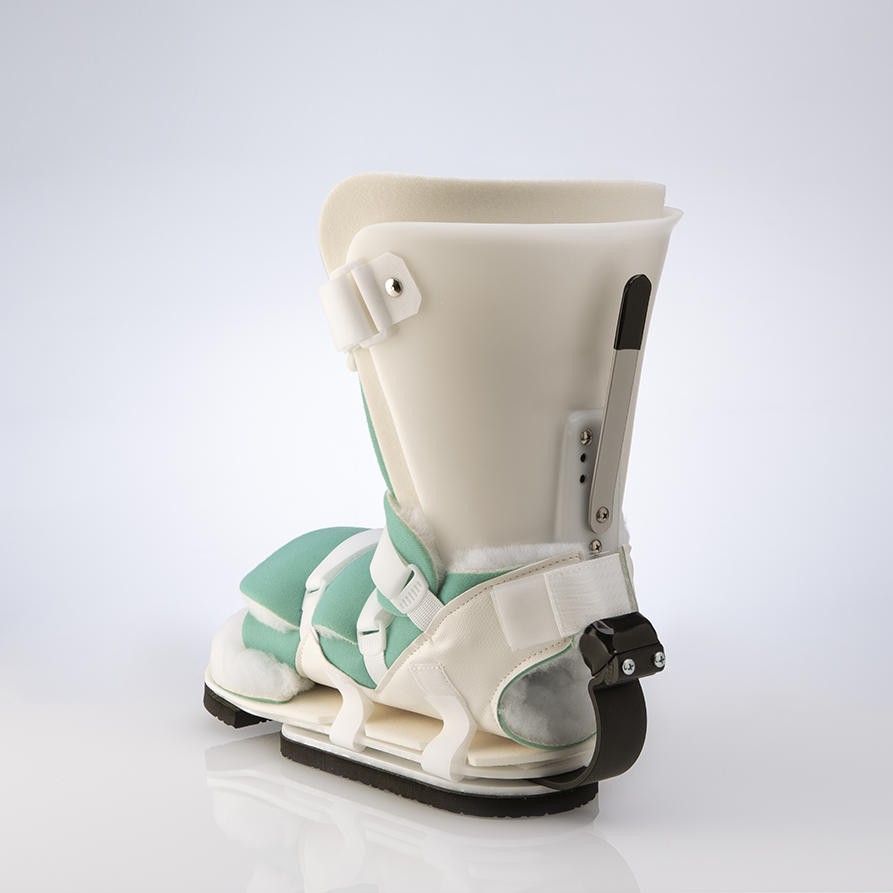
The 752SKT PRAFO for the larger person
This is where our bariatric PRAFO options fit, and I want to describe them the way I described the range in that earlier article: accurately, with the limitations stated.
We stock two bariatric configurations of the PRAFO, and both are rated for users up to 136 kg, including safe ambulation on the walking base:
The 752SKT Bariatric APU has the adjustable posterior upright: the clinician can set dorsiflexion up to 20° or plantarflexion up to 40°, and adjust it as the patient's presentation changes. It accepts a calf circumference up to 66 cm, has a replaceable, cleanable Kodel liner, and adjusts in length and height to the individual limb.
The 780SKG is the new heavy-duty bariatric version with a fixed posterior upright, for the patient whose ankle position is set once at fitting rather than adjusted over time. It can be adjusted by an orthotist but requires tools to bend the posterior upright. It is not currently listed on our website, so if it sounds relevant, contact us and we will advise on suitability.
The mechanical claim I will make for them is that correctly fitted, a PRAFO holds the heel fully free of any surface, so no pressure or shear acts on the heel itself, which is the position the 2025 international guideline describes. The load is carried along the calf, and the fitting is the part that makes the physics hold, which is why these are clinician-fitted devices and why we put our effort into training and supporting the people who fit them.
Two limitations, stated plainly. First, no trial has tested any heel protection device, ours included, in a plus-size population; the reasoning in this article is mechanism and fit, not trial evidence. Second, 136 kg is a genuine ceiling, and it matters as many services define their bariatric pathway at thresholds above this, and a patient over 136 kg needs an individually assessed solution, not a standard product pressed beyond its rating. That assessment conversation is one we are always willing to have, and the orthotic service is the right place for it to happen.
KEY POINT: For the plus-size patient, the escalation trigger in existing NHS pathways is already the right one when the standard device is not suitable for this individual. A calf beyond the range of the ward stock meets that trigger on fit alone, before any skin damage occurs. The bariatric PRAFO options extend the range to a 66 cm calf and 136 kg for ambulatory safety. Beyond those limits, the answer is individual orthotic assessment.
What I would suggest
If you are a tissue viability nurse, a manual handling lead or a therapist thinking about your own service, three things are worth doing with your team this month. First, put a tape measure in the risk assessment: record calf circumference for plus-size patients alongside weight, and compare it with the stated range of the heel devices you actually stock. Second, apply the safe working load habit to heel protection: check the rating and the size before the device goes on, not after the skin breaks down. Third, make the hand test routine: after every repositioning, someone confirms the heel is genuinely floating.
Anatomical Concepts (UK) has supplied the PRAFO range for more than thirty years. Where we can help is assessment and fit: if you have plus-size patients whose calves exceed the devices you hold, we are glad to talk through whether the 752SKT or the 780SKG is worth considering, to support your orthotic service with sizing, fitting and adjustment, and to train ward staff, podiatrists and physiotherapists to be confident with the products.
Decisions about any individual patient belong with the clinical team who assess them; nothing in this article replaces that assessment.
And if you simply want to compare notes on this odd, unmapped corner where manual handling meets tissue viability, I am always pleased to have that conversation. You can reach us through the contact page.
Further reading
Haesler E (ed). Prevention and Treatment of Pressure Ulcers/Injuries: Clinical Practice Guideline. The International Guideline, 4th edition, Heel Pressure Injuries chapter. EPUAP, NPIAP, PPPIA; 2025. https://internationalguideline.com
Kottner J, Gefen A, Lahmann N. Weight and pressure ulcer occurrence: a secondary data analysis. International Journal of Nursing Studies. 2011;48(11):1339-1348. https://doi.org/10.1016/j.ijnurstu.2011.04.011
Jia YJ, et al. Dose-response relationship between body mass index and pressure injury risk in hospitalised patients: a meta-analysis. Journal of Tissue Viability. 2024;33(3):405-411. https://doi.org/10.1016/j.jtv.2024.06.006
Marshall V, et al. Factors associated with hospital-acquired pressure injuries in patients with high body mass index: a scoping review. Journal of Advanced Nursing. 2024;80(4):1262-1282. https://doi.org/10.1111/jan.15882
Gefen A. The biomechanics of heel ulcers. Journal of Tissue Viability. 2010;19(4):124-131. https://doi.org/10.1016/j.jtv.2010.06.003
Rush A. Bariatric care: pressure ulcer prevention. Wound Essentials. 2009;4:68-74. https://wounds-uk.com/wp-content/uploads/2023/02/content_9446.pdf
Williamson K. The nursing lens: caring for people living with severe obesity. Journal of Research in Nursing. 2024;29(3):277-280. https://doi.org/10.1177/17449871241245711
National Institute for Health and Care Excellence. Pressure ulcers: prevention and management. Clinical guideline CG179; 2014. https://www.nice.org.uk/guidance/cg179
Related articles on our site
When a Soft Heel Boot Is Not Enough: How Heel Protection Escalates in the NHS
Floating Heels: What the 2025 International Pressure Injury Guideline Means for the PRAFO
Pressure Reduction vs Complete Offloading: Why the Distinction Matters for Tissue Viability
Articles on this site are researched and drafted with the help of AI tools, then checked, edited and approved by me. Every citation is verified against the original source before publication.