
Articles
Filter by Topic
- Adaptive Sport 2
- Artificial Intelligence 1
- Bariatric 1
- Bike Labyrinth 3
- Bone density 1
- Brachial Plexus 2
- Bridging the Gap 1
- Bridging the Gap 1
- Carbonhand 4
- Cardiovascular 1
- Cauda Equina Syndrome 1
- Client Stories 4
- Cognition 1
- Company Updates 3
- Decision Making 2
- Dementia 1
- Denervation 31
- Diabetic Foot 12
- Dressings 1
- Efficiency 1
- Electrotherapy 34
- Epilepsy 1
- Exercise Benefits 34
- FES Cycling 24
- Fatigue 1
- Functional Electrical Stimulation (FES) 66
- Gait 2
- Goal Setting 5
- Grip 3
- Guidelines 2
- HRV 1
- Healthspan 2
- History 1
- Indego 13
- Lifestyle 10
- Lower Motor Neuron 2
- Mobility 17
- Motivation 2
- Multiple Sclerosis 1
- NMES 4
- Nerve injury 5
- NexStride 1
- Occupational Therapy 1
- Orthotic 15
- PRAFO 33
- Pain 7
- Parkinsons 2
- Pressure Ulcers 21
- Product Updates 7
- RISE Stimulator 15
Article Length
- 1 minute read 3
- 10 minute read 27
- 11 minute read 4
- 12 minute read 11
- 14 minute read 1
- 15 minute read 15
- 18 minute read 1
- 2 minute read 4
- 24 minute read 1
- 25 minute read 2
- 26 minute read 1
- 28 minute read 1
- 3 minutes read 9
- 4 minute read 33
- 5 Minute read 18
- 6 minute read 6
- 7 minute read 20
- 8 minute read 14
- 9 minute read 4
- FES 2
- FoG 1
- Long Read 1
- PRAFO 1
- Seven Minute Read 1
- awareness 1
- carbonhand 2
- cognitive 1
- cues 1
- freezing gait 1
- freezing of gait 1
- gait 1
- neurological 1
- neuroplasticity 1
- nexstride 2
- occupational therapy 1
- occupational therapy day 1
- orthopaedics 1
- orthotic 1
- parkinson's 1
- pressure 1
- pressure relief 1
- prevention 1
- rehabilitation 2
- stroke 1
- ulcers 1
- world stroke day 1

Training Denervated Muscle With the RISE Stimulator and Its Patient Switcher: From Twitch to Standing
The patient switcher for the RISE Stimulator is a small white box on a long white cable. One rocker switch turns the current on and off. A second sends it to the left leg, the right leg, or both. A curved steel bar on the back hooks over a parallel bar, so the box sits under the hand of the person standing.
The patient switcher is the simplest accessory we supply for the RISE, and you could argue it's the one that takes longest to earn. Someone training denervated thigh muscles will usually spend the best part of a year, often longer, before it has any job to do. Training denervated muscle requires commitment and if it's a long time since injury, it takes consistent effort to be able to produce strong enough contractions to make use of the patient switcher.
A few months into training, once the thighs have started to fill out again, the conversation tends to turn to what all the effort is leading to. Sometimes the question is more direct: will I stand? This article is my answer, from the first twitch to the first stand, and what it takes to do that safely in a hospital gym or at home.

Peripheral Nerve Injury and Electrical Stimulation: Which of Three Situations Are You In?
Someone has damaged a nerve. Perhaps because of a fracture, perhaps a fall, perhaps a complication of surgery they were told would be routine. They have read that electrical stimulation can help prevent muscle wasting. They have bought a device, often an inexpensive TENS unit, sometimes a consumer muscle stimulator. They have put the pads on, turned the intensity up as far as it will go, and nothing has happened. No contraction. No twitch. Nothing at all.
Then, usually near the end of the call, comes the question, and it is nearly always some version of this:
Could I have made it worse?
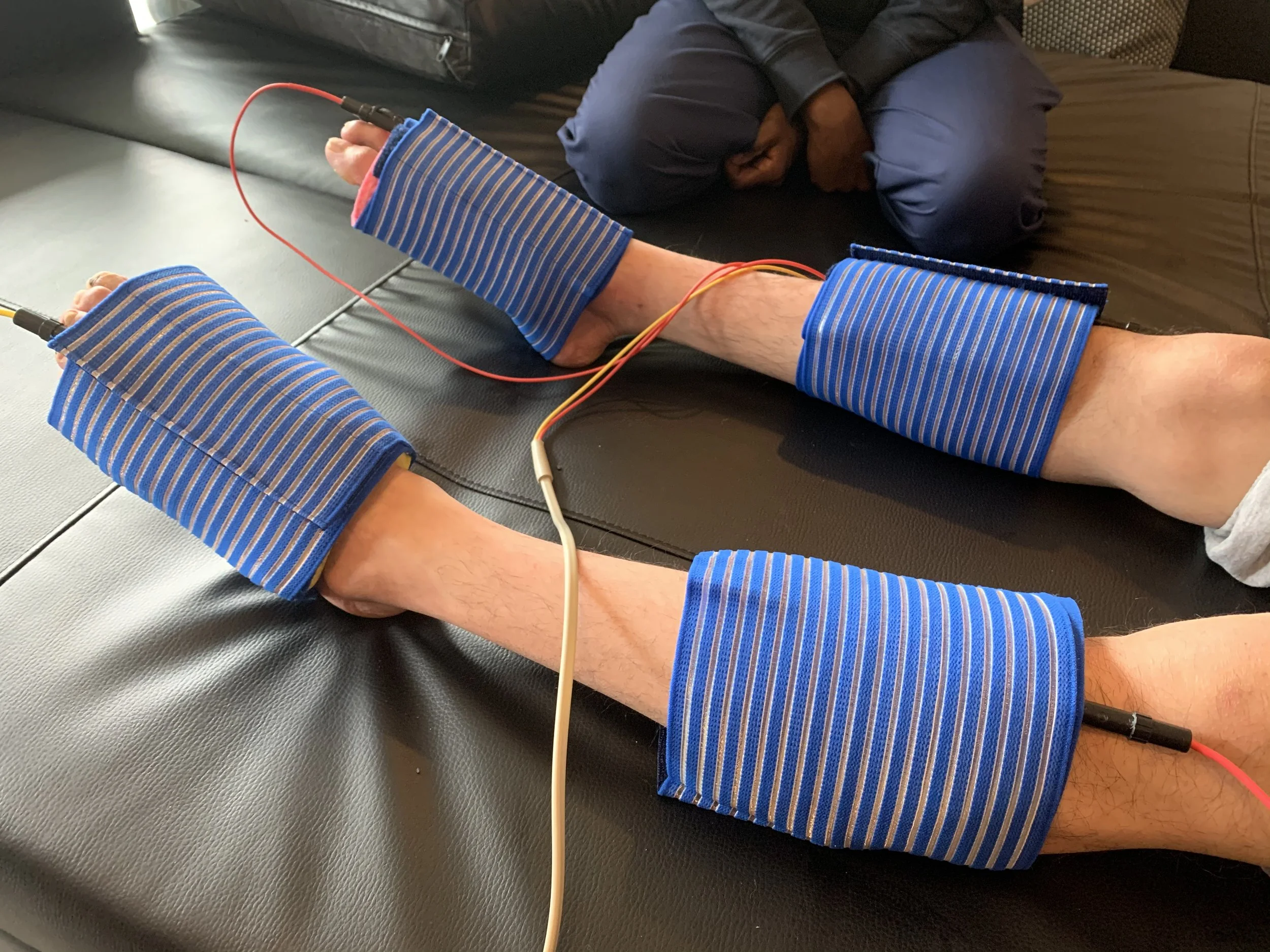
Normal vs Denervated Muscle: Why the Rules of Electrical Stimulation Change After Nerve Injury
It is quite common for us to meet clients who have tried electrical stimulation on a limb and found that nothing happened. No matter how high the intensity was set, the muscle simply would not contract. They arrive frustrated, sometimes having been told that nothing more can be done. When we then use the RISE Stimulator, a specialist device capable of producing the long-impulse-duration waveforms that denervated muscle actually requires, they are often surprised and relieved to see a contraction for the first time.
That moment of surprise reveals an important gap in understanding. The muscle did not fail to respond because it was beyond help. It failed because the wrong electrical 'language' was being spoken. A denervated muscle is not simply a weak muscle. It is, in a very real sense, a different tissue with altered structure, electrical properties, and activation rules. Understanding these differences is the foundation for making sense of any treatment approach.

Cauda Equina Syndrome and Denervated Muscle: Your Options for Long-Term Health
Cauda equina syndrome (CES) is one of the most challenging situations in spinal cord injury rehabilitation. Unlike injuries higher in the spine, CES directly damages the lower motor neurons—the nerve cells that connect to and control the leg muscles. This results in the muscles becoming denervated, losing their nerve supply completely.
For many years, people with CES were told little could be done about the muscle wasting that occurs. The common belief was that denervated muscles would inevitably weaken, and electrical stimulation—which is effective for higher spinal injuries—simply wouldn't help. That perspective has shifted.
Research over the past twenty years shows that denervated muscles can be preserved and even improved with appropriate electrical stimulation—however, it requires a different approach from standard rehabilitation methods. In this article, I will explain what happens to muscles after cauda equina syndrome, why conventional methods often fail, and what options are available for maintaining long-term muscle and tissue health.

How to Choose a Stimulator for Denervated Muscle: What Actually Matters
If you've determined that you need electrical stimulation for denervated muscles, the next question is obvious: which device should you choose? This is where many people become confused — and understandably so. The market is flooded with electrical stimulation devices, most of which cannot help denervated muscles, and the technical specifications can be bewildering even for clinicians, let alone someone navigating this for the first time after a life-changing injury.
In my experience, the confusion isn't really about the number of options. It's about how devices that look similar on the outside — a box, some wires, a pair of electrodes — can be fundamentally different on the inside. A TENS unit from a pharmacy or bought online, and a specialised denervated muscle stimulator may appear related, but they are designed for entirely different physiological purposes. Choosing the wrong one isn't just a waste of money; it means lost time during a period when early intervention matters most.
In this article, I'll explain what features actually matter for denervated muscle stimulation, why most devices on the market are unsuitable, and how to evaluate your options

Stop Muscle Atrophy Before It Starts with Proactive FES
Muscle loss doesn’t wait and neither should prevention. This article explains how proactive FES can support early muscle activation, helping reduce atrophy during periods of limited mobility. Learn why starting sooner can make a difference, who it may be suitable for, and how FES fits into a broader rehabilitation plan.