
Articles
Filter by Topic
- Adaptive Sport 2
- Artificial Intelligence 1
- Bariatric 1
- Bike Labyrinth 3
- Bone density 1
- Brachial Plexus 2
- Bridging the Gap 1
- Bridging the Gap 1
- Carbonhand 4
- Cardiovascular 1
- Cauda Equina Syndrome 1
- Client Stories 4
- Cognition 1
- Company Updates 3
- Decision Making 2
- Dementia 1
- Denervation 30
- Diabetic Foot 12
- Dressings 1
- Efficiency 1
- Electrotherapy 34
- Epilepsy 1
- Exercise Benefits 34
- FES Cycling 24
- Fatigue 1
- Functional Electrical Stimulation (FES) 66
- Gait 2
- Goal Setting 5
- Grip 3
- Guidelines 2
- HRV 1
- Healthspan 2
- History 1
- Indego 13
- Lifestyle 10
- Lower Motor Neuron 2
- Mobility 17
- Motivation 2
- Multiple Sclerosis 1
- NMES 4
- Nerve injury 5
- NexStride 1
- Occupational Therapy 1
- Orthotic 15
- PRAFO 33
- Pain 7
- Parkinsons 2
- Pressure Ulcers 21
- Product Updates 7
- RISE Stimulator 14
Article Length
- 1 minute read 3
- 10 minute read 27
- 11 minute read 4
- 12 minute read 11
- 14 minute read 1
- 15 minute read 14
- 18 minute read 1
- 2 minute read 4
- 24 minute read 1
- 25 minute read 2
- 26 minute read 1
- 28 minute read 1
- 3 minutes read 9
- 4 minute read 33
- 5 Minute read 18
- 6 minute read 6
- 7 minute read 20
- 8 minute read 14
- 9 minute read 4
- FES 2
- FoG 1
- Long Read 1
- PRAFO 1
- Seven Minute Read 1
- awareness 1
- carbonhand 2
- cognitive 1
- cues 1
- freezing gait 1
- freezing of gait 1
- gait 1
- neurological 1
- neuroplasticity 1
- nexstride 2
- occupational therapy 1
- occupational therapy day 1
- orthopaedics 1
- orthotic 1
- parkinson's 1
- pressure 1
- pressure relief 1
- prevention 1
- rehabilitation 2
- stroke 1
- ulcers 1
- world stroke day 1

Spasticity and Muscle Spasms: A Plain English Guide for People Living With Them
When I demonstrate an FES cycling system, spasticity is usually in the room before I have finished setting up. A leg that will not settle onto the pedal. A knee that pushes out straight at the wrong moment. A foot that starts bouncing the instant it takes any weight. The person in the chair rarely calls it spasticity. They say their legs have a mind of their own, or that everything goes rigid when they transfer, or that the spasms wake them at three in the morning. The clinical word comes later, if it comes at all.
This article is for the person who has just been introduced to that word, or who has lived with the thing itself for years without anyone quite explaining it. I want to cover what spasticity and spasms actually are, why they happen after a spinal cord injury, a stroke or with multiple sclerosis, what they do to daily life, and what genuinely helps, from medication through to electrical stimulation. I will try to be clear about what the evidence shows and what it does not; if different people have told you contradictory things, that is partly because the field itself contains genuine uncertainty.

Why structure beats willpower in neurological rehabilitation
If motivation were enough, rehabilitation adherence (sticking to the effort of training to recover) would not decline so predictably. But it does. Across conditions, across populations, the pattern is the same: strong engagement in the early weeks, followed by a steady fade. Not because people stop wanting to recover — but because motivation, by its nature, is temporary. It is a mood, not a method.
After decades of working in this field, I can tell you that the people who sustain their efforts over months and years are rarely the most motivated. They are the most structured. They have built something that works regardless of how they feel on any given morning — when they are tired, in pain, frustrated by slow progress, and wondering whether any of this is actually working.
To achieve significant functional gains and take advantage of neuroplasticity, it takes sustained, high-quality repetitions. Without structure, success will be elusive.
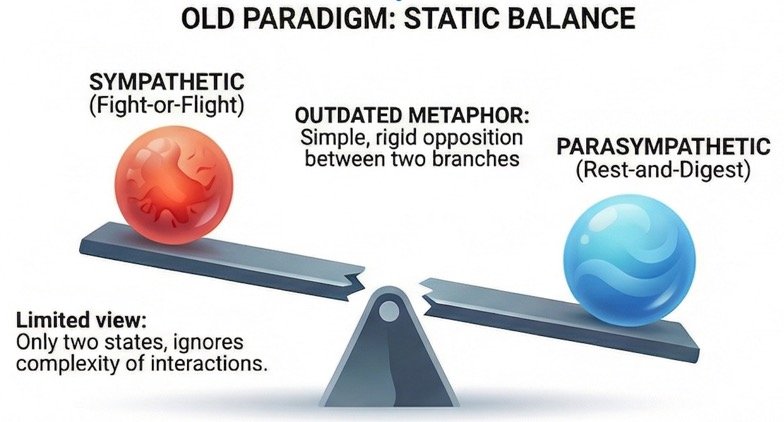
Is the Autonomic Nervous System Ever Truly "In Balance"?
If you have been reading about the autonomic nervous system — perhaps because you live with a spinal cord injury, or you work with people who do — you will almost certainly have encountered the idea of "autonomic balance." The image is seductive: sympathetic on one side, parasympathetic on the other, and health is achieved when the two sit neatly level, like a set of scales in equilibrium.
It is a useful teaching shorthand. It is also, as modern physiology has demonstrated over the past three decades, an oversimplification that can actually mislead both clinicians and patients.
The fundamental question is this: does the autonomic nervous system ever truly achieve "balance" — and if not, what should we be aiming for instead? The answer has direct implications for how we think about autonomic dysfunction after spinal cord injury and for emerging interventions such as transcutaneous vagus nerve stimulation (tVNS) that aim to improve autonomic regulation.

Can I Start Electrical Stimulation Years After My Denervation Injury? What the Research Shows
One of the most common questions I receive comes from people who've had a denervating injury—whether spinal cord injury, brachial plexus injury, or another peripheral nerve condition—years or even decades ago. They've recently learned that electrical stimulation might help preserve or improve their muscle condition, and they want to know: Is it too late for me?
This is an important question that deserves a thorough answer. The research evidence and my clinical experience both suggest that while earlier is definitely better, "too late" is rarely the correct conclusion. In this article, I'll examine what the evidence actually shows about late intervention, which factors influence outcomes, and how to decide whether it's worth trying in your specific situation.
We don't discuss the technical aspects of stimulation. This has been covered in other articles on this site. Recognise, however, that the stimulation patterns are designed to work directly with the muscle fibre and do not rely on an intact peripheral nerve.
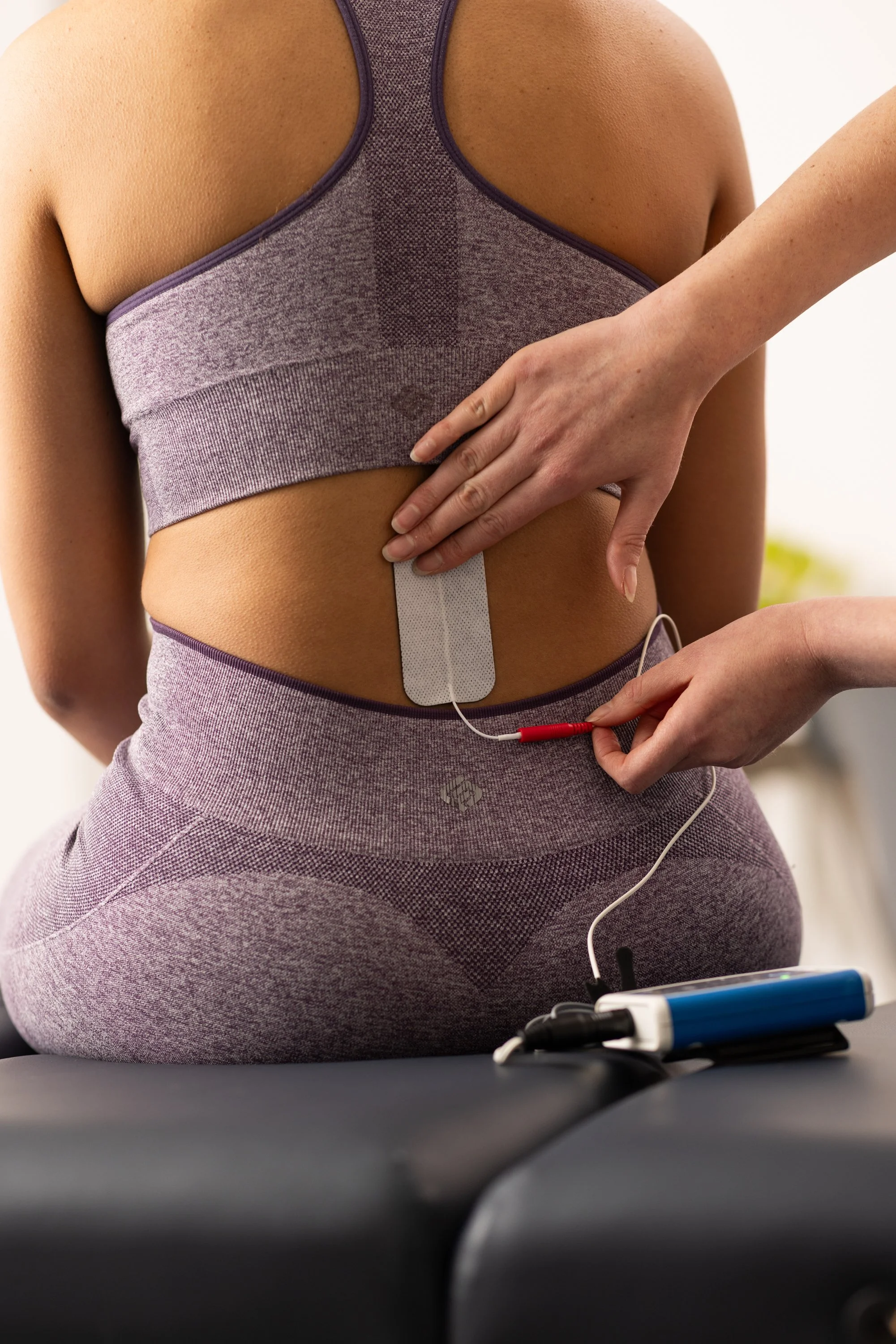
Spasticity After Spinal Cord Injury: When Medication Isn't the Answer
Spasticity is common after spinal cord injury, and while medication can help, it isn’t always the best or only option. This article explores alternative ways to manage spasticity when medication isn’t effective or suitable. It looks at why symptoms can vary, what triggers may make spasticity worse, and the importance of an individualised approach. From rehabilitation strategies to practical day-to-day management, it provides a helpful overview for improving comfort, function, and quality of life.

How Muscle Fibre Composition Impacts Electrical Stimulation Effectiveness
Electrical stimulation is a popular and widely used approach for physical rehabilitation. When used for muscle strengthening, it is necessary to take into account the fact that electrical stimulation produces muscle contractions in a relatively inefficient way.
In this article, we take a brief look at muscle fibre types. Following a neurological insult, muscle fibre types undergo transformation, producing changes that affect the ability of muscles to do work. We examine the particular case of spinal cord injury and consider how this affects the effectiveness of electrical stimulation.
Approaches to combat fatigue are examined. Finally, we consider attempts being made to improve the performance of stimulators and produce consistent muscle contractions under all circumstances.