
Articles
Filter by Topic
- Adaptive Sport 2
- Artificial Intelligence 1
- Bariatric 1
- Bike Labyrinth 3
- Bone density 1
- Brachial Plexus 2
- Bridging the Gap 1
- Bridging the Gap 1
- Carbonhand 4
- Cardiovascular 1
- Cauda Equina Syndrome 1
- Client Stories 4
- Cognition 1
- Company Updates 3
- Decision Making 2
- Dementia 1
- Denervation 31
- Diabetic Foot 12
- Dressings 1
- Efficiency 1
- Electrotherapy 34
- Epilepsy 1
- Exercise Benefits 34
- FES Cycling 24
- Fatigue 1
- Functional Electrical Stimulation (FES) 66
- Gait 2
- Goal Setting 5
- Grip 3
- Guidelines 2
- HRV 1
- Healthspan 2
- History 1
- Indego 13
- Lifestyle 10
- Lower Motor Neuron 2
- Mobility 17
- Motivation 2
- Multiple Sclerosis 1
- NMES 4
- Nerve injury 5
- NexStride 1
- Occupational Therapy 1
- Orthotic 15
- PRAFO 33
- Pain 7
- Parkinsons 2
- Pressure Ulcers 21
- Product Updates 7
- RISE Stimulator 15
Article Length
- 1 minute read 3
- 10 minute read 27
- 11 minute read 4
- 12 minute read 11
- 14 minute read 1
- 15 minute read 15
- 18 minute read 1
- 2 minute read 4
- 24 minute read 1
- 25 minute read 2
- 26 minute read 1
- 28 minute read 1
- 3 minutes read 9
- 4 minute read 33
- 5 Minute read 18
- 6 minute read 6
- 7 minute read 20
- 8 minute read 14
- 9 minute read 4
- FES 2
- FoG 1
- Long Read 1
- PRAFO 1
- Seven Minute Read 1
- awareness 1
- carbonhand 2
- cognitive 1
- cues 1
- freezing gait 1
- freezing of gait 1
- gait 1
- neurological 1
- neuroplasticity 1
- nexstride 2
- occupational therapy 1
- occupational therapy day 1
- orthopaedics 1
- orthotic 1
- parkinson's 1
- pressure 1
- pressure relief 1
- prevention 1
- rehabilitation 2
- stroke 1
- ulcers 1
- world stroke day 1

Electrical Stimulation and Muscle Quality: Why a Bigger Muscle Is Not the Whole Story
After a neurological injury, whether a spinal cord injury, a peripheral nerve injury, or a period of enforced immobility, clients often ask: "Will electrical stimulation bring the muscle back?"
I have learned to pause before answering, because "back" hides two quite different questions. The first is about size: will the muscle get bigger again? Obviously, this is what people notice when they look down at their legs. The second is about substance: will the tissue that returns actually be muscle, in the working sense of the word, rather than a mixture of shrunken fibres, fat and scar? This is less obvious to a client, but it's what we actually need. Researchers call this second property muscle quality, and it is the more important of the two. It is also the one that almost nobody explains to patients.
In this article, I want to walk through what muscle quality means, how it is measured, what happens to it after injury, and what electrical stimulation has been shown to do about it. I will cover both of the situations we work with: innervated muscle, where the nerve supply is intact and conventional stimulation applies, and denervated muscle, where the nerve supply has been lost and an entirely different approach is needed. The evidence differs between the two, and so do the limits of what is possible, and I will be plain about both.

How to Choose a Stimulator for Denervated Muscle: What Actually Matters
If you've determined that you need electrical stimulation for denervated muscles, the next question is obvious: which device should you choose? This is where many people become confused — and understandably so. The market is flooded with electrical stimulation devices, most of which cannot help denervated muscles, and the technical specifications can be bewildering even for clinicians, let alone someone navigating this for the first time after a life-changing injury.
In my experience, the confusion isn't really about the number of options. It's about how devices that look similar on the outside — a box, some wires, a pair of electrodes — can be fundamentally different on the inside. A TENS unit from a pharmacy or bought online, and a specialised denervated muscle stimulator may appear related, but they are designed for entirely different physiological purposes. Choosing the wrong one isn't just a waste of money; it means lost time during a period when early intervention matters most.
In this article, I'll explain what features actually matter for denervated muscle stimulation, why most devices on the market are unsuitable, and how to evaluate your options
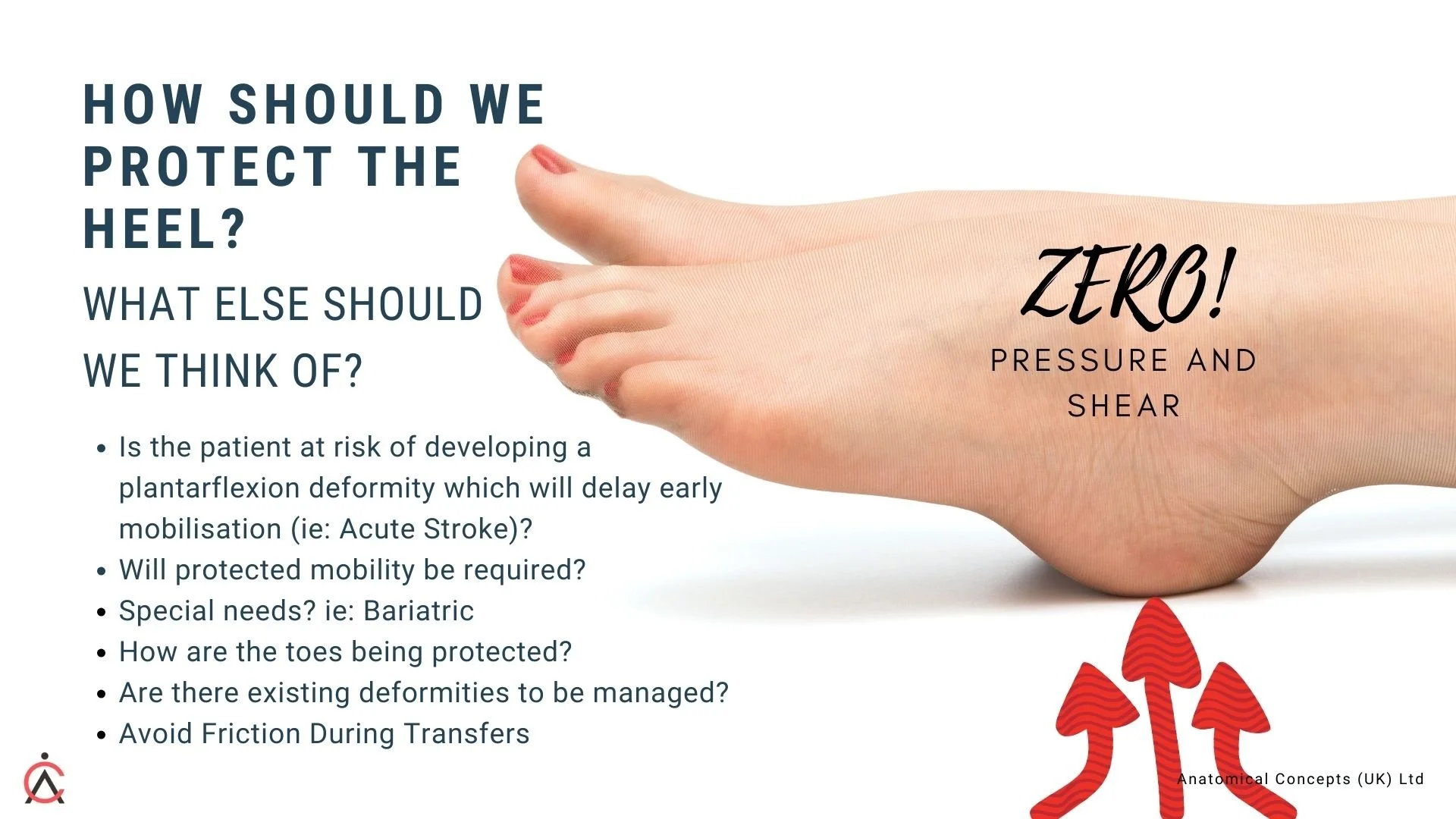
Shear Forces at the Heel: The Hidden Damage Mechanism
When clinicians think about pressure ulcer prevention, they typically focus on pressure—the perpendicular force that compresses tissue against a surface. This is understandable. The condition is called a pressure ulcer. Pressure is in the name.
But pressure tells only part of the story. Shear—the force acting parallel to the support surface that distorts tissue layers relative to each other—may be even more damaging than pressure alone. Research dating back to Bennett's seminal 1979 study demonstrated that when shear is present, the pressure required to produce vascular occlusion is reduced by approximately 50%. At shear levels of roughly 100 g/cm², the pressure needed to stop blood flow was half that required when little shear was present.
This finding has profound implications for heel protection. A device that reduces pressure but doesn't address shear may leave the heel vulnerable to the very damage it was meant to prevent.
Volume vs Intensity in Neurological Rehabilitation: Why Consistency Often Matters More
I recently came across an interesting newsletter item from "Building the Elite" about the relative importance of training volume versus intensity.
The argument—made by someone preparing candidates for special forces selection—was that volume is the primary training variable to manage. This is because it has the greatest impact on the training programme's effectiveness, while intensity determines the type of adaptation you're targeting.
This struck me as highly relevant to neurological rehabilitation. Let's see if you agree.

Electrical Stimulation and improved outcomes for Brachial Plexus injuries
In this article, we step back and consider how brachial plexus injuries are treated and then look at how forms of electrical stimulation might contribute to achieving the best clinical outcome.
Brachial plexus injuries present a complex challenge in medical practice, with the potential to produce significant functional impairment and reduced quality of life. Effective treatment requires a meticulous, multifaceted approach, combining surgical and non-surgical interventions tailored to the patient's specific needs. This article explores current treatment strategies, focusing on the potential role of electrical stimulation as a complementary therapy. By examining its applications and efficacy, we aim to highlight how this innovative technique could enhance recovery and optimise clinical outcomes for individuals affected by these injuries.

Electrical stimulation can condition muscles or help with pain. How do the techniques differ?
Electrical stimulation is a widely used method of applying energy to the body to produce a physiological response. By controlling the nature of this energy, we can expect to produce a useful therapeutic effect. These ideas have decades of practical use and are generally safe and effective in many situations. Still, it can be difficult to understand how to match one of the many techniques to a particular clinical case. This article delves into methodologies and technologies for pain management and muscle rehabilitation. We explore innovative solutions that offer customised and effective treatment plans, ensuring optimal patient outcomes.