
Articles
Filter by Topic
- Adaptive Sport 1
- Artificial Intelligence 1
- Bike Labyrinth 3
- Bone density 1
- Brachial Plexus 1
- Bridging the Gap 1
- Bridging the Gap 1
- Carbonhand 4
- Cardiovascular 1
- Client Stories 4
- Cognition 1
- Company Updates 3
- Decision Making 2
- Dementia 1
- Denervation 24
- Diabetic Foot 12
- Efficiency 1
- Electrotherapy 31
- Exercise Benefits 32
- FES Cycling 19
- Fatigue 1
- Functional Electrical Stimulation (FES) 61
- Gait 2
- Goal Setting 5
- Grip 3
- Guidelines 1
- HRV 1
- Healthspan 2
- Indego 13
- Lifestyle 10
- Lower Motor Neuron 1
- Mobility 17
- Motivation 2
- NMES 2
- Nerve injury 1
- NexStride 1
- Occupational Therapy 1
- Orthotic 15
- PRAFO 27
- Pain 7
- Parkinsons 2
- Pressure Ulcers 14
- Product Updates 7
- RISE Stimulator 11
- Safety 2
- Spasticity 2
- Sponsor 1
- Standing 5
- Stim2Go 6
- Stimulette den2x 5
Article Length
- 1 minute read 3
- 10 minute read 20
- 11 minute read 4
- 12 minute read 10
- 15 minute read 12
- 18 minute read 1
- 2 minute read 4
- 26 minute read 1
- 28 minute read 1
- 3 minutes read 9
- 4 minute read 34
- 5 Minute read 15
- 6 minute read 6
- 7 minute read 17
- 8 minute read 7
- 9 minute read 3
- FES 2
- FoG 1
- Long Read 1
- PRAFO 1
- Seven Minute Read 1
- awareness 1
- carbonhand 2
- cognitive 1
- cues 1
- freezing gait 1
- freezing of gait 1
- gait 1
- neurological 1
- neuroplasticity 1
- nexstride 2
- occupational therapy 1
- occupational therapy day 1
- orthopaedics 1
- orthotic 1
- parkinson's 1
- pressure 1
- pressure relief 1
- prevention 1
- rehabilitation 2
- stroke 1
- ulcers 1
- world stroke day 1
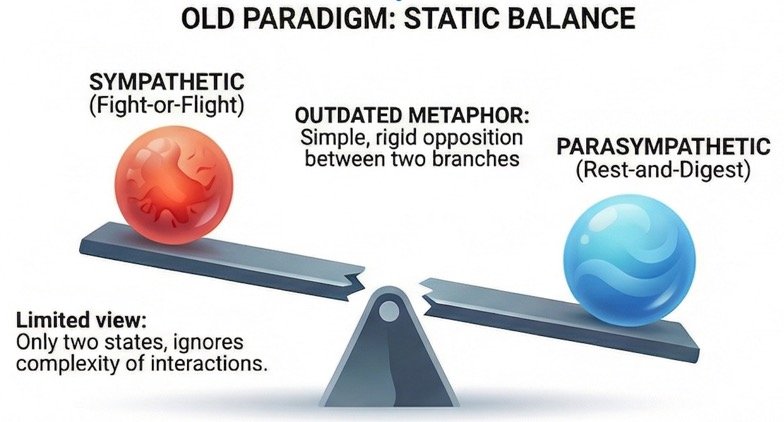
Is the Autonomic Nervous System Ever Truly "In Balance"?
If you have been reading about the autonomic nervous system — perhaps because you live with a spinal cord injury, or you work with people who do — you will almost certainly have encountered the idea of "autonomic balance." The image is seductive: sympathetic on one side, parasympathetic on the other, and health is achieved when the two sit neatly level, like a set of scales in equilibrium.
It is a useful teaching shorthand. It is also, as modern physiology has demonstrated over the past three decades, an oversimplification that can actually mislead both clinicians and patients.
The fundamental question is this: does the autonomic nervous system ever truly achieve "balance" — and if not, what should we be aiming for instead? The answer has direct implications for how we think about autonomic dysfunction after spinal cord injury and for emerging interventions such as transcutaneous vagus nerve stimulation (tVNS) that aim to improve autonomic regulation.